
Super dispersant dedicated to conductive carbon blackPolyolefin ether · polymer aqueous solution · CONDUCTIVE CB DISPERSANT
A highly water-soluble, high-efficiency additive developed for conductive carbon black ultrafine powders and conductive black masterbatches — it combines dispersion with conductivity enhancement; its low resistivity gives rubber or plastics stable conductive performance.
- ⚡ Low resistivity · boosts conductivity
- 🛡 Super dispersion · lubrication and wetting · encapsulation
- 🧬 Excellent, very narrow molecular-weight distribution
- 🌊 Highly water-soluble · very low dosage
- Solid content
- 0 – 0 %
- Density
- 0 g/cm³
- Viscosity
- 0 – 0 mPa·s
- pH
- 0 – 0
Core summary · how the conductive network forms
Drag the slider: as the dispersant dosage rises → the carbon black separates particle by particle → conductive paths light up one by one. Recommended window 0.5–2%.
High temperature and pressure · very narrow distribution
R1618 is a dispersant we developed specifically for conductive carbon black ultrafine powders and conductive black masterbatches — a polymer aqueous solution produced under high temperature and pressure from precisely metered raw materials, with excellent molecular weight and a fairly narrow molecular-weight distribution.
The finer the powder, the worse the aggregation
When producing ultrafine powders such as conductive carbon black and conductive black masterbatches, the finer the powder, the more easily serious aggregation occurs, which severely harms product quality; conventional dispersants generally offer only a single dispersion effect.
More than dispersion: the architect of the conductive network
R1618 not only provides super dispersion, lubrication and wetting, and encapsulation, it also notably boosts conductivity — separating the carbon black particles while keeping them connected, forming low-resistivity paths.
Physical and chemical indices (TDS)
Typical factory values; a COA test report accompanies every batch.
Application scope and end uses
Low resistivity gives rubber and plastics conductive performance — two product families: antistatic and conductive.
1 · Antistatic product family
ANTISTATIC SERIES2 · Conductive product family
CONDUCTIVE SERIES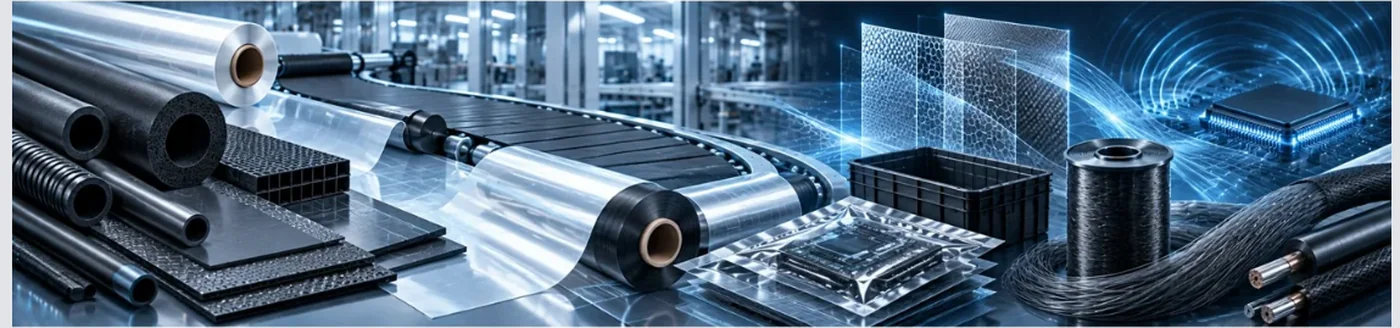
Recommended dosage · packing and storage · sample request
Submit the form and a technical consultant will contact you within 24 hours to arrange a sample.
Recommended dosage
Packing and storage
01Product positioning
R1618 belongs to the conductive hyperdispersant category; its official full name is "Conductive carbon black hyperdispersant for plastics R1618"; main component: polyolefin ether; mechanism field: "chemical dispersion + conductive pathway construction". The technical data pages and catalog lines of the four versions of the material corroborate one another verbatim: "R1618 hyperdispersant is a hyperdispersant with a conductive function developed specifically for conductive carbon black in plastics." (Data source: product handbook / official product data)
Overview paragraph, verbatim: "R1618 hyperdispersant is a dispersant developed by our company and specially used for conductive carbon black ultrafine powders. It is a polymer aqueous solution produced under high-temperature and high-pressure conditions using a precise ratio. It has an excellent molecular weight and a fairly narrow molecular weight distribution, and provides excellent dispersion and conductive effects for conductive carbon black powders and conductive carbon black masterbatches." (Data source: product handbook / official product data)
The advantages paragraph states the field problems and functional positioning verbatim: "R1618 hyperdispersant is a water-soluble high-efficiency dispersant with a low dosage, and it provides excellent dispersion and conductive effects for conductive carbon black and conductive carbon black masterbatches. For example, when producing ultrafine powders such as conductive carbon black and conductive carbon black masterbatches, the finer the powder, the more prone it is to agglomeration, which seriously affects product quality. The dispersants commonly used by many factories generally have only a dispersion effect, whereas R1618 hyperdispersant offers hyperdispersion, lubrication and wetting, and encapsulation, and in particular also has a conductive function." (Data source: product handbook / official product data)
This product is part of the hyperdispersant series, and the official list of representative models in the series includes this model; the company introduction list sentence in the product handbook also records "plastic conductive carbon black hyperdispersant: R1618". All effect statements given in the material are qualitative: no resistivity values, no quantified dispersion efficiency values, and no comparative data on conductive performance; this page makes no extrapolations and gives no commitments. (Data source: product handbook / official product data)
- Water-soluble system — supplied in the form of a polymer aqueous solution, readily soluble in water, with a low dosage.
- Four effects in one — "offers hyperdispersion, lubrication and wetting, and encapsulation, and in particular also has a conductive function"; the material also records that it has a relatively low resistivity and can enable rubber or plastics to achieve a certain degree of electrical conductivity.
- Molecular weight characteristics — "excellent molecular weight and a fairly narrow molecular weight distribution".
- Targeted at the ultrafine powder dilemma — "the finer the powder, the more prone it is to agglomeration, which seriously affects product quality"; the dispersion targets of this product are conductive carbon black ultrafine powders and conductive carbon black masterbatches.
- Target systems (two lists in the handbook) — Antistatic products: conductive foamed tubes, charging rollers, static eliminators, antistatic conveyor belts, antistatic rubber sheets, antistatic boxes and hollow boards, antistatic tubes, medical rubber products, carpets, copier rollers, printing press rollers, electronic component packaging films, explosion-proof cables, antistatic table mats, antistatic shoe soles, etc.; Conductive products: cable shielding compounds, planar heating elements, conductive films, elastic electrodes, printed circuits, conductive coatings, conductive inks, conductive fibers, conductive leather products and adhesives, mining conveyor belts, mining plastic pipes, mining air ducts, etc.
- Note on records — this product has no pairing, substitution, or upgrade relationship with any model (the model selection sentence in the handbook is a parallel recommendation); its dosage and composition are independent of and not interchangeable with models of the same type for other directions.
02Formulation system & mechanism of action
Composition and preparation: the main component is polyolefin ether; the material records that it is "a polymer aqueous solution produced under high-temperature and high-pressure conditions using a precise ratio", with an excellent molecular weight and a fairly narrow molecular weight distribution — dispersion stability derives from this. (Data source: product handbook / official product data)
The dispersion stage acts on conductive carbon black ultrafine powders: the finer the powder, the more prone it is to agglomeration, and agglomeration directly affects product quality; ordinary dispersants have only a dispersion effect, whereas in addition to hyperdispersion this product also provides lubrication and wetting and encapsulation, and in particular also has a conductive function. (Data source: product handbook / official product data)
How the conductive function is read (as expressed on the page): dispersant dosage increases → conductive carbon black is dispersed particle by particle → conductive pathways light up one by one and form a network; the page illustrates this process for visitors, and the page itself notes "not measured resistance data" — this page makes no quantitative statements based on it and cites no resistance values. The only writable statement in the material regarding conductive performance is "has a relatively low resistivity and can enable rubber or plastics to achieve a certain degree of electrical conductivity". (Data source: product handbook / official product data)
- Water-soluble dispersion — polymer aqueous solution enters the systemAdded in the form of a polymer aqueous solution; readily soluble in water and with a low dosage, it first distributes evenly in the medium.
- De-agglomeration — dispersion of ultrafine conductive carbon blackTargeting the ultrafine powder dilemma in which "the finer, the more agglomerated": hyperdispersion + lubrication and wetting + encapsulation de-agglomerate the conductive carbon black and disperse it stably.
- Network formation — construction of conductive pathwaysAfter the carbon black particles are evenly dispersed and the distance between them is reduced, continuous conductive pathways gradually form; this enables rubber or plastics to achieve a certain degree of electrical conductivity. This process is a qualitative reading, and the schematic diagram on the page is not measured resistance data.
- Into application — antistatic / conductive articlesPer the two lists in the handbook: antistatic product category and conductive product category; it provides excellent dispersion and conductive effects for conductive or antistatic articles and raw materials such as cable compounds.
03Key parameters
The six physicochemical indicators recorded in the product handbook and official product data are as follows (the wording of both sources is transcribed item by item, without cross-modification). The values in the table are as recorded in the source materials; before bulk use, it is recommended to conduct small-scale trials with your own formulation for verification.
| Item | Value / description |
|---|---|
| Main component | Polyolefin ether |
| Appearance | White milky liquid |
| Density | 1.210g/ cm³ |
| Solid content | 12-12.7% |
| PH value | 6.8-7mgKOH/g |
| Viscosity | 200-600mPas |
| Solubility | Easily soluble in water |
| Preparation method | A polymer aqueous solution produced under high-temperature and high-pressure conditions with precise proportions |
| Molecular weight characteristics | Possesses an excellent molecular weight and a fairly narrow molecular weight distribution |
Reading notes: (1) The pH value item is recorded as "6.8-7mgKOH/g" in both the handbook and the official product data (the pH row carries the mgKOH/g unit); this page transcribes it as-is without substituting a correction, and it has been listed as pending verification; (2) Differences in wording between layers for values such as density, solid content, and viscosity (e.g. 12-12.7% ↔ 12.0%–12.7%) are typographic normalization, and the values themselves are consistent; (3) The test methods / conditions / standard numbers for the six indicators are not listed in the source materials. (Data source: product handbook / official product data)
04Recommended dosage window
The dosage of this grade is a "two coexisting" case: within the same page of the handbook, two dosage lines coexist, each with its denominator explicitly stated, and with the same numerical range (0.5–2%) — one relative to the total carbon black weight, the other relative to the final plastic product. Both lines are presented side by side; this page does not choose between them and does not convert across lines.
| Scenario | Dosage | Conditions & notes |
|---|---|---|
| Based on total carbon black weight | 0.5% – 2% | Product handbook [Application Scope] main text sentence: "The recommended addition amount is suitably 0.5-2% based on the total carbon black weight" (denominator: total carbon black weight) |
| Addition amount for the final plastic product | 0.5% – 2% | The product handbook [Addition Content] subsection matches the official dosage field verbatim (denominator: final plastic product) |
| Sample test example | 1% | Page sample form example sentence ("test at 1%") — falls within the 0.5–2% range; it is a page example, not a recommended value, not a commitment, and not measured data |
The reason both lines coexist is that the denominators differ: the amount relative to the carbon black feed and the amount relative to the final product are two separate baselines. When using, first confirm the formulation basis before selecting a value — calculate the addition amount based on total carbon black weight, or based on the total amount of the final plastic product. The source materials do not provide applicability notes for the two lines, nor do they state a thickness-dosage direction clause (neither the grade's handbook pages nor the page contain any mention of "thinner" or "thickness").

Pending verification: (1) The two lines coexist (0.5-2% based on total carbon black weight / 0.5%—2% for the final plastic product) — it is recommended that the source material side add an applicability note for the two lines or a unified basis note; this page does not draft one on its behalf. (2) The source materials do not list the feeding order / mixing method / addition point; the clues are the overview sentence "polymer aqueous solution" and the physicochemical item "readily soluble in water". (3) The source materials do not provide a thickness-dosage direction clause (explicitly stated as "none"). (4) All of the above are values recorded in the source materials; for actual production, please conduct small-scale trials with your own carbon black and system for confirmation.
05Applications
The product handbook [Application Scope] provides two lists (antistatic product category, conductive product category), transcribed item by item as follows; the application tags in the official field are verified tags such as conductive film.
- Antistatic product category
- Conductive foam tubes, charging rollers, static eliminators, antistatic conveyor belts, antistatic rubber sheets, antistatic boxes and hollow boards, antistatic tubes, medical rubber products, carpets, copier rollers, printing press rollers, electronic component packaging films, explosion-proof cables; also antistatic bench mats, antistatic shoe soles, etc.
- Conductive product category
- Cable shielding compounds, planar heating elements, conductive films, elastic electrodes, printed circuits, conductive coatings, conductive inks, conductive fibers, conductive leather products and adhesives; mining conveyor belts, mining plastic pipes, mining ventilation ducts, etc.
- Conductive carbon black masterbatch
- One of the main subjects of the overview paragraph and the advantages paragraph: it has good dispersing and conductive effects on conductive carbon black powder and conductive carbon black masterbatch.
- Subject description (handbook main text sentence)
- "It has a relatively low resistivity, can give rubber or plastic a certain conductive performance, and provides good dispersing and conductive effects on raw materials for various conductive or antistatic products, such as antistatic or conductive rubber, plastic products, cable compounds, etc."
- Usage method clues
- The source materials do not list the feeding order / mixing method; the clues are "polymer aqueous solution" and "readily soluble in water" (physicochemical items).
- Boundary notes
- This product is independent from same-category or similar-numbered grades in the meltblown softening direction, water-based direction, carbon nanotube direction, etc. — their category fields, target systems, and dosage systems all differ, there is no substitution or pairing relationship, and values are not interchangeable.
Field issues & application examples (as recorded in the source material)
| Field issue | What the source material states |
|---|---|
| What should be done when finer conductive carbon black aggregates more? | Source advantages paragraph: "Generally, the finer the powder, the more likely it is to aggregate, seriously affecting product quality" — this product was developed specifically for ultrafine conductive carbon black powder, and in addition to hyperdispersion it also provides lubrication, wetting, and encapsulation. |
| Using a dispersant but conductivity still falls short? | The source states that ordinary dispersants "only have a dispersing effect", whereas this product "also has a particularly conductive function" and possesses a relatively low resistivity. The source materials do not provide quantitative resistance-versus-dosage comparison data; it is recommended to conduct small-scale trials at the two dosage lines and rely on measured resistance. |
| How much to add? Which denominator should be used? | Two lines coexist: 0.5-2% based on total carbon black weight, or 0.5%—2% based on the final plastic product. Both lines are presented side by side, with no choosing between them and no conversion — first confirm your own formulation basis, then take the corresponding line. |
| Can the "1%" in the sample form be referenced directly? | That is a page form example ("to request a sample, test at 1%…"), falling within the 0.5–2% range; it is an example, not a recommended value, not a commitment, and not measured data. For actual ratios, please request the technical documents accompanying the shipment and conduct small-scale trials. |
06How it differs from related grades
The differences between R1618 and similar models in each direction all lie in the category field, mechanism field, target system, main components, and dosage system; identification is based on the official full name and category field, not on numbering or appearance analogy. Comparison as follows:
| Model | Official full name · Category | Target | Main components / Appearance | Dosage system |
|---|---|---|---|---|
| R1618 | Conductive carbon black hyperdispersant for plastics · Conductive hyperdispersant | Plastic conductive carbon black (plastics / rubber products, cable compounds) | Polyolefin ether / white milky liquid | Two lines: by total carbon black weight 0.5-2% / plastic final product 0.5%—2% |
| R1608S | Internal additive softening agent for plastics · Softening agent | Meltblown fabric, non-woven fabric, etc. (softening direction) | Silicone polymer / transparent liquid | Recommended addition 2%-5% (denominator not specified) |
| D3-A | Waterborne super-conductive carbon black hyperdispersant · Conductive hyperdispersant | Waterborne super-conductive carbon black (waterborne system direction) | Ether polymer / light yellow liquid | Appropriate addition based on total formula weight (1-2%) + soaking type, one tier |
Reading notes: (1) Among the three models the numbering or category may overlap (R1608S and R1618 share the "16 / 8" digit positions in their numbers; D3-A and R1618 both belong to the conductive hyperdispersant category), but their target, components, appearance, and dosage systems are each independent, and the values are not interchangeable; (2) The same category also has models in the carbon nanotube direction, whose dosage systems are independent and are not listed in this table; (3) The selection sentence (in the handbook) recommends this model alongside R1800-SK, R1800-SH, R900A, etc., which is a parallel listing and is not written as a substitution or derivation relationship. (Data source: product handbook / official product data)
07Usage & storage
The following points come item by item from the recorded materials; items not listed in the materials are not drafted on our behalf.
Dosage (both lines recorded as-is)
- By total carbon black weight: 0.5% – 2% (handbook [Application Scope]).
- Addition for plastic final product: 0.5% – 2% (handbook [Addition Level], identical to the official dosage field).
- The two lines are parallel and not converted; the "1%" in the sample form is an example on the page.
Form and usage
- Appearance: white milky liquid; the materials record "easily soluble in water" and "polymer aqueous solution."
- Feeding order / mixing method / addition point: not listed in the materials, not drafted on our behalf.
- Processing temperature window: not listed on this model's page.
Packaging and storage
- Packaging: 25 kg / PE plastic drum.
- Storage conditions: cool and dry place, moisture-proof.
Not recorded in the materials (not written on this page)
- Shelf life / storage period, shipping terms, precautions and safety notes, disclaimer, test methods and test conditions — none are listed on this model's page; please request the accompanying technical documents for the specific item number.
08FAQ
How is R1618 different from an ordinary dispersant?
Materials, advantages section: "Dispersants commonly used in many factories generally only have a dispersing effect, whereas the R1618 hyperdispersant provides hyperdispersion, lubrication and wetting, encapsulation, and in particular a conductive function." At the same time, it is specially developed for conductive carbon black ultrafine powder and has relatively low resistivity.
Is it the same category as R1608S?
No. R1608S is an internal additive softening agent for plastics (category "softening agent"), and its target materials are meltblown fabric, non-woven fabric, etc.; R1618 is a conductive hyperdispersant, and its target is plastic conductive carbon black. The two models merely have similar numbering digits; their category, mechanism, components, target, and dosage are all different, and the values are not interchangeable.
Can a specific value be given for "low resistivity"?
No. The materials give only a qualitative description of the conductive performance ("has relatively low resistivity and can give rubber or plastics a certain conductive performance"); there is no resistivity value, no quantified dispersing efficiency value, and no comparative conductive performance data; the conductive network schematic on the page is self-annotated as "not measured resistance data." This page does not extrapolate.
How should the two dosage lines (total carbon black weight / plastic final product) be used?
Both lines are 0.5%–2%, but the denominators differ: one is based on the carbon black feed amount, the other on the final product amount. Confirm the formulation basis before choosing a value; the two lines are not converted and not mixed. The materials do not provide applicability notes for the two lines, and this page does not draft them.
Is it waterborne? Can it be used in a solvent system?
The materials record this product as a "polymer aqueous solution produced under high-temperature and high-pressure conditions" and, in the physicochemical items, "easily soluble in water," belonging to the water-soluble system direction. The materials do not list a list of applicable/prohibited solvents, nor a feeding order; for a specific system, please request the accompanying technical documents from the supplier and conduct a small-scale trial.
What are the packaging and storage conditions?
Packaging is 25 kg / PE plastic drum; storage conditions are a cool and dry place, moisture-proof. The materials do not record a shelf life, and this page does not draft one — after long-term storage, it is recommended to conduct a small-scale trial for confirmation before use.
AppendixData sources
The data on this page comes from two types of materials, and each item can be traced back:
- Product handbook: the full section of this model's technical data page (overview / advantages / main components / six physicochemical property items / two application scope lists / addition level / packaging / storage conditions); the table of contents line and the company introduction list sentence; the hyperdispersant by category section; the masterbatch selection section (parallel recommendation sentence).
- Official product data: all fields of this model (name, category, positioning, description, mechanism, application, physicochemical parameters, main components, recommended dosage); series entries (representative model list).
Not covered by the source material (not written on this page — to be added later)
- Two dosage lines in parallel: it is suggested that the materials be supplemented with an applicability note for the two lines (or a unified basis note).
- The pH value unit is written as "6.8-7mgKOH/g" (the pH row carries the mgKOH/g unit): recorded as-is without change on our behalf; it is suggested that the materials be reviewed.
- The test methods / conditions / standard numbers for the six indicators are not listed; there are no quantified performance values.
- Shelf life / transportation / usage method (feeding order, mixing method) / processing temperature window / safety notes / disclaimer — not listed, not drafted on our behalf.