
Technology explained · 11 October 2026
Same “0.5–2%,” Two Denominators in Manuals: Why Conductive Carbon Black Additive Dosages Cannot Be Directly Converted
The R1618 document gives two parallel dosage ranges, both 0.5–2%, but with different denominators: one is based on the total carbon-black weight, and the other on the final plastic product; it explicitly states that the two are not to be converted into one another. This document explains why this is not an oversight and examines the relationship between the premise that finer material agglomerates more readily and the four functions combined in one. The source does not specify electrical-resistivity values, dispersion efficiency, or the charging sequence; none is estimated or proposed here.
- 01Anti-agglomeration
- 02Distribution rate
- 03Lubrication balance

The Same “0.5–2%”: Two Denominators in the Manual—Why the Dosage of Conductive Carbon Black Additive Cannot Be Directly Converted Across
loading level 0.5–2%
If this percentage is calculated relative to carbon black, while the workshop’s convention is to calculate it based on the finished product, the amount of additive actually loaded
may differ by severalfold—and both sides believe they have followed the instructions.
This is not an oversight by an individual workshop, but a calculation basis in the additive loading table that must be proactively confirmed.
The 锎锔 R1618 documentation provides a relatively standardized example of how to handle this.
I. First, let’s look at what R1618 is
Conductive Carbon Black Hyperdispersant for Plastics R1618,
The source material describes its preparation in considerable detail:
A polymer aqueous solution is produced through precise formulation under high-temperature, high-pressure conditions.
With its very high molecular weight and relatively narrow molecular weight distribution, the solution
provides excellent dispersion and conductivity in conductive carbon black powders and conductive carbon black masterbatches.
narrow molecular weight distribution
The dispersant relies on polymer chains to form a coating and steric barrier on the particle surface; the narrower the molecular weight distribution, the more uniform the chain lengths, and the more uniform the adsorption and coating.
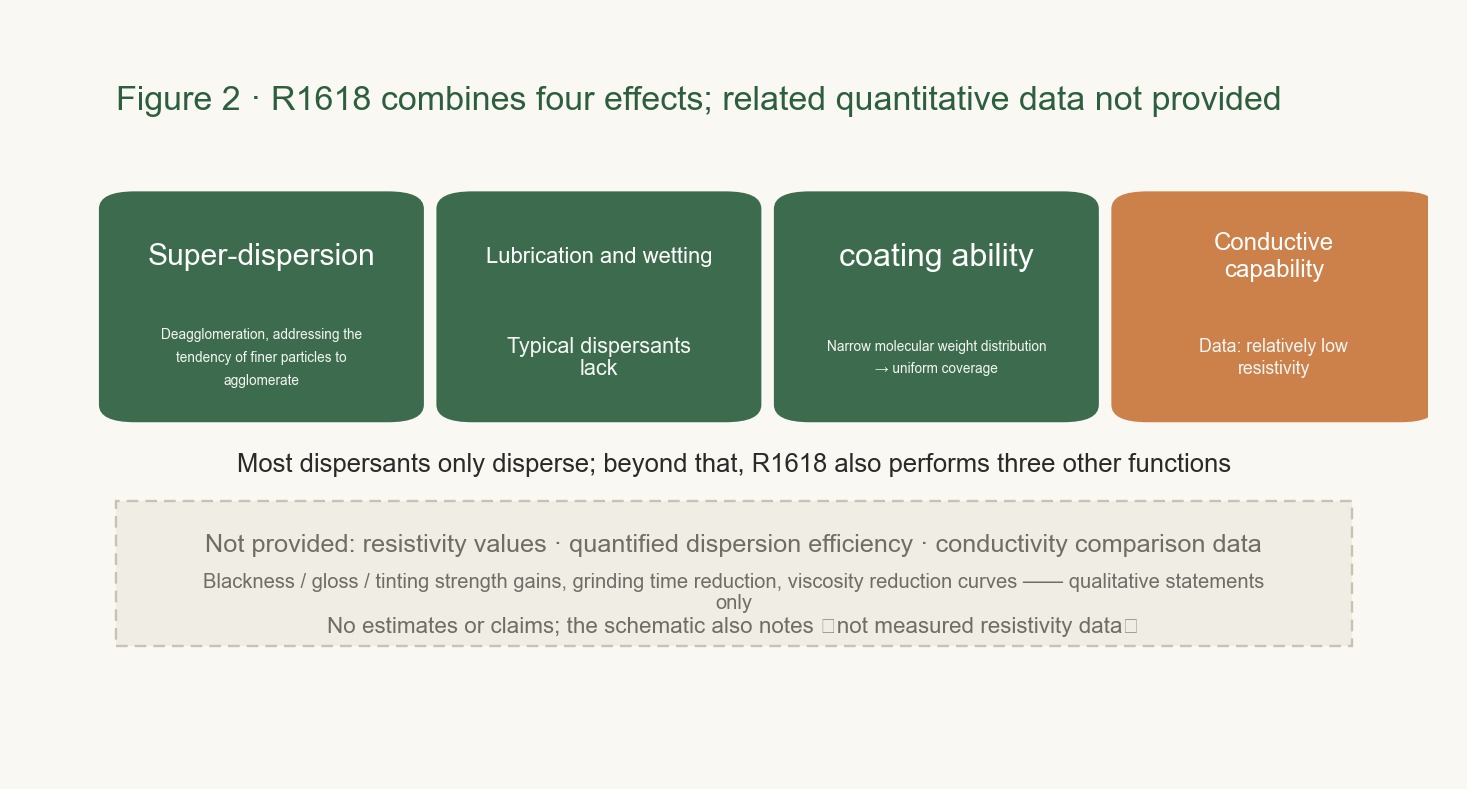
four functions in one.
It offers hyperdispersing, lubricating and wetting, and film-forming capabilities; notably, it also provides conductivity.
Compared with conventional dispersants, the document makes the contrast particularly blunt:
The dispersant commonly used by many factories generally only has a dispersing effect, whereas R1618 …
breaking up agglomerates,
It also provides lubrication and wetting, forms a coating, and additionally performs a conductive function.
II. The Key Issue: The Same 0.5–2% Is Expressed with Two Denominators
The usage level section of the R1618 document is the most deserving of separate discussion this time.
It is expressed as follows:
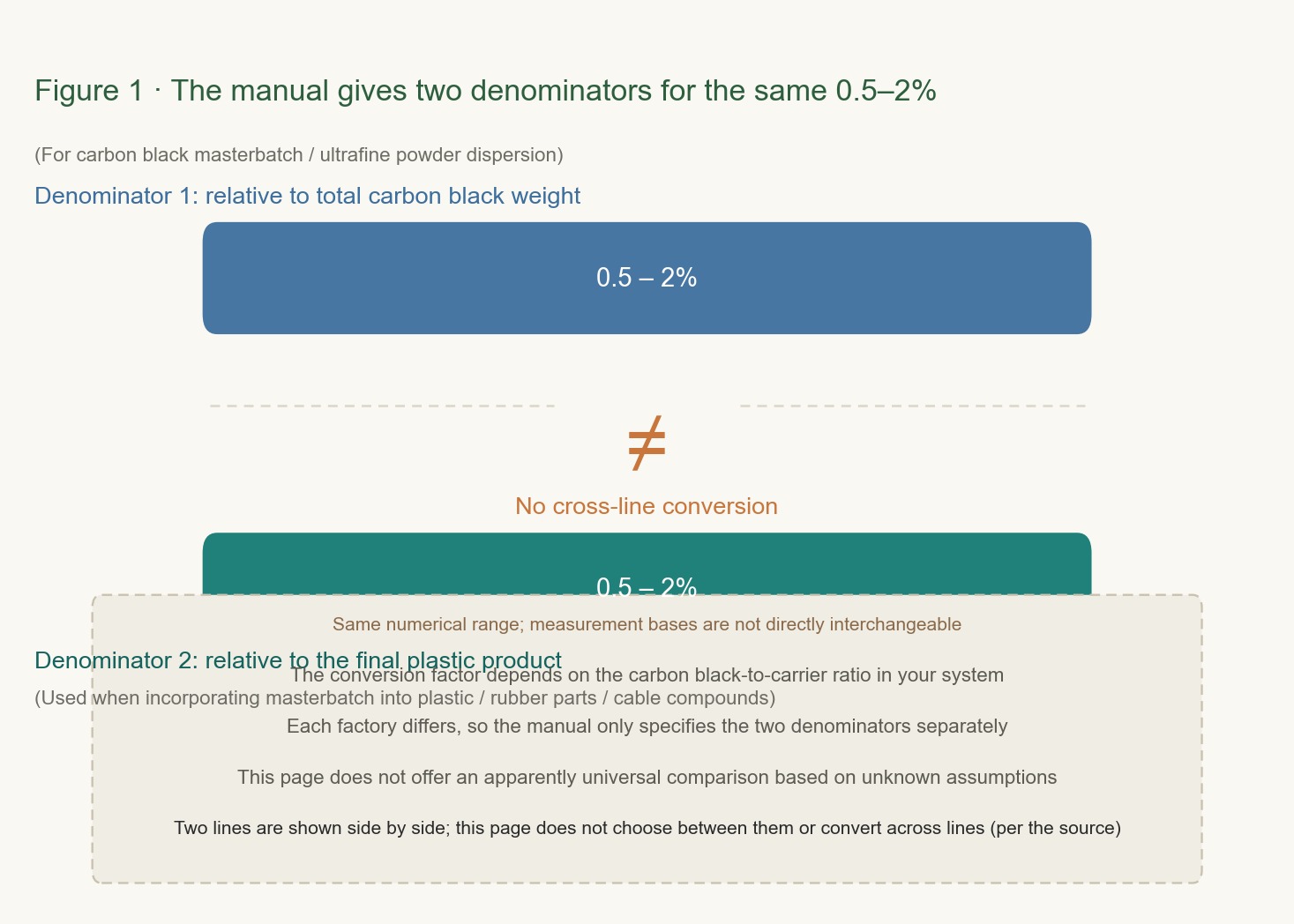
The usage level of this grade is presented as a “dual listing”: two loading lines appear on the same page of the manual, each has its denominator explicitly stated, and their numerical ranges are identical (0.5–2%)
——one relative to the total weight of carbon black, and one relative to the final plastic product.
The two lines are presented side by side; this page does not ask you to choose one, and values are not converted across the lines.
This passage spells out, in no uncertain terms, the point in the table for the additive loading level that is most easily glossed over.
First, let’s look at what each of the two denominators means:
- Relative to the total weight of carbon black: If you are making a carbon black masterbatch, this 0.5–2% is calculated from the weight of the carbon black portion in the masterbatch
- Relative to the final plastic product: The same 0.5–2% is calculated from the total weight of the finished product (carbon black + carrier + other components)
The difference in the absolute amount of additive calculated from the two denominators may be quite substantial ——
because carbon black often accounts for only part of the final formulation, **treating the "percentage calculated on the basis of the finished product" directly as
"The percentage calculated on a carbon black basis" amounts to discarding this proportional difference as well.**
The more important point, however, is the phrase: "not converted across lines."
This four-word instruction means that the manual deliberately does not provide that conversion relationship. Why?
Because the conversion factor depends on the ratio of carbon black to carrier in your own formulation,
and this ratio differs from one factory to another. If the manual provided a single conversion reference,
readers would nevertheless apply it using their own, different carbon black proportions, and the error would actually be greater.
**It is better to state the two denominators separately and let users select one based on their own formulation,
than to provide a seemingly universal conversion that actually relies on unknown assumptions.**
III. Why Two Denominators Coexist
This is not an arbitrary decision by the data compiler, but a consequence of the inherent nature of the additive category itself.
Conductive carbon black additives have one characteristic in their application: they enter at two levels—the “powder” stage and the “final product” stage.
- At the powder stage (in carbon black masterbatch production and ultrafine powder dispersion), the problem the additive must solve is agglomeration.
At this stage, the reference is the carbon black itself—how much additive is needed to treat a given amount of carbon black.
- At the product stage (incorporating the masterbatch into plastic parts, rubber parts, and cable compounds), the additive is one component of the formulation.
At this stage, the reference is the total amount of the final formulation—when designing the entire formulation, you consider cost and component ratios based on that total amount.
Each level has its own correct calculation method. Mixing the two is not a calculation error; it means calculating something that does not exist.
The Finer It Is, the More It Agglomerates
The source material is blunt about the difficulties associated with this category of conductive carbon black:
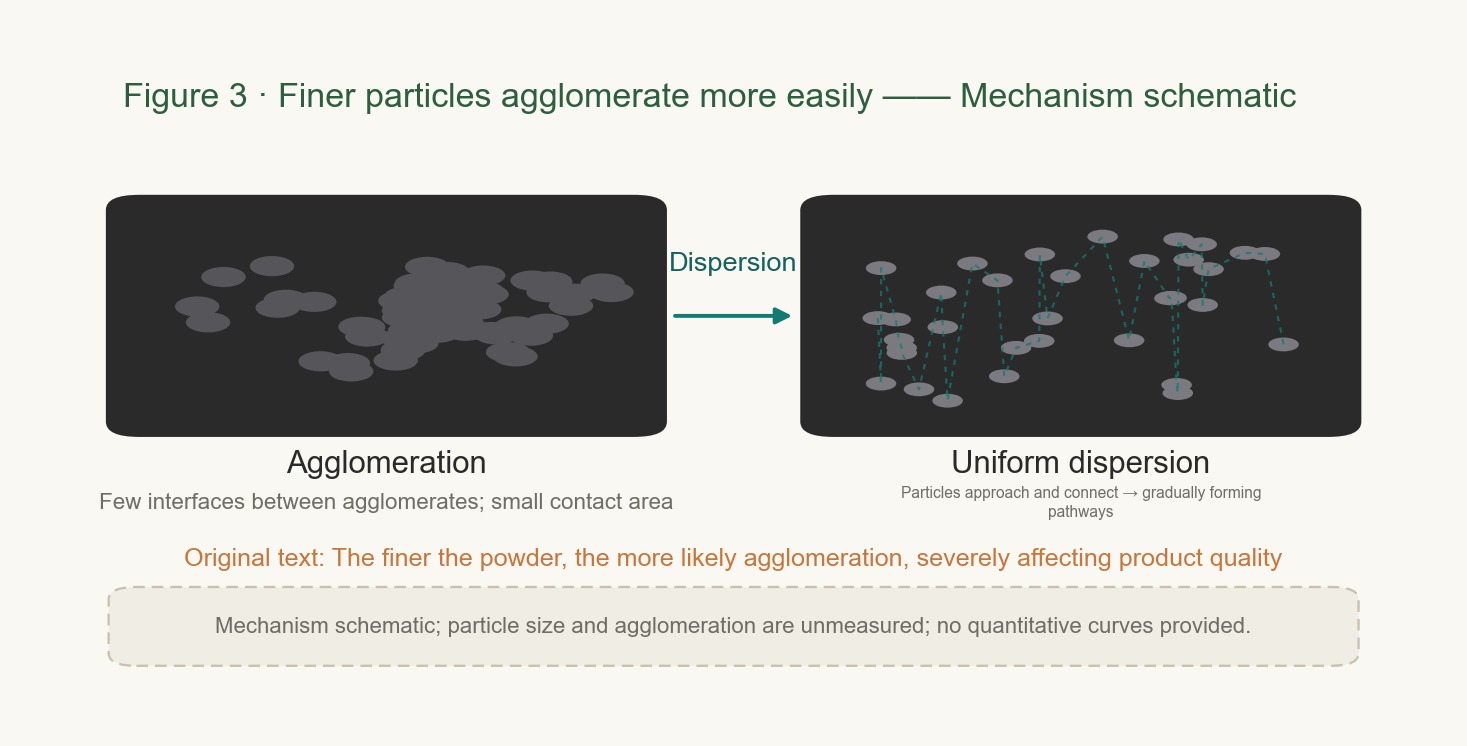
When producing ultrafine powders such as conductive carbon black and conductive carbon black masterbatch, the finer the powder, the more prone it is to agglomeration
This seriously compromises product quality.
This is a counterintuitive but physically sound fact. The finer the powder, the greater its specific surface area,
and the higher its surface energy, the more easily the attractive forces between particles exceed the repulsive force provided by the dispersant.
optional optimization,
The source material also provides an interpretation of the conductive function (as worded on the page):
Dispersant dosage increases → conductive carbon black is dispersed particle by particle → conductive pathways light up one by one and form a network;
Not measured resistance data
When the distance between carbon black particles is reduced to a certain extent, continuous pathways form—the basic principle of electrical conduction.
However, the material also states clearly: the diagram on the page is not measured resistance data,
has a relatively low resistivity and can give rubber or plastics a certain degree of conductivity
Five. What the Material Explicitly Does Not Provide (Equally Important)
The R1618 material does not provide the following information, which is faithfully listed here:
polymeric aqueous solution
It does not provide process instructions such as what to add first, what to add later, or whether predispersion is required.
the conductive carbon black additive must be added in four steps and the dry powder must not be soaked first,
you should confirm which document the statement comes from and which model that document addresses — it cannot be assumed to apply to R1618.
② No resistivity values, no quantitative dispersion-efficiency data, and no comparative data on conductive performance.
All performance claims in the materials are qualitative.
③ Magnitudes of improvement in blackness / gloss / tinting strength, amounts by which grinding time is shortened, and viscosity-reduction curves — the materials provide only qualitative statements.
This page does not extrapolate or promise any such figures.
④ Cross-model combinations or substitution relationships: none have been established in the materials.
This article neither lists other models as references nor uses values from other models to illustrate this model ——
Cross-model references conflate the measurement bases of the two systems.
If a model-selection comparison is needed, it should be confirmed separately against the respective data sheets.
VI. Practical Implementation
- Do not convert values across product lines on your own. The manual explicitly states that values are not converted across; the conversion factor comes from your own carbon black formulation, must be calculated by you, and should be confirmed with the supplier.
- Distinguish between the powder stage and the product stage. When making the masterbatch, follow powder-stage logic; when making the product, follow formulation logic.
- Do not use “the finer, the better” to work backward in estimating the loading level. The data indicates that “the finer it is, the more prone it is to agglomeration”; fineness and additive requirements move in the same direction.
- Confirm the source before citing performance data. The diagram on the page is annotated "non-measured electrical resistance data";
For items without quantitative values, neither this article nor the official website will supply figures on their behalf.
Conclusion
Moved from the bodyOperation steps (original text, as is)
- When you receive a range for the loading level, first ask what the denominator is. “Is 0.5–2% relative to carbon black or to the finished product?”—this question alone can save a round of rework.
When the loading level of an additive is written as "0.5–2%", it already appears fairly complete.
But when it also identifies two denominators, "relative to carbon black" and "relative to the finished product," and explicitly declines to provide a conversion,
Only then does the range become genuinely usable.
The way the R1618 information handles this matter is worth noting: the two lines are stated side by side, each denominator is labeled separately, neither is chosen over the other, and no values are converted across them.
This is not an incompleteness of information, but rather a way of placing uncertainty in the right position ——
The conversion relationship depends on the user’s system formulation, and only the user knows this.
Data basis: the Keiju product manual and official product data.
The composition, preparation descriptions, four-effect summary, dual-denominator loading level figures, and applicable scenarios discussed in this article are all taken from the original R1618 source material.
Items not documented in the source material, including the addition sequence, quantified effects, resistance values, and cross-model relationships, are identified in the main text. No extrapolation, substitute formulation, or cross-model citation is provided on this page.
The loading level ranges cited in the text are taken from the original R1618 source material.
The conversion coefficient depends on the respective system, so no universal conversion is provided on this page.

Article actions
If this piece was useful, you can leave a mark — the like count comes from our back office at admin.kj9896.com; when the endpoint is unreachable the buttons are disabled and the count shows “—”. No invented figures are ever filled in.
Link: https://kj9896.com/en/news/r1618-conductive-carbon-black-two-denominators
Related reading
- 01Anchoring and Solvation: How a Single Dispersant Molecule Divides the Work at the Powder Surface4 October 2026
- 02Melt Viscosity Goes Up: Which Figures Can Be Compared, and Which Are Not Stated in the Documentation4 October 2026
- 03Hyperdispersant and Wetting-Type Dispersant: Division of Roles in Plastics Colouring and Four Operational Guidelines1 October 2026
Products mentioned in this article
Keep reading
More company announcements and product updates are in the newsroom.