
Technology explained · 11 October 2026
When National Standard FV-2 and UL94 V-2 Are Both Listed: Why Do Both Conclusions Hold for the Same Formulation?
R911 documentation lists both UL94 V-2 (film types) and GB/T 2408-2008 FV-2. The apparent conflict reflects different test observations. This article explains what each test observes, why one formulation can receive two ratings, and presents the loading window (10%–20%), thickness direction, processing-temperature window, and prohibition on ultrahigh temperatures, all drawn from the source.
- 01Anti-agglomeration
- 02Distribution rate
- 03Lubrication balance
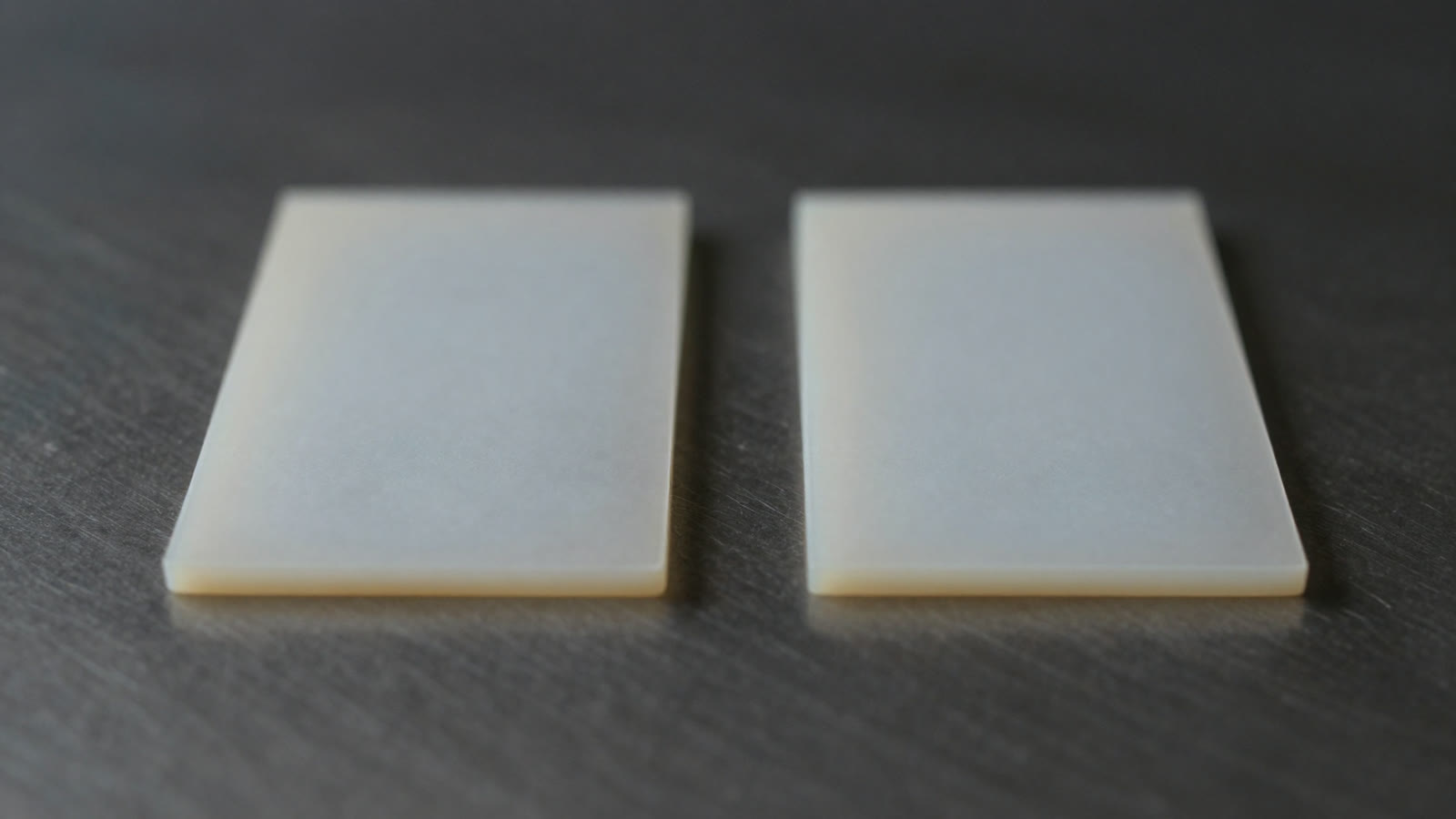
Both the national-standard FV-2 and UL94 V-2 appear in the same document: Why are both conclusions valid for the same formulation?
When two standards and two grade codes appear together in a document, procurement and process engineering often get stuck here:
Which one should the assessment be based on?
This article uses the documentation for 锎锔 R911 (a PE hindered-amine-type halogen-free flame retardant) as an example to clarify this point.
I. The two standards do not evaluate the same thing
The following sentence is quoted verbatim from the 锎锔 R911 documentation:
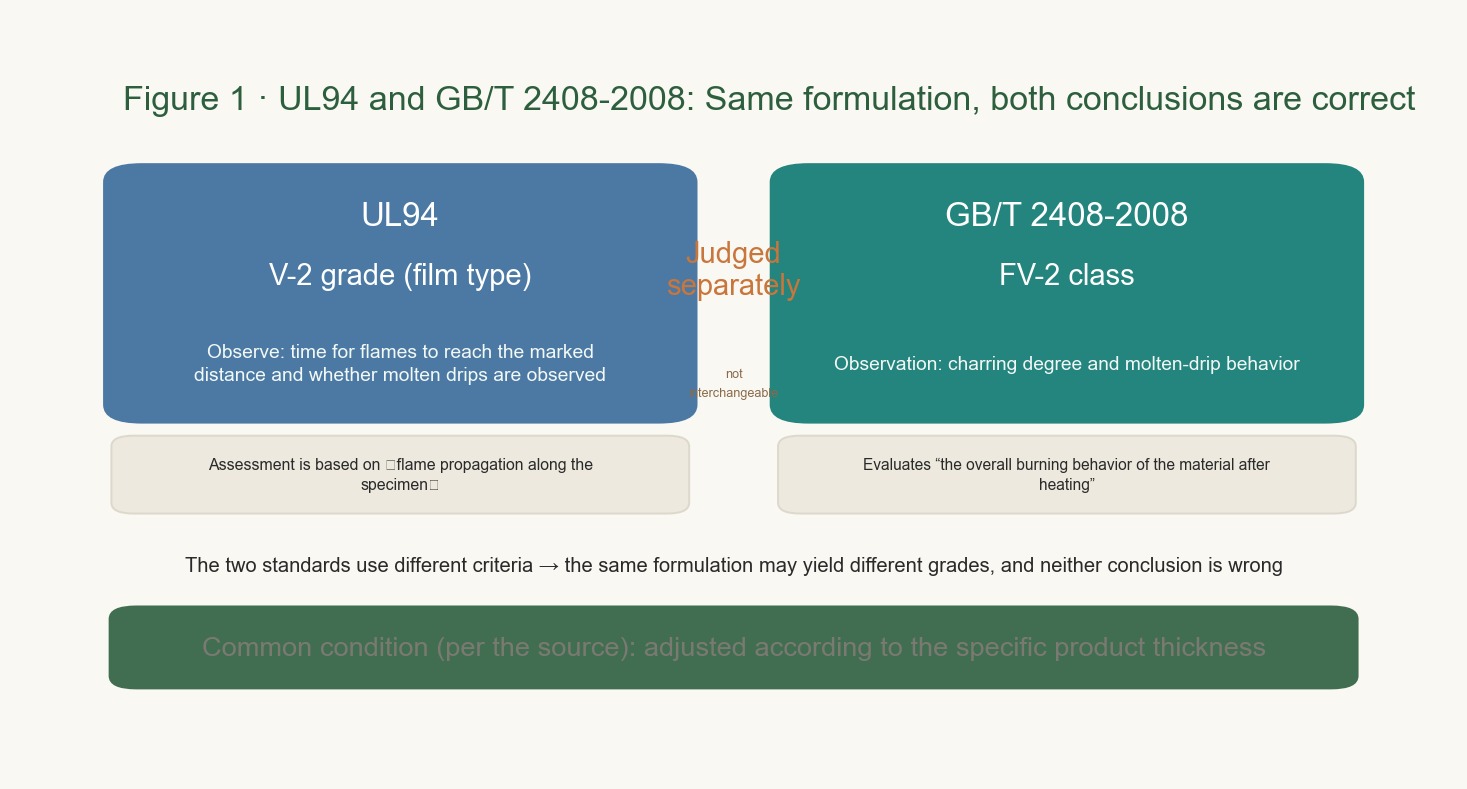
UL94 V-2 grade (thin-film type) or the FV-2 flame retardancy grade in GB/T 2408-2008 (specifically adjusted according to product thickness)
either standard may be chosen, and whichever one passes counts,
Rather, it admits the two standards use different determination logic, so the same formulation may yield different grade classifications, and neither result is incorrect.
The differences are roughly as follows:
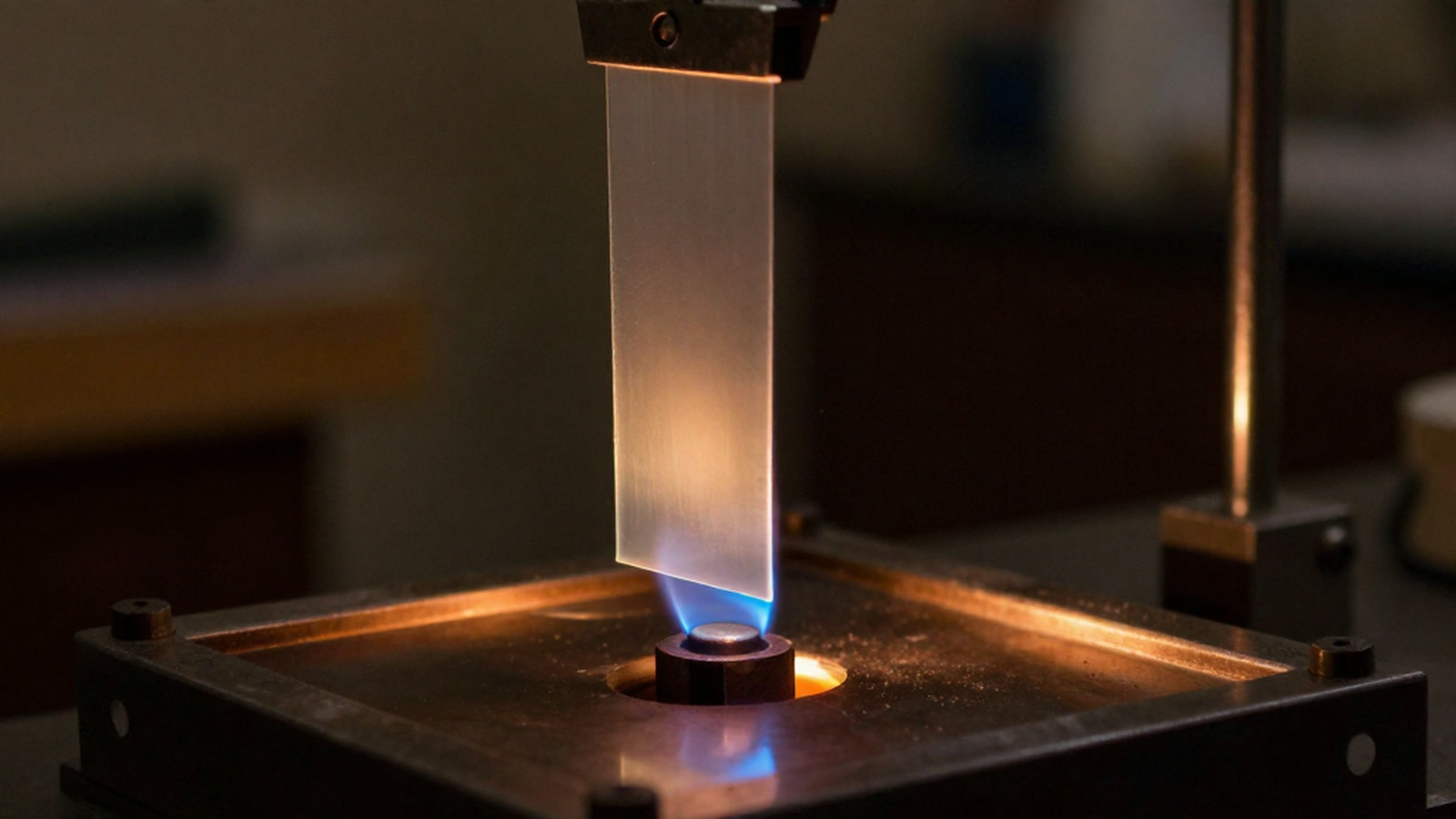
- UL94 is a vertical burning test: the specimen is ignited at a fixed position above the flame, and the time required for the flame to spread to the marked distance and whether molten drip is observed are recorded,
Grades such as V-0 and V-2 are assigned accordingly. What is evaluated is flame propagation along the specimen.
- GB/T 2408-2008 is a method for classifying combustion performance. The observation focus for grade FV-2 includes the degree of charring and molten drip behavior,
What is evaluated is the material’s overall combustion behavior after heating.
When the same film is tested under UL94, it may be rated V-2; when tested under GB/T 2408, it may be rated exactly FV-2.
Both reports are authentic, and neither figure is fabricated.
This is precisely the mechanism that makes both conclusions valid for the same formulation.
II. A More Practical Variable: Product Thickness
The original source text contains another qualification:
(Adjust specifically according to product thickness)
This is not a standard disclaimer but a substantive constraint. Elsewhere, the R911 documentation provides a more explicit statement—
For thin PE products:
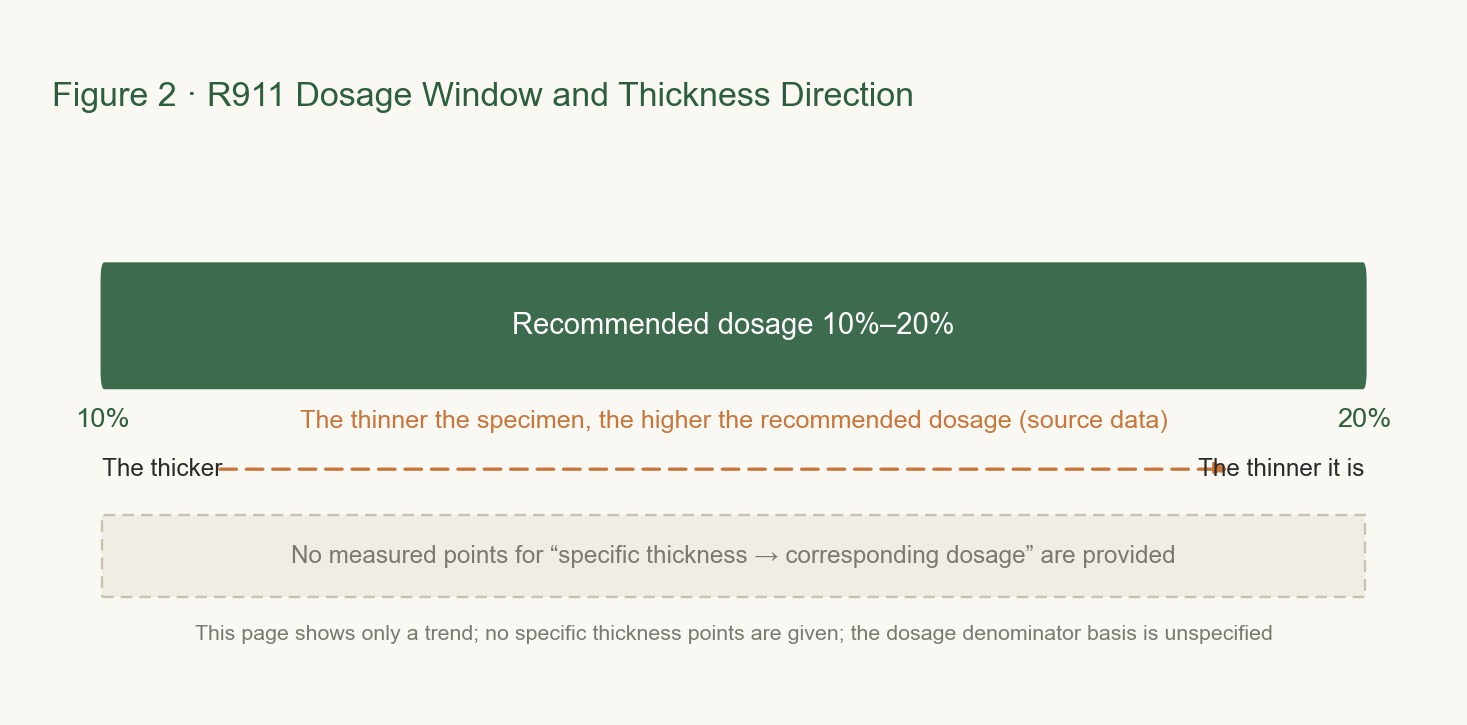
recommended loading 10%-20%; the thinner the product thickness, the more appropriately the loading level should be increased; the optimal ratio can be specifically determined through small-sample testing
Thus, the “product thickness” variable affects both aspects at the same time:
- Assessment side
- Product thickness affects the flame retardancy grade bracket
- Formulation side
- Product thickness conversely affects the required loading level
The thinner the film, the faster it dissipates heat, the less likely the flame is to sustain itself, and the higher the system’s absolute demand for flame retardant.
The same loading level used in a thick product and in a thin product inherently constitutes two different systems.
thin products ≤15 denier(0.15mm)
pending verification
and merely notes here the discrepancy between its presence and its source. When citing it, confirmation should be made by referring back to your own technical specifications.
III. R911 is a hindered amine type: beyond flame retardancy, there is another calculation to consider
PE hindered-amine halogen-free flame retardant.
In the literature, the benefits brought by this hindered-amine structure are reflected in two parallel effects:
First, flame retardancy itself.
does not release toxic hydrogen halide gas during combustion and produces little smoke
Second, antioxidant synergy. The literature states:
It has antioxidant properties and delays the aging of PE—making it relevant to long-term outdoor applications such as agricultural films (a qualitative statement with no quantitative weatherability data)
This statement is of considerable value to manufacturers of agricultural films and agricultural covering films: the need for both flame retardancy and antioxidant performance is a common requirement for long-term outdoor PE products.
no quantitative weatherability data
IV. Compatibility determines whether an additive can truly be put to use
Even if an additive has an excellent flame-retardant mechanism, if it precipitates during processing or affects heat sealing and transparency,
it amounts to an ineffective addition on the production line. The documentation for R911 reports favorable results in this regard:
It has good compatibility with PE resins (LDPE, LLDPE, etc.) and does not readily precipitate during film processing;
It does not affect transparency, flexibility, or heat-seal performance
For products such as packaging films and shrink films that are sensitive to transparency and heat-seal strength,
how much it improves
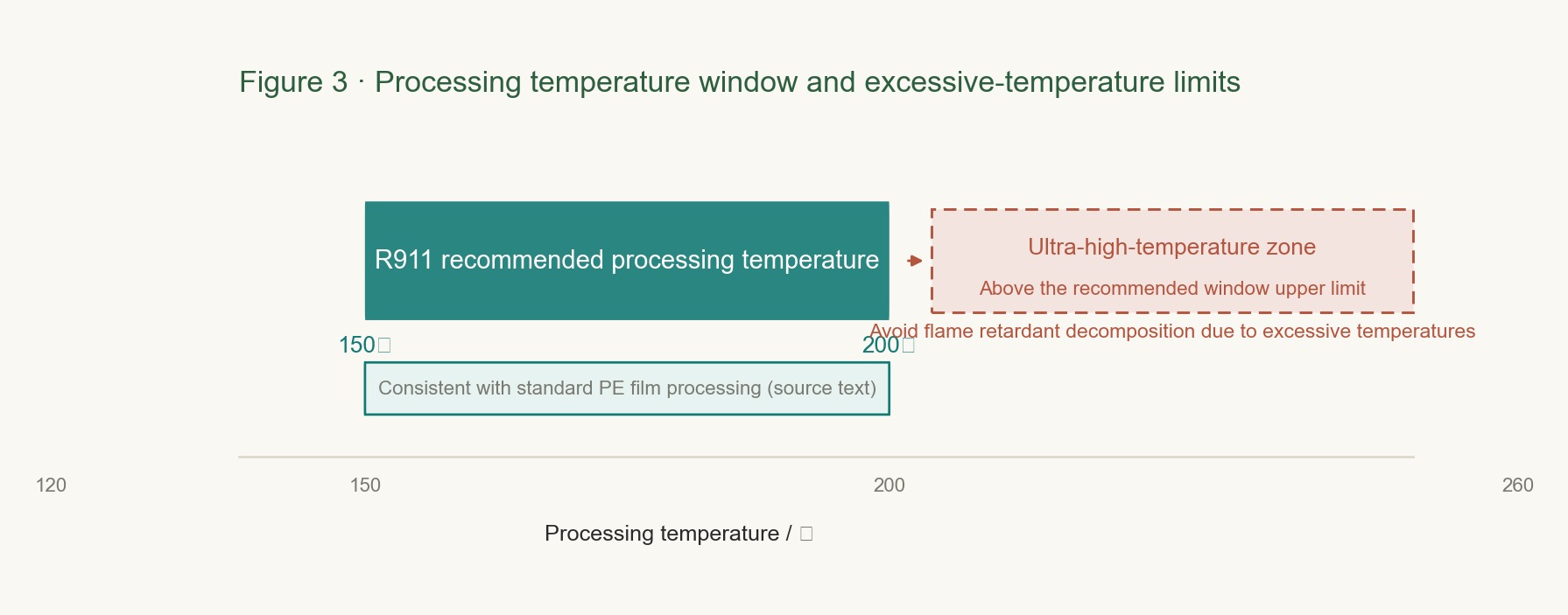
Another statement in the source specifies the recommended processing temperature for R911:
150-200℃(consistent with conventional PE film processing);Avoid excessively high temperatures that cause the flame retardant to decompose
consistent with conventional PE film processing
The restriction in the second clause is equally specific — excessively high temperatures will cause the flame retardant to decompose, making this a boundary that must not be crossed.
V. Scope of Application and What the Source Does Not Provide
Scope of application (transcribed item by item from the source):
- PE thin products (adjusted according to product thickness and flame-retardancy requirements): packaging film, shrink film, protective film, agricultural covering film; the overview separately lists agricultural film, tent film, and electronic insulating film
- PE thin sheets and ultrathin products: electronic insulating sheets, lightweight packaging sheets, etc.
- Braided filament / ultra-thin tubing (the range of thin PE products listed in the overview)
The following information has explicitly not been provided and is listed here as-is, without extrapolation:
① The compliance documents are not attached. Halogen content thresholds and test reports (values at the ppm level), UL94 / GB/T test specimens and thicknesses,
RoHS / REACH declarations of compliance and report numbers —— none of the information has been provided (compliance claims are made in the main text, but the documents are not included in the materials).
If halogen compliance documentation is needed, it should be requested from the supplier for the specific grade.
② No test method is provided for "not readily migrating". The materials provide a qualitative statement, but no test method or acceptance criteria.
It is safer to treat this as an assumption requiring verification than as a conclusion.
③ No quantitative retention rates have been provided. Quantitative retention data for transparency, heat-sealing strength, and mechanical properties after loading have not been provided,
There are only qualitative statements.
④ The starting point for calculating the shelf-life period has not been specified. The documentation states "12 months", but does not explain how the starting point is calculated or the shelf life after opening.
VI. If You Remember Only Three Sentences
The “or” between UL94 and GB/T 2408 does not indicate leniency; it reflects two assessment logics. Both conclusions are correct for the same formulation, which is normal.
Thickness affects both the assessment and the formulation. The manual’s statement that "the thinner the product, the more appropriately the loading level should be increased" should be read together with "adjust specifically according to product thickness."
For compliance documents not provided in the materials, request them from the supplier by material number. A statement of conformity on a webpage does not amount to a deliverable report.
Conclusion
Writing two standards in the same sentence calls not for deciding "which one is correct," but for clarifying "what each should be assessed against."
The information on R911 is presented as text with clearly defined boundaries: the loading range, processing window, compatibility statement, and scope of application are listed item by item,
It also identifies the compliance documents that have not been attached, the test methods that have not been provided, and the quantitative retention rates that have not been specified.
It does not omit any conditions on the user’s behalf, nor does it make any additional inferential leap on the user’s behalf.
This article follows the same approach: every item provided in the source material is reproduced verbatim and explained; where information is not provided, it is truthfully stated as "not given," with nothing drafted in its place.
*Data sources: the 锎锔 product manual and official product data. The loading range, processing temperature window, and compatibility statement discussed in this article,
as well as the scope of application, are all taken verbatim from the original R911 information; items not documented in the source material are identified in the main text, no extrapolation is performed on this page, and no documents that were not attached are cited.*
*the grades and loading levels stated in the text are all taken from the original R911 information,
It does not represent measured results for any specific formulation.*
Article actions
If this piece was useful, you can leave a mark — the like count comes from our back office at admin.kj9896.com; when the endpoint is unreachable the buttons are disabled and the count shows “—”. No invented figures are ever filled in.
Link: https://kj9896.com/en/news/r911-national-standard-vs-ul94
Related reading
- 01Flame-Retardant Ratings Cannot Be Looked Up in a Table: Loading, Thickness, and UL94 Must Be Considered Together11 October 2026
- 02Melt Viscosity Goes Up: Which Figures Can Be Compared, and Which Are Not Stated in the Documentation4 October 2026
- 03Same “0.5–2%,” Two Denominators in Manuals: Why Conductive Carbon Black Additive Dosages Cannot Be Directly Converted11 October 2026
Products mentioned in this article
Keep reading
More company announcements and product updates are in the newsroom.