
Technology explained · 11 October 2026
Flame-Retardant Ratings Cannot Be Looked Up in a Table: Loading, Thickness, and UL94 Must Be Considered Together
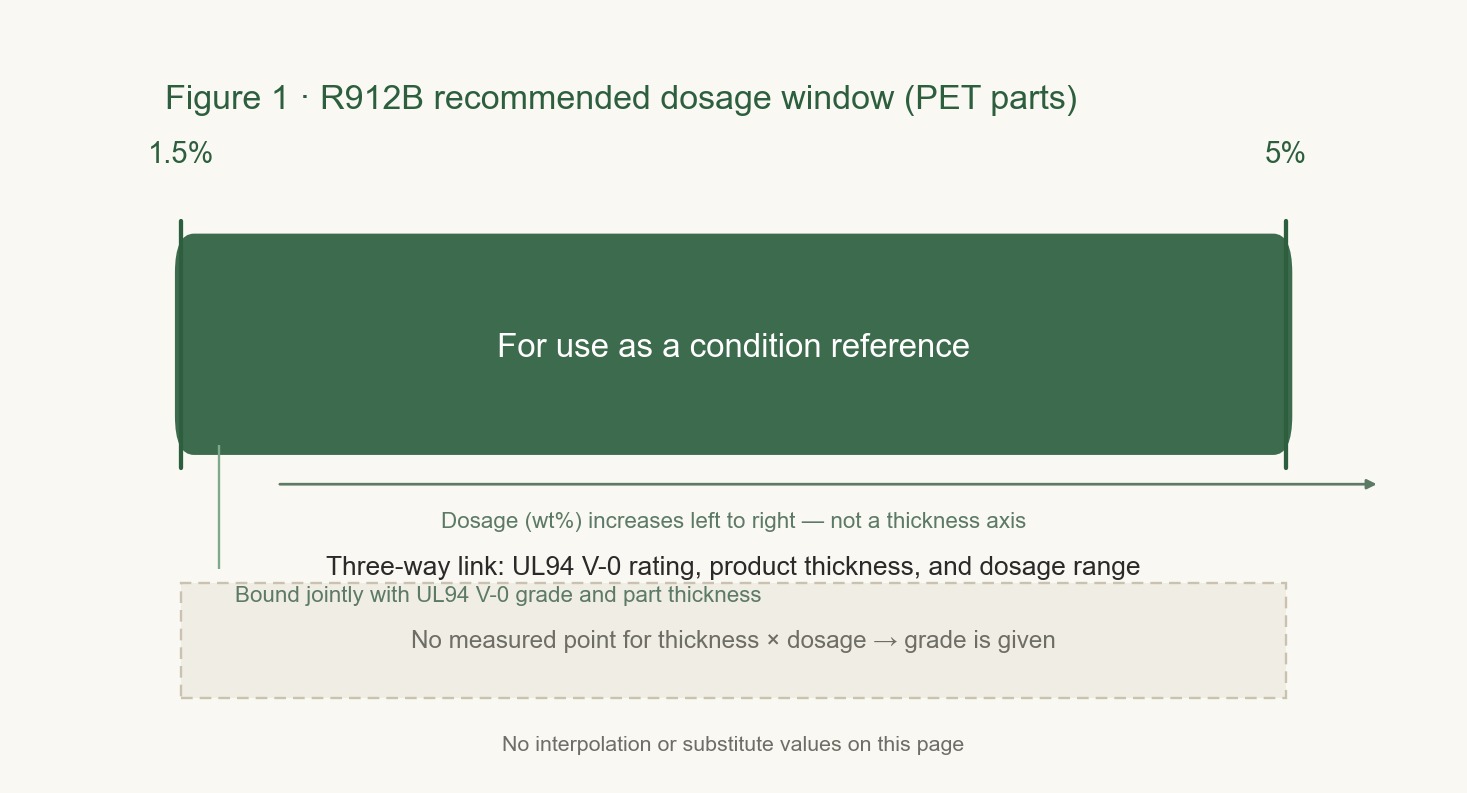
The data for R912B specifies a recommended addition range of 1.5%-5% and a suggested processing temperature of 230-280°C. However, these numbers are not 'conclusions' but 'premises' - the flame retardancy level is determined by the addition amount, product thickness, and base material. This article explains the observation dimensions as described in the original data and why the data does not provide actual measured points of 'thickness × addition amount → level'.
- 01Anti-agglomeration
- 02Distribution rate
- 03Lubrication balance
Flame retardancy grade cannot be determined from a table: loading level, product thickness, and UL94 must be considered together
A flame retardant supplier gives you a recommended loading range. The laboratory prepares samples within that range, and the test report comes back showing V-2.
Switch to another product manufacturer, and with the same additive and the same loading level, the report changes to V-0 or simply fails to meet the requirements.
This is particularly common with halogen-free flame-retardant PET. The problem often lies not in the additive itself, but in a misconception:
“UL94 V-0” is not a single value; it is the result of jointly considering three variables.
This article breaks down the issue and explains the role of 锎锔 R912B within this three-variable framework.
I. The Three Variables in V-0
The manual describes the loading level of R912B as follows:
According to the flame retardancy grade requirements for PET products, the recommended loading is 1.5%-5% (the optimal ratio can be determined through small-sample tests)
Meanwhile:
A loading level of 1.5%-5% enables PET material to meet the UL94 V-0 flame retardancy standard (adjust specifically according to product thickness)
Reading these two statements together reveals three things:
Variable one: loading level. 1.5%–5% is a range, and the manual does not provide any single recommended value within the range.
The actual grade corresponding to each point in this range depends on the other two variables.
adjust specifically according to product thickness
The UL94 test itself assigns ratings by specimen thickness—that is, with the same formulation, when using thick and thin specimens,
The burning behavior when the flame spreads to the marked distance differs.
Discussing flame retardancy grade without thickness is equivalent to drawing conclusions without conditions.
The applicable substrate is PET alone (the data have not been extrapolated to PETG / TPU / PE / PP).
The manual’s 【Scope of Application】 lists PET fibers (flame-retardant apparel fabrics, curtain fibers, and industrial filter media)
and PET films (flame-retardant packaging films and electrical insulation films). This is not conservatism but an honest delineation of the applicable boundaries ——
The flame-retardant mechanism is strongly correlated with the compatibility and decomposition behavior of the resin, so conclusions cannot be drawn across different substrates by analogy.
II. Why a 2% loading level can fail while a 5% loading level may not necessarily pass
When the three variables are considered in the context of real-world production, the point of conflict becomes clear:
The thinner the product, the higher the required loading level. Thin sheets dissipate heat quickly and are less likely to sustain a flame, but they place greater demands on the uniform distribution of the additive;
The thinner the product, the more advisable it is to appropriately increase the loading level.
The higher the loading level, the greater the processing challenges. Once the additive exceeds a certain proportion, the melt viscosity increases,
making dispersion more difficult and potentially adversely affecting the mechanical properties and appearance of the product.
The grade is a test result, not a description of the formulation. When the result is “UL94 V-0,”
what actually determines it is whether three conditions are met simultaneously: the thickness of the specimen + how much additive was added + the type of substrate.
a loading level that can pass V-0
What should the product thickness be, what grade should it achieve, and how should the loading level range be specified?
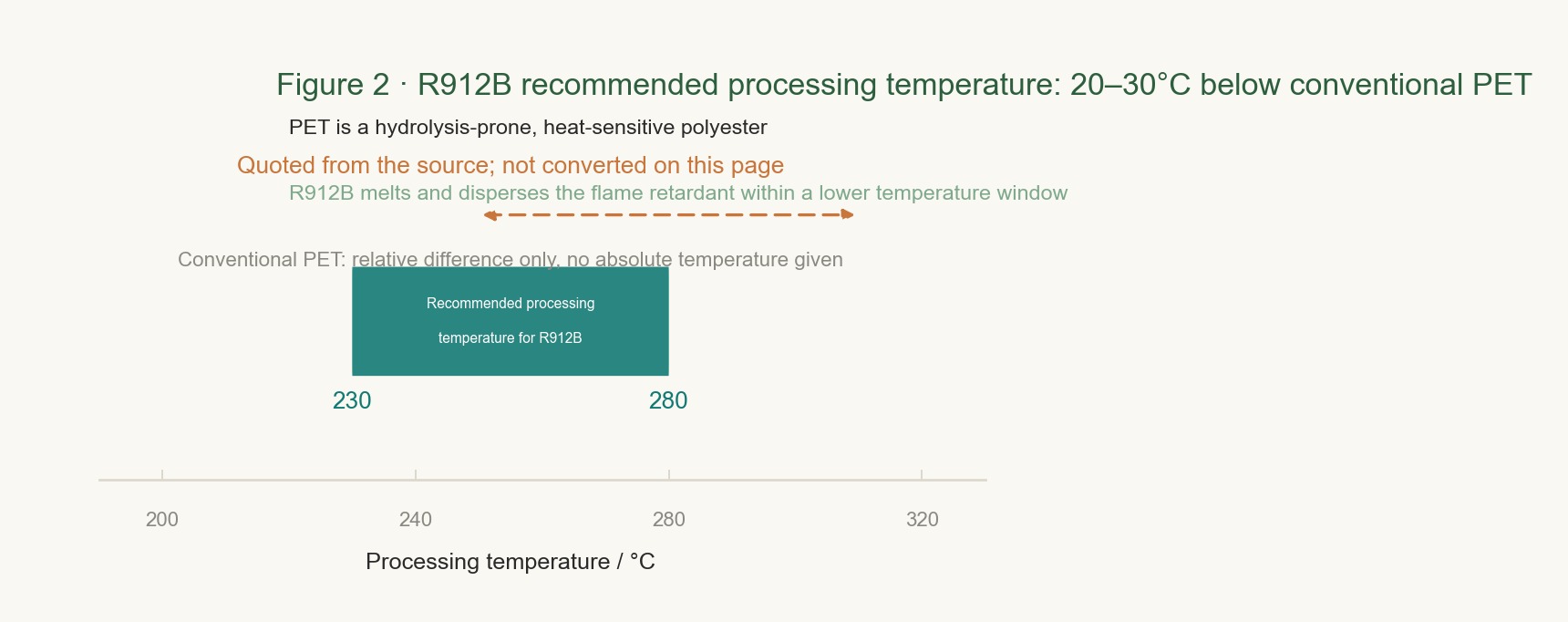
III. Special Processing Characteristics of R912B: Processing Temperature 20–30℃ Lower Than Conventional PET
This point deserves separate discussion because its processing window is markedly different from that of R915, another flame retardant from 锎锔 for use with PET.
The R912B technical data sheet gives the following recommended processing temperature:
230℃-280℃ (20-30℃ lower than conventional PET processing temperature)
What does it mean to be 20–30℃ lower? PET is a typical polyester that is susceptible to hydrolysis and sensitive to high temperatures, and every slight increase in processing temperature,
increases the risk of molecular-chain breakage and hydrolytic degradation, causing viscosity to decrease and compromising product strength.
Being able to melt and disperse the flame retardant within a lower-temperature processing window is itself a direct contribution to PET processability.
The technical documentation also notes that R912B has excellent compatibility with PET resin and is not prone to migration; it has minimal impact on tensile strength and impact strength,
Heat resistance and chemical resistance must be maintained. These requirements are two sides of the same coin as the low-temperature window —
The additive must not compromise the base material or force the factory to raise the machine temperature.
IV. Three mechanisms, and why a dispersing aid is still needed
Moved from the bodyOperation steps (original text, as is)
- Ask the right questions: When requesting a loading level range from the supplier, also specify the product thickness and target flame retardancy grade.
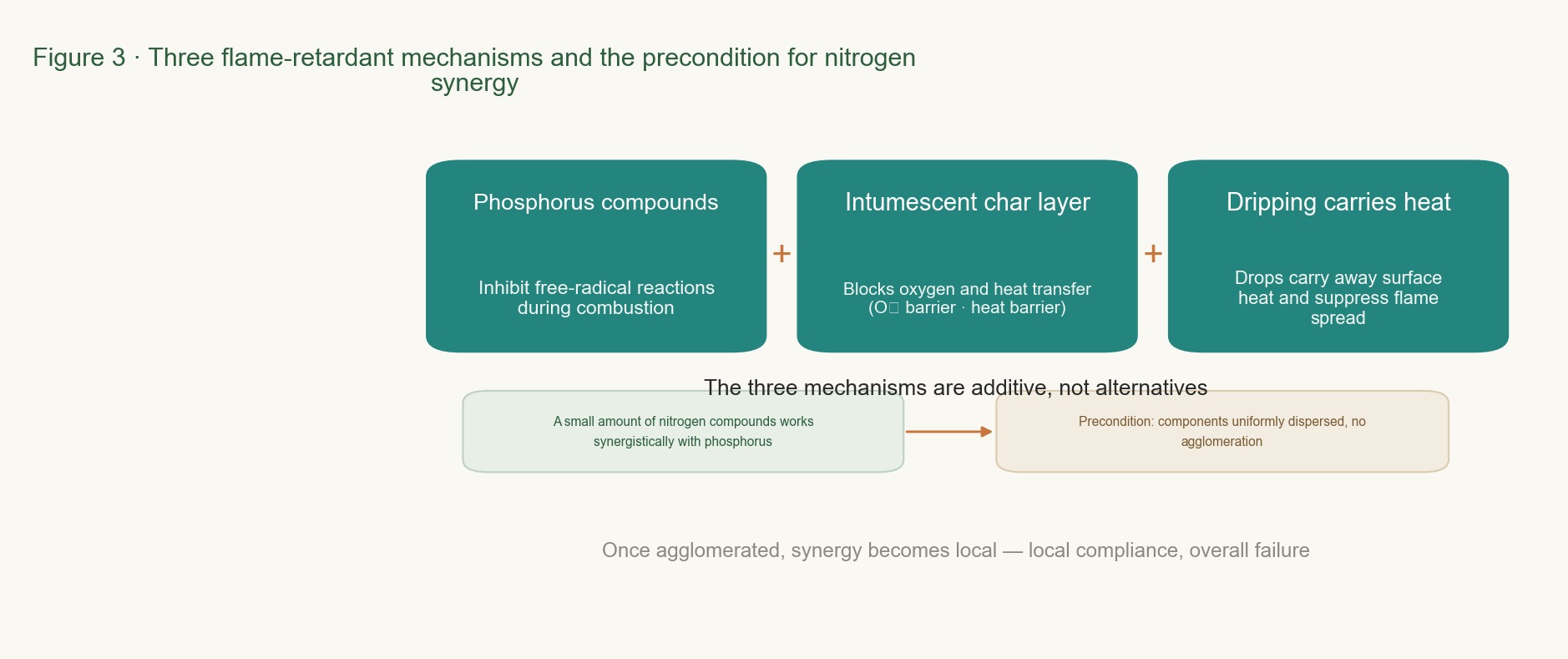
The manual breaks down the action of R912B into three mechanisms, reproduced verbatim:
- Phosphorus-based compounds inhibit free-radical reactions during combustion — cutting off the chain reaction from a chemical kinetics perspective
- Intumescent char layer (oxygen and heat barrier) — an intumescent char layer forms during combustion, blocking the transfer of oxygen and heat
- Molten drip heat removal (suppression of flame spread) — dripping carries heat away from the surface, "effectively suppressing flame spread and accelerating dripping"
These three mechanisms work in combination rather than being mutually exclusive alternatives. For engineers, the practical implication is:
When these three factors operate simultaneously, the flame retardancy performance of the system should not be summarized using a single indicator.
If optimization focuses on only one direction—for example, only increasing the loading level without improving dispersion—the other two may be compromised.
Regarding bridging, the document also provides a clear statement:
A small amount of nitrogen-based compounds synergizes with the phosphorus-based components, enhancing flame retardancy efficiency and reducing the loading level;
Nonionic dispersing aids ensure uniform dispersion of the components and prevent agglomeration.
The latter clause is easily overlooked. Synergy between the nitrogen-based and phosphorus-based components requires them to be uniformly dispersed in the resin.
Once agglomeration occurs, synergy becomes a localized phenomenon—localized compliance may be achieved, but overall compliance is not.
This is why “dispersion” appears as a requirement in the R912B documentation, rather than the documentation discussing flame retardancy alone.
What the Technical Documentation Does Not Provide (This Section Is Equally Important)
thinking that you know.
① The denominator basis for the loading level is not specified. Is the denominator for “1.5%–5%” the mass of the PET resin or the total mass of the system?
The documentation does not specify. Under these two denominator bases, the same percentage corresponds to different actual numbers of grams of material to be added.
Until this is confirmed with the supplier, it is not advisable to copy this range directly into the process formulation.
② No measured data points are provided for product thickness × loading level → flame retardancy grade.
a given product thickness achieves V-0 at a given loading level.
Therefore, this article does not provide any conversion table—any claim that this table can be back-calculated from the manual is fabricated.
③ The physical and chemical property table is not included. Appearance, density, moisture, particle size/fine ness, effective content, etc. are not listed on the page for this grade.
Further information is pending, and values from other grades in the same series are not substituted on this page.
This is consistent with the approach used throughout the entire 锎锔 product documentation system.
VI. Practical Implementation Checklist for Frontline Engineers
- Observe substrate boundaries: The documentation for R912B covers PET only. For the flame-retardant requirements of PETG, TPU, PE, and PP, please ask about the corresponding grades separately.
- Test the lower end of the processing-temperature range first: The documented window is 230–280℃, which is 20–30℃ lower than conventional PET,
First validate processing and dispersion at the lower end before considering exploring higher temperatures.
- Start with small-sample testing: The manual explicitly states that “the optimal ratio can be determined through small-sample testing”—
A range is a starting point, not the endpoint.
- Dispersion cannot be omitted: The document states in the mechanism section that “a nonionic dispersing aid ensures uniform dispersion of the components and prevents agglomeration,”
nitrogen-based synergy depends on this prerequisite.
- Clarify the denominator: The document does not specify this; do not make an assumption based on experience.
Conclusion
A flame retardancy grade is not a conclusion that can be obtained by consulting a table. It is the result of the combined effects of loading level, product thickness, and the substrate.
The documentation for 锎锔 R912B states this quite clearly: it provides a range of 1.5%–5% and a target of UL94 V-0,
adjustments must be made specifically according to product thickness
It leaves the user with no condition omitted.
This article likewise omits nothing: the denominator basis left unspecified in the source material, the measured data points not provided, and the table of physicochemical indicators not attached,
have all been faithfully listed above. Engineering judgments may differ, but the boundaries of the facts should remain clear.
Data sources: 锎锔 product manuals and official product data. The loading level range, processing temperature window, and applicable substrates discussed in this article,
are all taken from the original R912B source material; items not documented therein are flagged in the main text, and this page neither substitutes values from models in the same series nor makes any extrapolations.
Article actions
If this piece was useful, you can leave a mark — the like count comes from our back office at admin.kj9896.com; when the endpoint is unreachable the buttons are disabled and the count shows “—”. No invented figures are ever filled in.
Link: https://kj9896.com/en/news/r912b-flame-retardant-grade-triangle
Related reading
- 01When National Standard FV-2 and UL94 V-2 Are Both Listed: Why Do Both Conclusions Hold for the Same Formulation?11 October 2026
- 02Melt Viscosity Goes Up: Which Figures Can Be Compared, and Which Are Not Stated in the Documentation4 October 2026
- 03Low-Halogen ≠ Halogen-Free: Where Exactly Is the Compliance Boundary for Halogenated Flame Retardants?28 September 2026
Products mentioned in this article
Keep reading
More company announcements and product updates are in the newsroom.