
Technology explained · 4 October 2026
Anchoring and Solvation: How a Single Dispersant Molecule Divides the Work at the Powder Surface
On a single dispersant molecule, the anchoring group is responsible for attaching to the powder surface, while the solvating chain is responsible for transferring the molecule into the dispersion medium; their requirements for external conditions are opposite. Following the original wording in the manual, this article separates the functions of these two components and presents two dosage-and-performance data series for R1800-SK-treated titanium dioxide (TiO₂) and R1800-SH-treated carbon black. It explains why the dosage varies with powder fineness, oil absorption value, and specific surface area, and identifies, item by item, the parameters not provided in the manual.
- 01Anti-agglomeration
- 02Distribution rate
- 03Lubrication balance

Moved from the bodyFirst data table in this article (as quoted)
| Component | Manual wording | Function performed | Temperature conditions in the manual |
|---|---|---|---|
| Anchoring group | "anchoring group-COOH"; "through interactions such as ionic bonds, hydrogen bonds, and van der Waals forces"; "tightly adsorb onto the pigment surface"; "preventing dissociation" | Attachment strength; prevention of dissociation | Not separately stated |
| Solvating chain (referred to as "solvating chain" in the manual) | "directly determines the stability of the dispersed pigment in the solvent"; "the solvating chain is required to have a high affinity for the dispersant to ensure good solvation" | Post-dispersion stability; solvation | Below 70℃, the coating layer does not dissolve; above 70℃, it begins to dissolve and converts into an ionic coupling agent |
| Temperature boundary | "converts into an ionic coupling agent, thereby improving the compatibility between titanium dioxide and the resin" | Phase transition | The source text records 70℃ for SK |
A Specific On-Site Problem
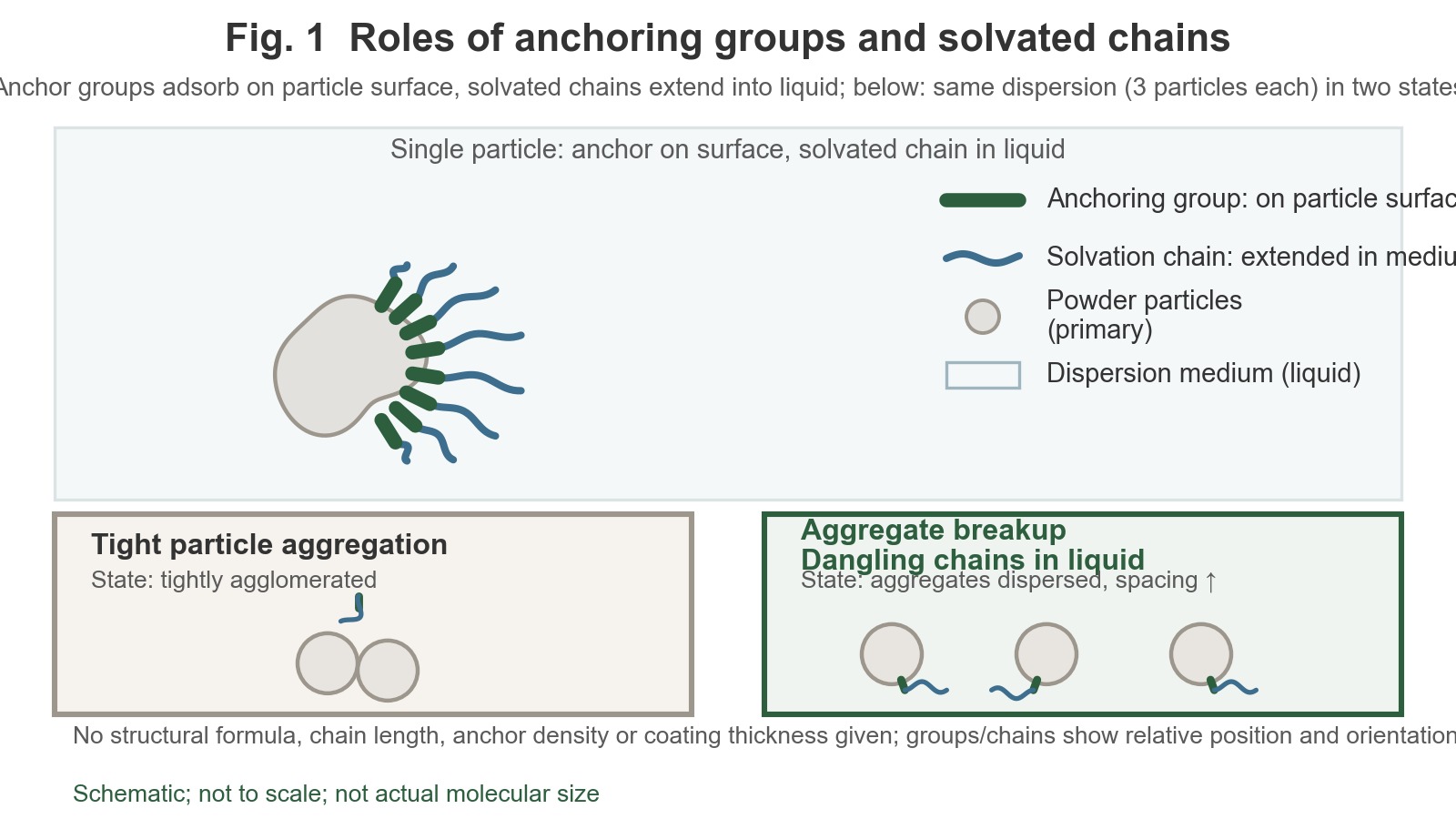
When titanium dioxide (TiO₂) is treated with R1800-SK hyperdispersant, the brightness of the masterbatch is 88.89 at a dosage of 0.5%. At 1.6%, the brightness rises to 90.18, the highest point on the entire curve; adding another 0.2 percentage points to 1.8% causes the brightness to fall back to 88.26, and at 2.0% it decreases further to 87.83 (data source: product manual).
When more dispersant is added, the colour becomes worse. The most common on-site explanation is weighing error; this statement is general industry knowledge, and the source text does not record any on-site troubleshooting investigation, so it is not a conclusion of Californium Curium's materials. The same data set also states another point: as the R1800-SK content increases, "the number of anchoring groups adsorbed onto the pigment surface continues to increase, reaching saturation at 1.6%, at which point the optical density is the highest" (data source: product manual). In other words, the optimum is not reached by adding "enough", but by "just filling the surface". Beyond this threshold, additional molecules begin to perform another function: "the interaction between R1800-SK hyperdispersant molecules produces bridging flocculation: pigment particles flocculate through entanglement of the solvating chains of the hyperdispersant, causing the optical density to decrease instead" (data source: product manual).
The technical question that therefore needs to be answered is not "how much should be added", but: on the same molecule, which part anchors the molecule to the powder and which part transfers it to the medium; under what conditions do these two parts reach their respective limits, and which part fails first when the dosage is excessive?
Californium Curium's source text is highly specific on this point, to the extent that it can be compared sentence by sentence. The only aspects supported by the source text are the wording of these statements themselves: the number of replicates, the standard deviation, and the confidence interval of the differences for these two sets of experiments are not provided in the source text (see Section 7 and the specifications in Figure 4).
Anchoring the Two Functions to the Manual's Original Wording
The most relevant sentence in the product manual presents the division of labour between the two components within a single sentence:
"The mechanism of action during the dispersion of pigments and powders is: the anchoring group of R1800-S hyperdispersant is strongly adsorbed onto the surface of pigments and powders, while the solvating chain dissolves rapidly in the dispersion medium and has good compatibility with the dispersion medium. Therefore, R1800-S hyperdispersant can substantially reduce the interfacial tension between pigment and powder particles and the dispersion medium, enabling pigments and powders to be rapidly wetted by the medium during dispersion."
Two verbs in this sentence warrant close attention: strong adsorption and rapid dissolution. One keeps the molecule on the powder; the other transfers the molecule to the medium. The manual's causal explanation ends here: only when the latter occurs is the powder wetted by the medium; only when the former occurs are the molecules washed away by the medium—the second half of this statement is this article's interpretation of the two verbs, not the original wording of the manual. A single molecule must play both roles simultaneously, and these two roles have opposite requirements for external conditions. The source text juxtaposes this structure with the observation that "adding too much dispersant is detrimental", but provides neither a derivation nor validation data connecting the two.
The itemized division of labour at the molecular level is described more fully in the R1800-SK section (data source: product manual):
"The molecular structure of R1800-SK hyperdispersant is mainly divided into two parts. One part is the anchoring group-COOH. These polar groups tightly adsorb onto the pigment surface through interactions such as ionic bonds, hydrogen bonds, and van der Waals forces, thereby preventing the dissociation of R1800-SK hyperdispersant. The other part is the solvating chain (dispersion), which directly determines the stability of the dispersed pigment in the solvent. At temperatures below 70℃, the coating layer does not dissolve; above 70℃, it begins to dissolve and convert into an ionic coupling agent, thereby improving the compatibility between titanium dioxide and the resin. For this reason, the solvating chain is required to have a high affinity for the dispersant to ensure good solvation."
The following 3-line breakdown is more useful:
The corresponding wording in the R1800-SH section is verbatim identical, with only 2 differences: the model name and the powder name (titanium dioxide ↔ carbon black), and the phase-transition boundary changes from 70℃ to 80℃ (data source: product manual). The source text does not provide the measurement method or criteria used to determine this boundary temperature for either model; the 80℃ recorded for SH is inconsistent with the "greater than 70℃" statement in the process conclusion in Section 5 within the source text itself (the original wording is reproduced below).
Note on verbatim terminology: The manual uses at least 4 different expressions for the same concept; this article reproduces all of them without modification—"solvating chain" and "dissolving chain" coexist, as do "anchoring group" and "anchoring group" without the final "group" character in the SK charge-matching passage. The occurrence of "dissolving chain" is not a typographical error in this article. The source text does not provide a glossary or definition clause, and it provides no basis for determining whether the editor treats the 4 expressions as synonymous.
How the Division of Labour Applies to Practical Grade Selection
Moved from the bodyOperation steps (original text, as is)
- Mesh is not the only variable. At 800 mesh, calcium carbonate is 0.2% < kaolin 0.3% < talc 0.32%. For calcium carbonate, different fineness levels also require different dosages. Therefore, "using the table by mesh" can only provide a starting point.
- The slopes differ substantially. From 800 mesh to 3000 mesh, calcium carbonate increases from 0.2% to 0.5%, kaolin from 0.3% to 0.8%, and talc from 0.32% to 1%. The manual's original wording for this comparison is "talc has the largest slope (0.32%→1%, approximately 3.1 times)." The finer the powder, the more steeply the dosage increases according to the criterion. The statement that "the finer the powder, the steeper the increase" applies only to the 4 mesh levels and these 3 powder types in the table; the source text provides no continuous evidence beyond mesh.
- The denominator is not stated in the manual. It is not stated whether the percentages in this table are relative to the powder or to the final plastic product. Another entry for the same model states "0.5%-1% of the final plastic product" (data source: product manual), indicating 2 different bases; these must not be used interchangeably. The source text provides no basis for determining whether the 3 inorganic powder rows and the pigment row use the same denominator.
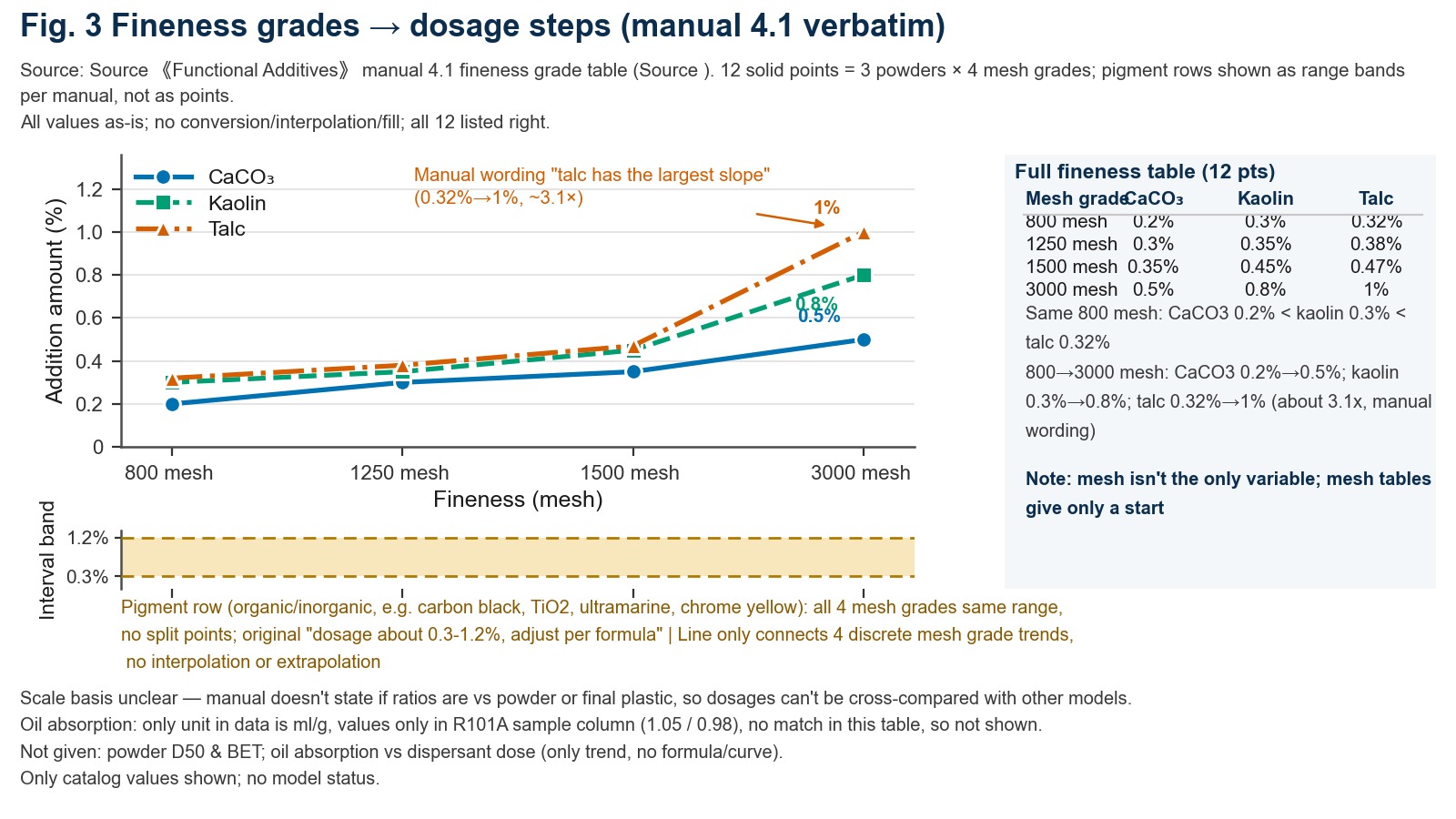
Once the division of labour is clear, the question for grade selection changes. It is no longer "which model is stronger", but "will each of these 2 components reach its limit in your system". This interpretation is proposed in this article and is not the manual's grade-selection method: the manual does not provide a procedure for evaluating models according to these 2 components (see line 8 in Section 7).
Anchoring side: what provides the attachment
The anchoring mechanism given in the manual consists of 3 forces presented in parallel (data source: product manual): ionic bonds, hydrogen bonds, and van der Waals forces. However, the statement relating to charge matching is the one that can be applied directly to grade selection (data source: product manual):
"In the TiO₂ paste, the particle surface is enriched with charge, which readily combines with the anchoring group (-COOH) of R1800-SK hyperdispersant, forming a robust protective layer on the titanium dioxide particle surface. Through the steric barrier effect of the solvating chain of R1800-SK hyperdispersant, a stable dispersion of titanium dioxide is achieved."
The carbon black passage is verbatim identical (data source: product manual). Please note that the terms used in Californium Curium's source text are "steric barrier effect", "spatial obstacle", and "repulsive effect of the adsorbed layer", rather than "steric hindrance"—the latter is a general term in the dispersant field, but it is not used anywhere in the R1800 section of Californium Curium's source text (see the terminology notes in Section 7). The source text does not explain the differences among these 3 expressions, nor does it identify which test each expression corresponds to. It also provides no basis for determining whether the 3 expressions describe the same mechanism.
Implications for grade selection: The manual only states that the anchoring group of the 3 R1800 models is -COOH, and it provides a charge-matching statement only for the 2 powder classes, titanium dioxide and carbon black. The source text does not provide surface-electrical descriptions for other powders (Zeta potential, isoelectric point, etc.). Therefore, in Californium Curium's source text, there are only 2 clear answers to the question "can this powder be anchored by -COOH": titanium dioxide and carbon black.
Solvation side: how the molecule is handed over
The separate descriptions of R1800-SK and R1800-SH both focus on the same sentence: "this part directly determines the stability of the dispersed pigment in the solvent". However, the 2 models are not equivalent on this side. The manual clearly states the difference in its model overview (data source: product manual):
"R1800-SK hyperdispersant incorporates ester functional groups on the basis of R1800-S, improving the yellowing resistance and weather resistance of R1800-SK in plastic products... R1800-SH incorporates silicon-based products on the basis of R1800-S, improving the dispersing performance of R1800-SH in carbon black."
The difference between the 3 models lies not in the anchoring group, but in the category of functional group introduced: SK contains ester groups, whereas SH contains silicon-based products. Their common base is "a poly(polyether) polyol produced by high-temperature, high-pressure copolymerisation". Accordingly, the line of assigning SK to white masterbatch and SH to black masterbatch is based in Californium Curium's source text on "ester-/silicon-based products + application scenario", rather than on generalisations such as "white = inorganic, black = organic"; the latter are not stated in the source text. This distinction appears in the source text in the model overview and list of target materials. The source text does not provide comparative test data for the 2 models in white masterbatch or black masterbatch: all SK test data derive from titanium dioxide, and all SH test data derive from carbon black. No source data are provided for the performance of either model in the other model type of powder.
Anti-reagglomeration side: what pushes the 2 particles apart when they approach
The manual gives 3 expressions whose meanings progress logically (data source: product manual):
- General principle
- "When pigment and powder particles adsorbed with hyperdispersant approach one another, the spatial obstacle of the protective layer (coating) makes it difficult for pigment and powder particles to form tightly packed agglomerates or flocs" (data source: product manual)
- SK/SH-specific
- "R1800-SK hyperdispersant forms a coating layer of a certain thickness on the pigment particle surface, and the solvating chains are relatively extended in the dispersant. When pigment particles adsorbed with R1800-SK hyperdispersant approach one another, the repulsive effect of the adsorbed layer causes the particles to rebound away from each other" (data source: product manual)
- Earlier in the adsorption process: adsorption occurs during the formation of primary particles, "filling the lattice defects of pigment and powder particles and passivating active sites on the pigment and powder surfaces that readily promote aggregation", and "owing to the isolating effect of R1800-S hyperdispersant, the aggregated state of pigment and powder particles is also relatively loose (particles mainly contact one another at points and edges)" (data source: product manual)
The final half of this statement contains the engineering implication most easily overlooked in this section: even if a powder has already agglomerated during pressure filtration and drying, it remains "particularly easy to disperse" because point and edge contact is maintained (this is a statement by the manual, not an inference of this article). This represents the division of labour between powder treatment before shipment and subsequent dispersion, rather than processes completed within the same step. The source text does not provide specific process parameters for pressure filtration or drying, nor does it provide a quantitative relationship between "point and edge contact" and dispersion performance.
A frequently cited statement requires separate clarification
The statement that "similar properties result in compatibility" cannot be found in its original form in Californium Curium's source text. It is general industry knowledge—an empirical statement commonly used in the dispersant field, referring to the greater ease with which a solvent and a resin (or dispersion medium) wet one another when their properties are similar. It can be used to explain the original manual statement in §1.2 that there is "good compatibility with the dispersion medium", but it must not be cited as a statement from Californium Curium's source text.
What Californium Curium's source text provides is a different statement—a monotonic dosage relationship, rather than a law stating that compatibility is determined by similarity in properties (data source: product manual):
"Most pigments are powders. The amount of dispersant added varies depending on the type, fineness, and oil absorption value of the pigment. Generally, the finer the powder, the higher its oil absorption value and specific surface area, and the higher the amount of dispersant that must be added. Therefore, different models of dispersant should be selected according to production cost and product requirements..."
Californium Curium's source text states that the dosage follows the physical properties; it does not state that compatibility is determined by the degree of property similarity. The criteria in Section ④ below are all based on this statement. The statement itself is directional: the source text does not provide a quantitative relationship between oil absorption value, fineness, and dosage (no formula or curve; see line 9 in Section 7), nor does it indicate the powder class in which this statement has been verified.
Semi-Empirical Criteria: How Dosage Follows Powder Properties
Numerical matrix heatmap (unit unified %)
Dimension · %Each cell = one value (unit %); darker color = larger value; rows can be directly compared across columns.
- 800 mesh
- 1250 mesh
- 1500 mesh
- 3000 mesh
- Calcium carbon…
- Organic/inorg…
- Relative size within same table (unit unified %) · Color depth does not represent cross-table comparability
- Calcium carbonate0.2–0.5 %
- Talc0.32–1 %
- Kaolin0.3–0.8 %
- Organic/inorganic …0.75–0.75 %
Chart data (source text verbatim)
| Row | 800 mesh | 1250 mesh | 1500 mesh | 3000 mesh |
|---|---|---|---|---|
| Calcium carbonate | 0.2 % | 0.3 % | 0.35 % | 0.5 % |
| Talc | 0.32 % | 0.38 % | 0.47 % | 1 % |
| Kaolin | 0.3 % | 0.35 % | 0.45 % | 0.8 % |
| Organic/inorganic pigments (e.g., carbon black, titanium dioxide, ultramarine, chrome yellow, etc. | 0.75 % | 0.75 % | 0.75 % | 0.75 % |
Source textScale 0.2–1 %

The criterion itself consists of only 1 sentence (data source: product manual), but Californium Curium's source text provides 3 mutually independent expressions describing the same determining factor:
- "Determine the dosage according to the oil absorption value and particle size of the different powders. The following table may be used as a reference:" (data source: product manual)
- "The specific dosage should be added appropriately with reference to the oil absorption value and fineness of the powder" (data source: product manual)
- "The amount added is determined primarily according to the oil absorption value and fineness of the pigment" (data source: product manual)
- "The recommended dosage should be added appropriately at 0.2-1.5% based on the total powder weight and fineness" (data source: product manual)
Although the 4 expressions differ, they share the same point: dosage is determined by the physical properties of the powder, not by the total formulation. These 4 statements are printed in 4 different chapters and relate to 4 different product contexts. The source text does not state whether they apply to the same formulation conditions; reading them together as a single criterion is an approach taken by this article, and the source text provides no basis for this combined reading.
4.1 Fineness Classification Table (Verbatim Reproduction)
| Product | 800 mesh | 1250 mesh | 1500 mesh | 3000 mesh |
|---|---|---|---|---|
| Calcium carbonate | 0.2% | 0.3% | 0.35% | 0.5% |
| Talc | 0.32% | 0.38% | 0.47% | 1% |
| Kaolin | 0.3% | 0.35% | 0.45% | 0.8% |
| Organic/inorganic pigments (e.g., carbon black, titanium dioxide, ultramarine, chrome yellow, etc.) | Range 0.3-1.2% | Range 0.3-1.2% | Range 0.3-1.2% | Range 0.3-1.2% |
The original wording in the pigment row is "the dosage is approximately 0.3-1.2%, adjusted according to the actual formulation"—this is a range, not a single value.
This table provides 3 observations:
This table has already appeared in the first 2 technical articles on the Californium Curium official website (2026-09-25 and 2026-10-01, one article each), with no changes to either the scope or the values. This article uses it as evidence for the criteria—the anchoring/solvation division of labour in Section 2 provides the molecular-level explanation for "why different dosages should be specified according to fineness".
4.2 The Other End of the Criteria: Excess Is a Physical Event, Not a Weighing Error
The manual provides a definite mechanism for exceeding the applicable range (data source: product manual):
"The interaction between R1800-SK hyperdispersant molecules produces bridging flocculation: pigment particles flocculate through entanglement of the solvating chains of the hyperdispersant, causing the optical density to decrease instead."
The corresponding R1800-SH passage is structurally identical, with only the model name differing.
This statement clarifies what happens when the dosage is excessive: it is not a vague claim such as "the powder cannot accommodate this much dispersant", but the mutual entanglement of solvating chains and bridging that reconnect the particles. The original text attributes the entanglement to the solvating chains, but the assertion that "which molecular section is depleted first and fails first" is an inference of this article based on the quoted wording; the source text does not provide data distinguishing failure by component. Interpreting the peak point as "just filling the surface" is likewise an interpretation rather than a measured result.
4.3 Unit Basis for Oil Absorption Value
The only unit used for oil absorption value in Californium Curium's source text is ml/g, and the values appear in the 2-sample comparison columns for R101A general-purpose polyol-modified silicone coating agent: Sample 1 1.05, Sample 2 0.98 (data source: product manual). The product features for the same grade state "reduces oil absorption" (data source: product manual).
The point that needs to be clarified is: the oil absorption value basis of "sodium oleate g/100g" does not appear anywhere in Californium Curium's source text—the source text never mentions "sodium oleate". If a different basis is used on site or by a customer, it belongs to a different test method and cannot be converted directly into, or compared side by side with, values in ml/g.
The same applies to specific surface area: the manual provides only the direction (the finer the powder, the greater the specific surface area), but no specific m²/g values in the context of hyperdispersants. The m²/g values appearing in the source text relate to flame retardant/coupling agent contexts (data source: product manual) and are unrelated to dispersant selection. Likewise, the source text does not provide a list of the oil absorption value test methods, other than the ml/g basis, that are excluded from Californium Curium's source text.
Two Complete Experimental Data Series
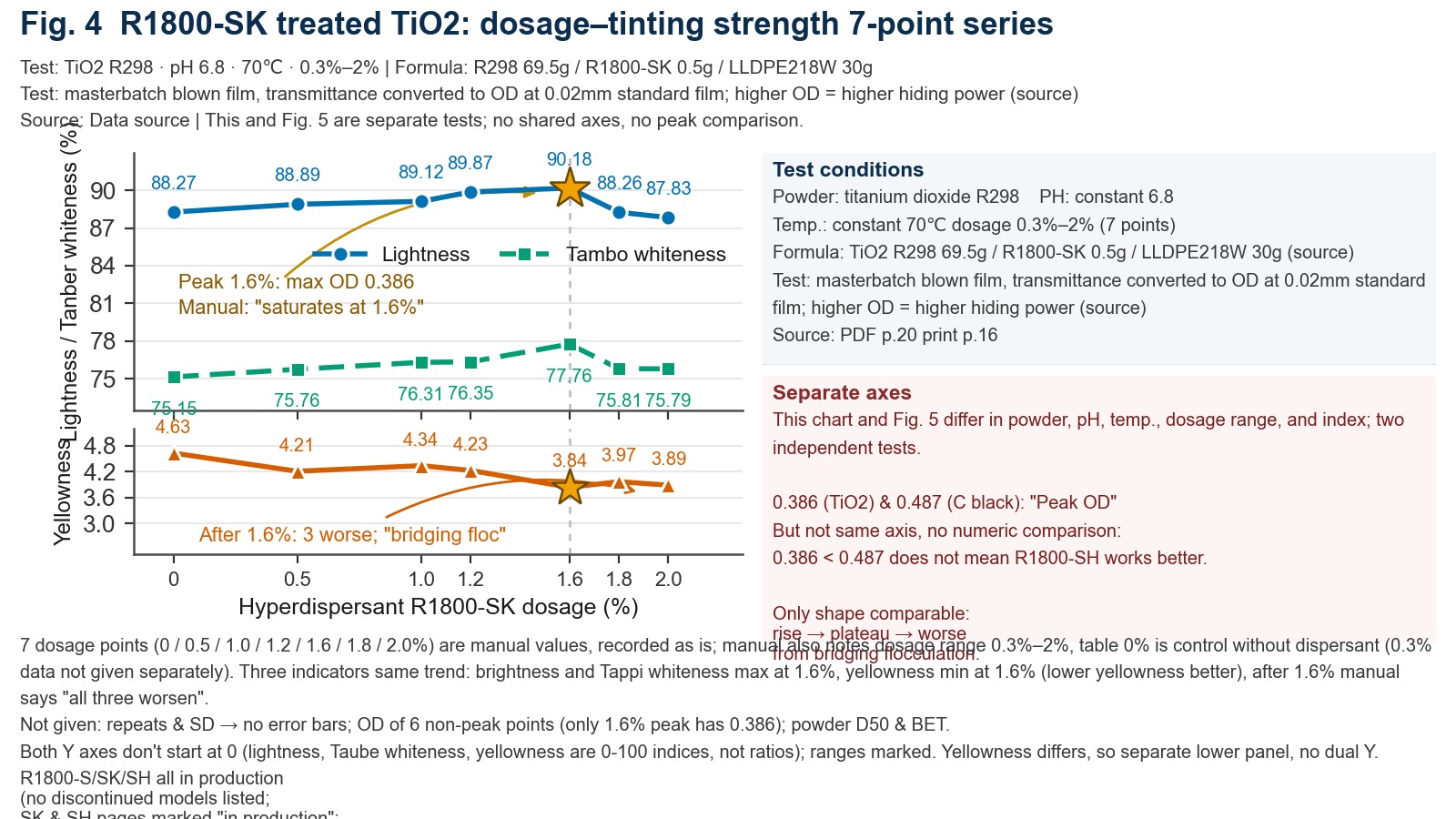
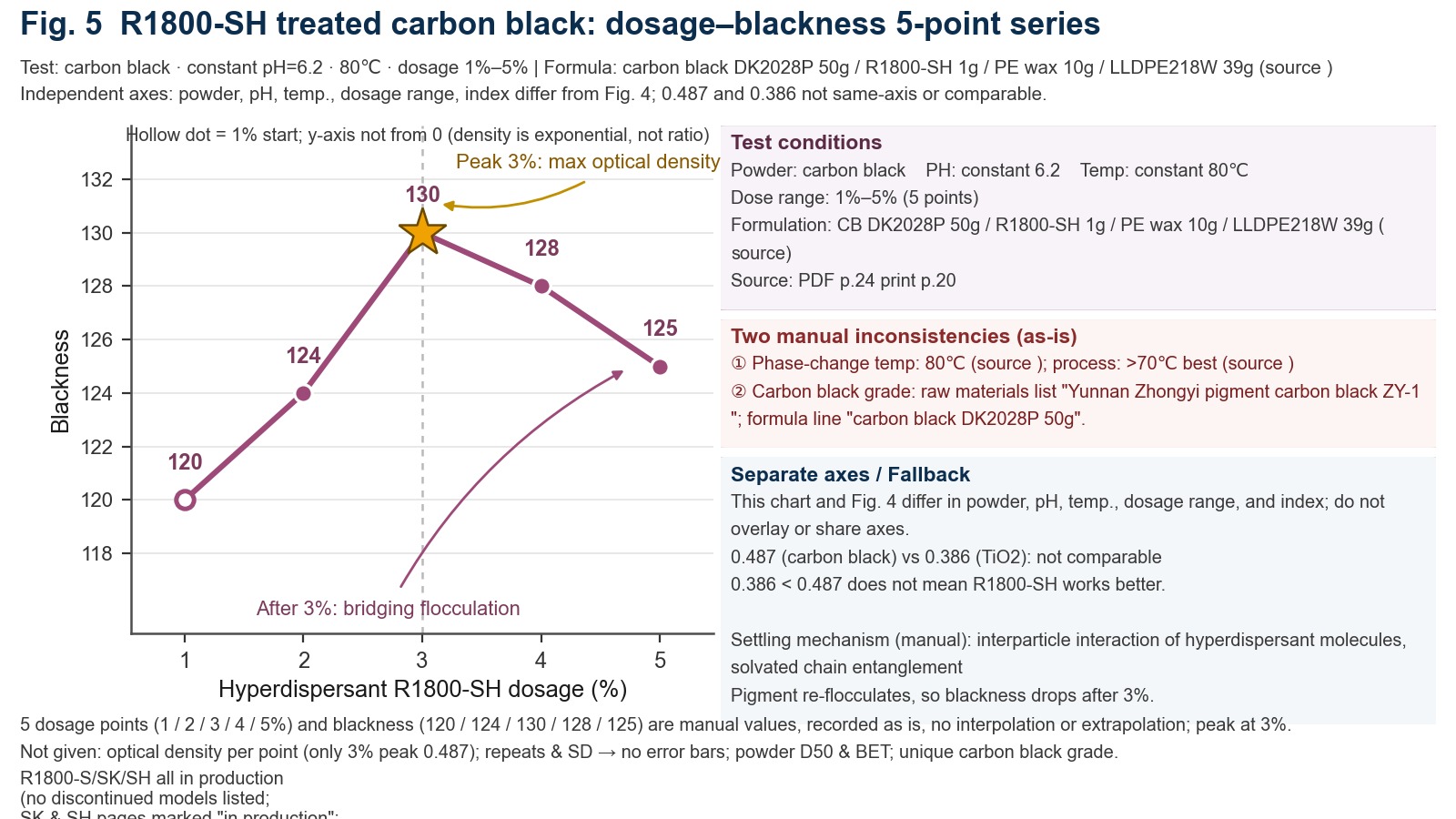
These are the only 2 complete measured data series in Californium Curium's source text in which dosage and performance are matched point by point. The 2 sets operate under different conditions and can only be interpreted separately. They must not be compared on the same axes, used to calculate an intersection, or used to place the 2 peak values side by side for comparison.
5.1 Treatment of Titanium Dioxide (TiO₂) with R1800-SK (7 Dosage Points)
Conditions: Constant pH=6.8 and 70℃; dosage range 0.3%–2% Formulation: Titanium dioxide (TiO₂) R298 69.5g / R1800-SK 0.5g / LLDPE218W 30g (data source: product manual) Test method (data source: product manual): "A masterbatch was prepared using titanium dioxide (TiO₂) pretreated with different hyperdispersant concentrations, followed by film blowing. The film transmittance was measured and converted into an optical density value at a standard film thickness of 0.02mm (hereinafter referred to as optical density). The higher the optical density, the greater the hiding power." Data (data source: product manual):
| Hyperdispersant dosage % | Lightness | Tappi whiteness | Yellow index |
|---|---|---|---|
| 0 | 88.27 | 75.15 | 4.63 |
| 0.5 | 88.89 | 75.76 | 4.21 |
| 1.0 | 89.12 | 76.31 | 4.34 |
| 1.2 | 89.87 | 76.35 | 4.23 |
| 1.6 | 90.18 | 77.76 | 3.84 |
| 1.8 | 88.26 | 75.81 | 3.97 |
| 2.0 | 87.83 | 75.79 | 3.89 |
Peak: "When the hyperdispersant dosage is 1.6%, the film reaches its maximum optical density of 0.386." Conclusion (data source: product manual): "(2) The best titanium dioxide (TiO₂) treatment performance is achieved at an R1800-SK hyperdispersant dosage of 1.6%. (3) The best surface-treatment performance is achieved at 70℃."
All 3 indicators change in the same direction: lightness and Tappi whiteness reach their maximum values at 1.6%, while the yellow index reaches its minimum value at 1.6%. Above 1.6%, all 3 deteriorate.
5.2 Treatment of Carbon Black with R1800-SH (5 Dosage Points)
Conditions: Constant pH=6.2 and 80℃; dosage range 1%–5% Formulation: Carbon black DK2028P 50g / R1800-SH 1g / polyethylene wax 10g / LLDPE218W 39g (data source: product manual) Data (data source: product manual):
Peak: "When the hyperdispersant dosage is 3%, the film reaches its maximum optical density of 0.487." Conclusion: "The best carbon black treatment performance is achieved at an R1800-SH hyperdispersant dosage of 3%. The best surface-treatment performance is achieved at temperatures above 70℃."
⚠ 2 internal inconsistencies in the manual are transcribed as written and have not been altered:
- Phase-transition temperature: The molecular structure section for R1800-SH (data source: product manual) gives a phase-transition boundary of 80℃, whereas the conclusion in this section states that "the best surface-treatment performance is achieved at temperatures above 70℃." The 2 figures differ.
- Carbon black grade: The experimental raw-material list specifies "pigment carbon black ZY-1 produced by Yunnan Zhongyi", whereas the formulation line specifies "carbon black DK2028P 50g".
5.3 Why 0.386 and 0.487 Cannot Be Compared Directly
Both values are described as "optical density peak values", but the powders differ (titanium dioxide (TiO₂) vs carbon black), as do the pH values (6.8 vs 6.2), temperatures (70℃ vs 80℃), dosage ranges (0.3%–2% vs 1%–5%), and resin-to-wax ratios in the formulations. The indicators measured also differ (SK: lightness/Tappi whiteness/yellow index; SH: blackness).
Therefore, 0.386 < 0.487 does not indicate that R1800-SH provides better performance, and the 2 curves must not be plotted on the same coordinate system. The only common feature that can be stated is that both data series rise monotonically, reach saturation at a certain point, and subsequently decline due to bridging flocculation.
Selection by Powder
The target materials and dosages in the table below are taken item by item from the material lists and dosage columns in Californium Curium's source text. Each cell specifies its manual reference; the dosage denominator differs by row, and cross-row conversion or application is not permitted.
| Dispersant | Target materials specified in the source text | Dosage (source text) | Denominator | Reference |
|---|---|---|---|---|
| R1800-S (in production) | Colour masterbatch, textile coatings, powder coatings, solvent-based coatings; solvent-based inks; filler systems | 0.5%—1% of the final plastic product | Final plastic product | Model entry in the product manual |
| R1800-SK | White masterbatches for plastics and rubber, metal powder colour masterbatch, powder coatings, solvent-based coatings, titanium dioxide (TiO₂) surface treatment | 0.5%—1% of the final plastic product | Final plastic product | Model entry in the product manual |
| R1800-SH | Black masterbatch, wet granulation of carbon black, dry granulation of carbon black | 0.5%—1% of the final plastic product | Final plastic product | Model entry in the product manual |
| R1848 (discontinued) | Aluminium silver powder / aluminium powder encapsulation; powders with high dust generation | 8%-10% for aluminium powder encapsulation; 5%-8% for brightener encapsulation | Not specified in the source text | Model entry in the product manual |
| R900 (discontinued) | Filler masterbatches based on calcium carbonate, talc, and kaolin; titanium dioxide (TiO₂), lithopone, heavy calcium carbonate, and light calcium carbonate | 0.2-1.5%, based on the total powder weight and appropriate fineness | Total powder weight | Model entry in the product manual |
| R101A | Crude rutile titanium dioxide (TiO₂), carbon black, calcium carbonate, talc, lithopone, barium sulphate, and sodium sulphate | 0.1-3% | Based on powder weight | Model entry in the product manual |
| R6100 (discontinued) | Calcium carbonate, talc, barium sulphate, sodium sulphate, copper sulphate, ferric sulphate, and silicon dioxide | 7 dosage levels: calcium carbonate 1-3% / talc 3-5% / barium sulphate 2-4% / sodium sulphate 1-3% / copper sulphate 3-5% / ferric sulphate 3-5% / silicon dioxide 30-50% | Not specified in the source text | Model entry in the product manual |
| R100 | Calcium carbonate, talc, barium sulphate, and sodium sulphate × PE/PP/PVC | 0.5% - 3% of the inorganic filler mass | Inorganic filler mass | Model entry in the product manual |
| R1618 | Conductive carbon black for plastics | 0.5%—2% of the final plastic product | Final plastic product | Model entry in the product manual |
| PT50 | High-gloss automotive interior plastics and electronic enclosures | 0.5-8% of the final plastic product | Final plastic product | Model entry in the product manual |
| RPEG20 (discontinued) | A high-dispersibility coating agent for titanium dioxide (TiO₂), produced from R1800-SK and a polyoxyethylene-polyoxypropylene ether-modified polysiloxane nonionic surfactant at 420℃ and 6.4MPa | The source text does not provide a dosage for this model | — | Model entry in the product manual |
The following 3 points must be considered together:
- Multiple options are available; the correspondence is not exclusive. Calcium carbonate, talc, barium sulphate, and sodium sulphate appear in all 4 product lines: R6100, R100, R900, and R1800-S. The source text provides target-material coverage relationships, not a statement that "this powder can only be used with this model".
- The 7 dosage levels for R6100 span from 1% to 50%. The silicon dioxide level (30-50%) is one order of magnitude higher than the other 6 levels. This is direct evidence that "the suitability of the same coupling-type product for different inorganic materials varies substantially". The source text does not provide measured data for these 7 dosage levels or specify the applicable-condition boundaries for each level.
- The source text does not provide a model-selection decision rule. Apart from the statement in Section 3.1 that "different models should be selected according to production cost and product requirements" (data source: product manual), the manual does not provide a decision process from powder to model. The table above should therefore be read only as a "target-material coverage map" and must not be used as a recommendation heatmap.
An adjacent source can also illustrate how different models are derived from the same molecular product line: RPEG20 is "produced at 420℃ and 6.4MPa in a steel-lined tetrafluor reactor using a nanocatalyst comprising R1800-SK produced by our company and a polyoxyethylene-polyoxypropylene ether-modified polysiloxane nonionic surfactant" (data source: product manual). It further states that "the difference in performance between RPEG20 and the R1800 series is that RPEG20 has substantially better weather resistance and oxidation resistance than the R1800 series. However, its external and internal lubrication performance is weaker than that of the R1800 series" (data source: product manual).
⚠ Critical scope boundary: RPEG20 is derived from R1800-SK, but the value "HLB value: 10-12" applies to RPEG20, not to the R1800 series, and must not be transferred (data source: product manual). Likewise, the list of anchoring groups "-COOH, -NH₂, -SOH" comes from the PT50 section (data source: product manual). Only -COOH is specified for the 3 R1800 models, and the two must not be used interchangeably.
Not Provided in the Source Text
None of the following items can be found in Californium Curium's source text, and no assumptions have been made to fill the gaps:
| # | Item | Measured result | |
|---|---|---|---|
| 1 | "Sodium oleate g/100g" oil absorption value basis | "Sodium oleate" is not found anywhere in the source text. The only oil absorption value unit used is ml/g (data source: product manual) | |
| 2 | Powder D50 / particle size distribution values for dispersant selection | No data are provided in the dispersant section. There are only 2 occurrences of D50 in the source text, both relating to other products: "Particle size distribution (D50, μm) 8~12" relates to the adhesion promoter R1880 (discontinued) for powder coatings (data source: product manual); the other occurrence is a false-positive match for LD50 relating to the light-fatigue-resistant agent S38 (discontinued) for photochromic pigments. The source text describes the quantitative method for dispersibility only as "the method is to measure particle size distribution" (data source: product manual), without providing data | |
| 3 | Specific powder specific surface area values | None are provided in the hyperdispersant section. The m²/g values in the source text relate to flame retardant/coupling agent contexts (data source: product manual) and must not be transferred | |
| 4 | Molecular structural formula, specific chemical structures of anchoring groups, chain length, and hydrophile-lipophile balance | Not provided. Only 1 component name, "polyalkylene ether", and 1 functional group, -COOH, are given. The source text does contain 1 HLB value (10-12), but it applies to RPEG20 (discontinued), not the R1800 series | |
| 5 | Coating-layer thickness, anchoring-site density, and measured interfacial tension | Not provided. Only the qualitative statement referring to "a protective layer (encapsulation) of a certain thickness" is provided | |
| 6 | The statement itself that "similar physical properties imply compatibility" | This statement is not found in the source text. The source text provides a monotonic dosage relationship (data source: product manual) | |
| 7 | Use of "steric hindrance" in relation to R1800 | The term is not found in the R1800 section. In the source text, it relates to 3 other models: E099 (high-temperature resistance), D³-A (water-based conductive carbon black), and R780 (water-based dye). The terms used for R1800 itself are "steric obstruction", "steric barrier effect", "repulsive effect of the adsorption layer", and "encapsulation" | |
| 8 | Model-selection decision rules / criteria for model selection | Only a target-material list and 1 qualitative statement, "according to production cost and product requirements", are provided; no rules are given | |
| 9 | Quantitative functional relationship between oil absorption value and dispersant dosage | Not provided. The source text provides only the direction of change (the finer the powder, the greater the dosage) and 1 mesh-size classification table; no formula or curve is provided | |
| 10 | Quantitative surface charge characteristics of powders for each model (Zeta potential, pH, and isoelectric point) | Not provided. Only the qualitative statement that "the particle surfaces are enriched with charge" is given | |
| 11 | Correspondence between the R1800-SK overview value (0.5%—1%) and the experimental optimum (1.6%) | No correspondence is identified between the target materials and evaluation criteria in the 2 locations | |
| 12 | Phase-transition temperature of R1800-SH | The source text is inconsistent: the molecular structure section states 80℃ (data source: product manual), whereas the process conclusion section states "above 70℃" (data source: product manual) | |
| 13 | Carbon black grade used in the R1800-SH experiment | The source text is inconsistent: the experimental raw-material list gives ZY-1, whereas the formulation line gives DK2028P | |
| 14 | "70℃ ethanol 2%" in the R1800-SK dispersibility comparison | The source text states this, and the wording is relatively brief | |
| 15 | Dosage denominators for R1848 / R6100 | Not specified | |
| 16 | Production status of the 3 R1800 models (S / SK / SH) | All 3 models are in production: None of the R1800-S / SK / SH models is included in the discontinued model list on Californium Curium's official website; the header of the official website detail pages for both R1800-SK and R1800-SH is marked "in production". Mr. Tang explicitly confirmed the status of R1800-S on 2026-10-04: production will not be discontinued | Pass |
| 17 | Prohibited applications / MSDS-level safety data for R1848 / R6100 / R900 | Not recorded in the source text |
Caution on similar model numbers: R18 and the R1800 series have similar numbers but are entirely unrelated. R18 is a toughening and low-temperature-resistance agent for PET/PETG (delaying crystallization and improving toughness). It is unrelated to hyperdispersants and the anchoring/solvation mechanism, and is not used in this article.
Illustration List (Text Descriptions; Images Not Yet Generated)
The following are proposed specifications for the illustrations. The images have not yet been generated. ⚠ Illustration layout note (existing behavior of the official website content parser): if a body paragraph contains a 20–120-character quotation enclosed in “...”, it is converted into a block quotation, and any subsequent images are discarded; images placed on standalone lines are also ignored. When inserting illustrations, each image line must be placed at the end of a “normal body paragraph containing no long quotation”, and the layout must be reviewed separately in all 10 languages. This article contains many body paragraphs with long quotations, particularly in Sections 2, 4, and 5; the placement of each illustration must therefore be confirmed individually.
ionic bonds, hydrogen bonds and van der Waals forces
reduces interfacial tension
-COOH, firm adsorption / tightly adsorbed onto the pigment surface / prevents the desorption of…, forms a firm protective layer; right column “Sovation Chain”, 3 lines = solvation chain (hydrocarbon chain), rapidly dissolves in the dispersion medium / has good compatibility with the dispersion medium / extends comparatively fully, directly determines the stability of the dispersed pigment in the solvent; mark 1 temperature at the bottom of each column (SK 70℃ / SH 80℃) — Recommended chart type: a 2-column comparison card with equal numbers of rows; the numbers of rows and their visual weight must be strictly symmetrical between the 2 columns; do not assign the solvation chain any individual function not stated in the manual (“reduces interfacial tension” appears in the conclusion applying to both and is not an independent function of the solvation chain); use the original manual wording for all text without paraphrasingadjust according to the actual formulation
maximum optical density 0.386
maximum optical density 0.487
the source text does not specify [the denominator]
Data and Basis
The models, parameters, experimental data, and original manual sentences discussed in this article are all sourced from Californium Curium – Functional Additives Manual. All items not provided in that source—including the number of experimental replicates and standard deviations, dosage denominators, grade-selection decision rules, molecular structure and chain length, anchoring-point density, etc.—have been individually identified in the article as not provided in the source text; no inferences or supplementary values have been made here.
Discontinued models are quoted as they appear in historical source text and do not represent current availability for sale.
Article actions
If this piece was useful, you can leave a mark — the like count comes from our back office at admin.kj9896.com; when the endpoint is unreachable the buttons are disabled and the count shows “—”. No invented figures are ever filled in.
Link: https://kj9896.com/en/news/dispersant-anchoring-vs-solvation
Related reading
- 01How to Determine Hyperdispersant Dosage: Check the Table by Powder Fineness and Select the Model by Equipment25 September 2026
- 02Same “0.5–2%,” Two Denominators in Manuals: Why Conductive Carbon Black Additive Dosages Cannot Be Directly Converted11 October 2026
- 03Melt Viscosity Goes Up: Which Figures Can Be Compared, and Which Are Not Stated in the Documentation4 October 2026
Products mentioned in this article
- R1800-SKR1800-SK Hyperdispersant R1800-SK
- R1800-SHR1800-SH Hyperdispersant R1800-SH
- R1800-SR1800-S Hyperdispersant R1800-S
- R900R900 Hyperdispersant R900
- E099E099 Hyperdispersant E099
- R1618R1618 Conductive Carbon Black Dispersant R1618
- D3-AD3-A Aqueous Conductive Dispersant D3-A
- R780R780 Dye Hyperdispersant R780
- PT50PT50 Mirror-Finish Dispersant PT50
- R101AR101A Inorganic Powder Coating R101A
Keep reading
More company announcements and product updates are in the newsroom.