
Multi-polyol silicone coating agentNew rutile titanium dioxide and colour masterbatch coating solution · SILICONE COATING
Combines the high heat resistance and weatherability of inorganic materials with the excellent wetting compatibility of organic materials — engineered for the organic modification of titanium dioxide, carbon black and inorganic/organic powders; it forms a complete, flexible and lubricious silicone film.
- ✨ Complete flexible silicone film
- 🔥 Heat resistant >300℃ · no yellowing or blackening
- 🎨 Tinting strength·whiteness·gloss ↑ · oil absorption ↓
- 🛡 Anti-caking · anti-flocculation · anti-agglomeration
- Non-volatile matter
- 0 %
- Specific gravity
- 0 g/mL
- pH value
- 0 – 0
- Diluent
- Water
Molecular structure · the flexible-chain theatre
Si-O-Si has a wide bond angle and Si-O-OH a long bond length → the bonds rotate very easily. Switch to compare with the rigid C-O backbone.
Protection by Si atoms
The methyl groups on the Si atoms shield the high-energy polysiloxane backbone.
Non-polar C-Si-Na bonds
C-Si-Na bonds are non-polar, so the intermolecular forces are extremely weak — the source of low surface tension and a low viscosity coefficient.
Si-O-OH bonds rotate very easily
The long Si-O-OH bond and the wide Si-O-Si angle make rotation very easy — which is why R101A offers excellent lubricity, flow, weatherability and acid resistance.
75% ionic bond character
The Si-O-OH bond has 75% ionic bond character (covalent bonds are directional, ionic bonds are not), and its bond energy far exceeds that of the C-O bond — excellent affinity for inorganic materials and very good heat resistance and weatherability.
Inorganic × organic dual performance
It combines the properties of inorganic and organic materials: low surface tension, small viscosity coefficient, high and low temperature resistance, oxidation resistance, weatherability, flame resistance and physical inertness and other excellent characteristics.
Physical and chemical properties (TDS)
Typical factory values; a COA test report accompanies every batch.
Comparative lab data · three-way arena
Driven by real Table 1 data: switch the index and the TMP / 7020 / R101A bars recalculate live.
Laboratory coating procedure (based on 200 g of powder)
Five steps: slurry → add agent → add powder → oven drying → jet milling.
Slurry with purified water
Add a suitable amount of purified water to a glass beaker fitted with a mechanical stirrer and stir into a uniform slurry.
Purified water 20–50 mLUntil the powder is fully wettedWeigh in R101A
Weigh the R101A multi-phenol modified silicone coating agent with a spatula and add it to the beaker.
R101A 1 g≈0.5% on powderAdd the powder slowly · stir
Add the powder to be treated slowly to the beaker and stir.
Powder 200 gStirring 30 minOven dry at constant temperature
Stop stirring, transfer the titanium dioxide / carbon black to a tray, cover with clean filter paper and place it in an oven with extraction and constant-temperature control.
110 ℃6–8 hExtraction + constant-temperature ovenJet milling
Take out the dried powder and mill it in a small jet mill.
Small jet mill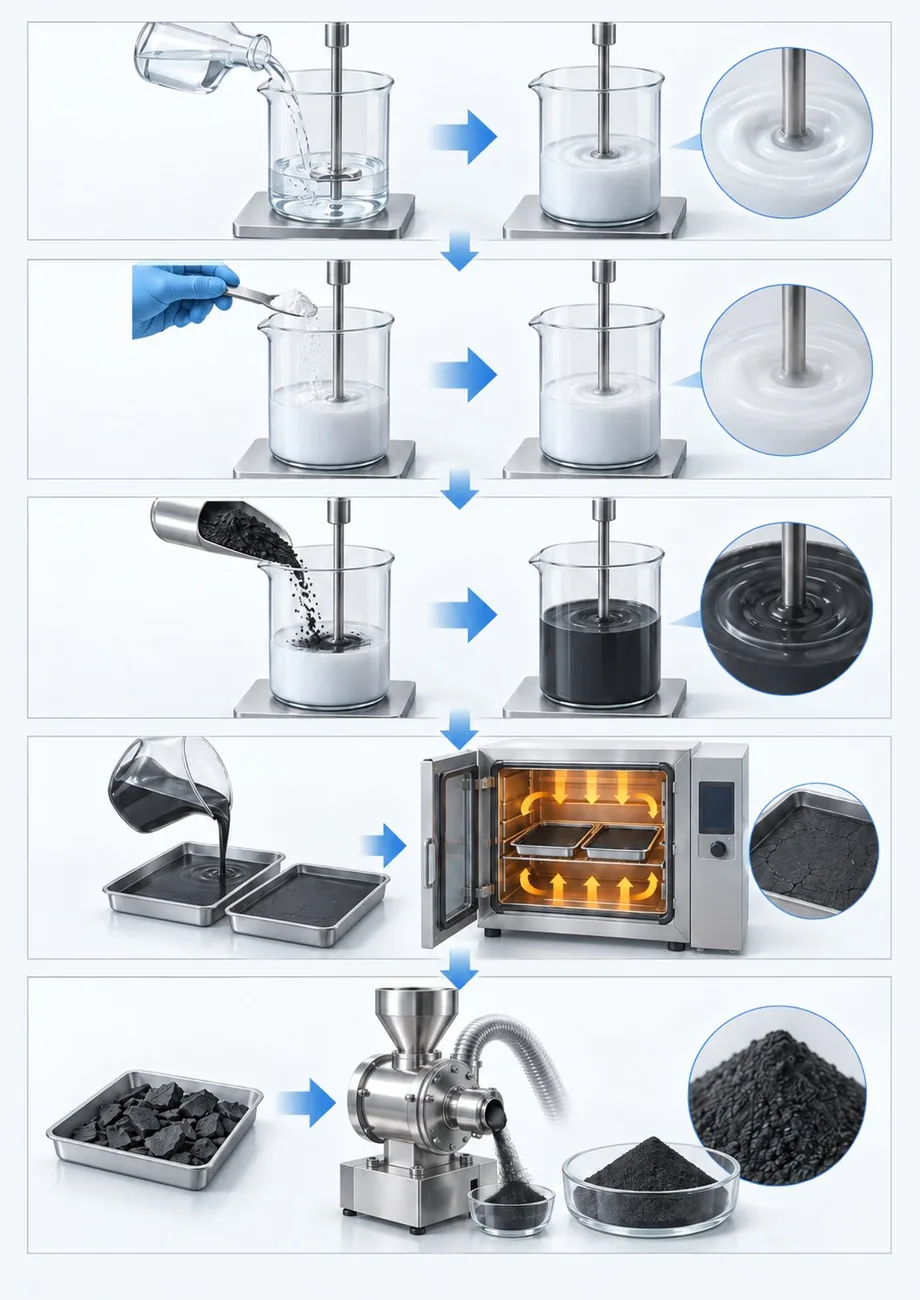
Dosage · applicable powders · sample request
Submit the form on the right and a technical adviser will contact you within 24 hours and arrange the sample.
Recommended dosage
Applicable powders and uses
01Product positioning
R101A belongs to the "coating agent" category (English category name: Coating Agent), with the official full name "inorganic powder coating agent for titanium dioxide / carbon black, etc. R101A"; the page title is "polyol-modified silicone coating agent". The handbook table-of-contents line, verbatim: "R101A: titanium dioxide, carbon black, and other inorganic powder coating agent"; the official positioning line: "inorganic powder coating, leap in titanium dioxide dispersing power"; the official mechanism field: "chemical dispersion (inorganic powder surface treatment)". (Data source: product handbook / official product data)
This grade is used for surface coating treatment at the powder production stage: the handbook technical data page contains two scheme versions — "new rutile titanium dioxide coating technical scheme" and "high-color carbon black coating technical scheme". (Data source: product handbook)
[Main components and molecular structure] verbatim: "R101A belongs to a polyol-modified silicone emulsion. Its main components are polysiloxanes containing active hydroxyl groups and polysiloxanes with active ether groups, and high-molecular-weight polyols. Its molecule is an organic polymer centered on a silicon atom, carrying hydroxyl, ether, alcohol, and other functional groups." (Data source: product handbook / official product data)
Official description: "coating agent for titanium dioxide, carbon black, and other inorganic powders; forms a protective layer on the powder surface, greatly improving dispersibility. In measured comparison with TMP/7020, R101A leads in tinting strength, dispersibility, brightness, and yellowing resistance." (Data source: official product data)
- Forms a complete film layer — "forms a complete, smooth alcohol-based silicone film on the titanium dioxide surface."
- Improves pigment indices — "improves the tinting strength, whiteness, dispersion performance, and gloss of titanium dioxide, and reduces oil absorption."
- Moisture resistance and anti-agglomeration — "improves the moisture resistance of titanium dioxide and prevents agglomeration of titanium dioxide particles caused by polar adsorption."
- Improves wettability — "increases the wettability of titanium dioxide in application systems."
- Use stability — "excellent storage and use stability" "very good product versatility."
- Versatility across systems — "must take into account ordinary water-based systems (such as papermaking and coatings), ordinary oil-based systems (such as paints and inks), and also high-temperature systems (such as rubber/plastics and color masterbatch)."
02Formulation system & mechanism of action
Organic coating mechanism (compared with traditional physical adsorption, verbatim key points): traditional coating agents "are physically adsorbed onto the titanium dioxide surface through their hydrophilic polar groups"; "whereas R101A mainly works through hydrogen-bond chemical adsorption between the siloxane groups in the polyol-modified silicone polymer and titanium dioxide, as well as chemical condensation or substitution reactions between the hydroxyl / ether groups on the polyol-modified silicone molecule and the hydroxyl groups on the titanium dioxide surface, forming a very uniform, dense, and firm polyol-modified silicone film layer on the titanium dioxide surface. This film layer can eliminate or weaken the polar adsorption between titanium dioxide particles, and at the same time form steric hindrance functional groups between the titanium dioxide particles, preventing agglomeration of the titanium dioxide particles... it can significantly improve the wetting and dispersion performance of titanium dioxide in various dispersion media, and increase the optical stability of titanium dioxide." (Data source: product handbook)
Four structural characteristics (verbatim key points from the document): 1) "sufficient methyl groups on the Si atom shield the high-energy polysiloxane backbone"; 2) "the C-Si-Na bond is nonpolar, making the intermolecular interaction force very weak"; 3) "the Si-O-OH bond is relatively long and the Si-O-OH-O-Si bond angle is large, causing the Si-O-OH bond to rotate very easily", and therefore "it has very good lubricity, flowability, weather resistance, and abrasion resistance"; 4) "the Si-O-OH bond is a covalent bond with 75% ionic-bond character... its bond energy is far greater than that of the C-O bond", and therefore "it has very good heat resistance and weather resistance". (Data source: product handbook)
Combined-property sentence, verbatim: "combines the properties of both inorganic and organic materials, and has excellent characteristics such as low surface tension, small viscosity coefficient, high and low temperature resistance, oxidation stability, weather resistance, flame retardancy, and physical inertness", and is therefore suitable for the organic coating treatment of general-purpose rutile titanium dioxide (the inorganic pigment version refers to it as "general-purpose inorganic powder"). Data boundaries: quantitative documents such as coating rate / film thickness / bonding quantification and heat-resistance test reports are not provided on this grade's page — not drafted on its behalf, not inferred. (Data source: product handbook / official product data)
- Chemical adsorption — siloxane groups with the powder surfaceThe siloxane groups in the polyol-modified silicone polymer form hydrogen-bond chemical adsorption with titanium dioxide (compared with the traditional physical adsorption route).
- Chemical condensation — forming a firm film layerThe hydroxyl / ether groups on the polyol-modified silicone molecule undergo chemical condensation or substitution reactions with the hydroxyl groups on the powder surface, "forming a very uniform, dense, and firm polyol-modified silicone film layer".
- Steric hindrance against agglomeration — eliminating polar adsorption"eliminating or weakening the polar adsorption between titanium dioxide particles, while forming steric hindrance functional groups between the titanium dioxide particles to prevent agglomeration of the titanium dioxide particles".
- Improving application performance — wetting and optical stability"significantly improves the wetting and dispersion performance of titanium dioxide in various dispersion media, and increases the optical stability of titanium dioxide"; the film layer also provides lubricity, weather resistance, and thermal stability.
03Key parameters
For this grade, two scheme-version specification tables coexist (titanium dioxide scheme version / inorganic pigment scheme version); differences are recorded per version, with no preference taken; the official website detail page wording is listed separately. Values in the table are as recorded in the source materials.
| Item | Value / description |
|---|---|
| Main component | Polysiloxanes containing active hydroxyl groups and polysiloxanes with active ether groups, high-molecular-weight polyols |
| vs TMP · color-reducing power | 1860 → 2013 (higher for R101A) |
| vs 7020 · color-reducing power | 1930 → 2013 (higher for R101A) |
| Dispersibility (5-point scale) | 4.5 / 5.3 → 6.50 |
| Oil absorption (g/100g) | 19.09 / 18.56 → 16.30 (lower is better) |
| Brightness | 93.5 / 94.6 → 96.2 |
| Yellowing resistance temperature | 110°C → 150°C (increase of 40°C) |
| Appearance (titanium dioxide version / inorganic pigment version) | White liquid / white paste-like liquid (both versions coexist) |
| Non-volatile matter (both versions coexist) | 23% / 99.9% |
| Specific gravity (both versions coexist) | 0.99 g/mL / 1.03 g/mL |
| pH value | 6.8-7 (both versions in the handbook); the official website detail page records 6.8 – 7.7 |
| Diluent | Water |
| Packaging · shelf life · storage conditions | Not listed on this grade's page — subject to the technical documents accompanying the shipment; not filled in on your behalf |
Reading notes: ① The three items appearance / non-volatile matter / specific gravity coexist in two versions (white liquid 23% 0.99 / white paste-like liquid 99.9% 1.03), with no explanation found, and this page takes no preference; ② The upper pH notations (6.8-7 / 6.8 – 7.7) are recorded as they appear per layer; ③ Quantitative documents such as coating rate / film thickness / bonding quantitative data and heat-resistance test reports are not given on this grade's page; ④ The values in the table are as recorded in the source materials. (Data source: product handbook / official product data)
04Recommended dosage window
For this grade, two dosage notations coexist in the source materials, and this page presents them side by side: Value ① "0.1%-3% (based on powder weight)" — from the dosage column and method sentences on this grade's page in the handbook ("The addition amount of R101A in titanium dioxide is 0.1%-3%." "The addition amount of R101A in inorganic pigments is 0.1%-3%.") and the "Recommended dosage" row on the official website detail page; Value ② "0.5-2.0%" — from the dosage field of the official product data, with no denominator specified. The two values are presented side by side, with no choice made between them, no judgment of typographical error, and no denominator added on our own; the actual addition amount is subject to the technical documents accompanying the shipment and written confirmation from the product side.
| Scenario | Dosage | Conditions & notes |
|---|---|---|
| Based on powder weight (handbook · detail page) | 0.1% – 3% | Dosage column and method sentences on this grade's page in the handbook (same value for both the titanium dioxide / inorganic pigment versions); the "Recommended dosage" row on the official website detail page: "0.1% – 3% (based on powder weight)"; denominator = powder weight |
| Official data layer notation (no denominator specified) | 0.5-2.0% | The official product data dosage field, verbatim "0.5-2.0%", with no denominator specified — recorded as is, not supplemented on our own; the coexistence relationship with Value ① is not explained in the source materials |
The coexistence of the two values is unresolved: Value ① has the denominator qualifier "based on powder weight", while Value ② has no denominator specified; the approach is to present them side by side, without judging right or wrong or judging typographical error, and the amount to be used is subject to the technical documents accompanying the shipment and written confirmation from the product side. The experimental method dosage is separately recorded as "taking the treatment of 200 g powder at an addition ratio of 0.5% as an example" (dosing 1 g) — the relationship between the experimental 0.5% and the two ranges is not described in the source materials, and no inference is made on our own. This grade has no "thickness-dosage" directional clause.

To be verified: ① Two dosage notations coexist ("0.1%-3% (based on powder weight)" vs "0.5-2.0%") — coexistence unresolved; subject to the technical documents accompanying the shipment and written confirmation from the product side; ② The correspondence between the experimental 0.5% and the two ranges is not described in the source materials; ③ The above are values as recorded in the source materials; for actual use, please conduct a small-scale trial in combination with your own powder and process to confirm.
05Applications
The target system is surface coating treatment at the powder production end; the handbook method sentences and the official website list of applicable powders are recorded as follows.
- Rutile-type titanium dioxide crude product (primary)
- "For rutile-type titanium dioxide crude product, the polyol-modified silicone coating agent material can be added directly into the titanium dioxide slurry in a homogenizer or mixing tank; after sufficient and uniform coating, jet milling is then carried out. Alternatively, R101A can be added directly in proportion along with the screw feed during the jet milling process, or sprayed in inside the gas milling chamber."
- High-color carbon black
- "For pigment carbon black manufacturers, it can be added directly to the secondary cooling water (ratio to water: water 5 : R101A 1) and directly spray-coated, maintaining a good primary particle size to improve the dispersion performance in subsequent applications and reduce the carbon black oil absorption value."
- Extended uses
- "It can also be used for activated dispersive coating of powder series such as oxidized carbon black, carbon black, calcium carbonate, talc powder, lithopone, barium sulfate, sodium sulfate, and organic or inorganic pigments. Its main function is to improve oxidation resistance, temperature resistance, organic compatibility with materials, dispersibility and anti-agglomeration, etc."
- List of applicable powders (official website detail page)
- Rutile-type titanium dioxide, anatase-type titanium dioxide, black iron oxide, carbon black, calcium carbonate, talc powder, lithopone, barium sulfate, sodium sulfate, and other organic / inorganic powders (coexisting with the handbook list in two places, recorded as is without mutual modification).
- Stage of use
- Surface treatment at the pigment production end (slurry addition / screw feed during the milling process / spraying) — different from the "masterbatch production" and "ore grinding" stages (the stages of use for other grades in the same series; this product's values and specifications are not applied interchangeably).
- Experimental method (as recorded in the source materials)
- Limited by laboratory equipment, dry coating is difficult to disperse uniformly ⇒ wet coating is recommended: pulping → dosing → adding powder → baking → jet milling, then testing pigment indicators and application indicators.
Field issues & application examples (as recorded in the source material)
| Field issue | What the source material states |
|---|---|
| What is different between it and ordinary coating agents? | Traditional coating agents "are physically adsorbed onto the surface of titanium dioxide through their hydrophilic polar groups"; R101A follows chemical adsorption + chemical condensation / substitution reactions, forming a "very uniform, dense and firm polyol-modified silicone film layer" on the surface. |
| How much to add? Why are there two numbers? | Two notations coexist: the handbook and the official website detail page record "0.1%-3% (based on powder weight)"; the official data layer dosage field records "0.5-2.0%" (no denominator specified). The two values are presented side by side, with no single choice made; the actual addition amount is subject to the technical documents accompanying the shipment and written confirmation from the product side. |
| Is there comparative data? | The source materials provide experimental data: titanium dioxide modification (dosage 0.5%) compared with TMP / 7020 — tinting strength 1860 / 1930 → 2013; oil absorption 19.09 / 18.56 → 16.30; brightness 93.5 / 94.6 → 96.2; yellowing resistance (no discoloration or gloss loss) 110°C → 150°C, etc. The source materials also state: "Due to differences in the testing systems and evaluation standards of various manufacturers, the results of this experiment are for reference only, and we make no commitment or guarantee; the using manufacturer is responsible for verifying whether it meets its own requirements." |
| Is there also data on carbon black? | Yes. Pigment carbon black Z111 experiment (dosage 0.5%): blackness (≤) 16→15; tinting power (%≥) 125→130; oil absorption value (ml/g) 1.05→0.98; moisture (%≤) 5→4.5; fluidity (35℃) 22→28; sieve residue 50→20, etc. The same special statement applies. |
06How it differs from related grades
The three axes that delimit the three grades in the same series (R101A / R100 / R100A): category field, application stage, dosage basis — each of the three is independent and not a sub-code; values are not cross-converted, and compositions are not cross-applied. Comparison as follows:
| Dimension | R101A | R100 | R100A |
|---|---|---|---|
| Category field | Coating agent (Coating Agent) | Coupling-type hyperdispersant | Filler activator |
| Full name | Coating agent for inorganic powders such as titanium dioxide / carbon black R101A | Coupling-type hyperdispersant for filled masterbatch R100 | Multifunctional filler activator R100A |
| Main components | Polysiloxane bearing active hydroxyl groups and polysiloxane bearing active ether groups, high-molecular-weight polyol | Siloxane / ammonium lauryl sulfate / hyperdispersant | Amide compound / ammonium lauryl sulfate / hyperdispersant |
| Appearance | White paste-like liquid (inorganic pigment version) · white liquid (titanium dioxide version) | Milky white liquid | Milky white liquid |
| Application stage | Surface treatment at the pigment production end (slurry addition / milling step / secondary cooling water) | Masterbatch production (including the direct grinding treatment method) | Limited to ore grinding (ground together with the ore (ore powder)) |
| Dosage basis | 0.1%-3% (by powder weight) + 0.5-2.0% (official field; two records on file) | 0.5% - 3% by mass of the inorganic filler | Three to ten parts per thousand (varies with the powder type; denominator not stated) |
Reading notes: ① Same series ≠ same use (three stages: coating / masterbatch / grinding); ② dosages are not cross-converted (three dosage bases, and this grade additionally has two records on file); ③ compositions are not cross-applied (the three sets of components each belong to a different chemical system); ④ with the masterbatch side / flame-retardant side: the materials establish no corresponding relationship — no inference, no bridging. (Data source: product handbook / official product data)
07Usage & storage
The following points are drawn item by item from the recorded materials; items not listed in the materials are not drafted on their behalf.
Addition level (both records reproduced as-is)
- Value ①: 0.1%-3% (by powder weight) — recorded both in the dosage column and the method sentence of the handbook and on the official website detail page.
- Value ②: 0.5-2.0% — the dosage field in the official data layer; denominator not indicated.
- The two values stand side by side, with no either/or choice; the technical documents supplied with the shipment and written confirmation from the product side shall prevail.
Method of addition
- Addition to the slurry (homogenizer / mixing tank) → jet milling; or direct addition with screw feeding during the jet milling step; or spray addition inside the gas milling chamber.
- Color carbon black can be added directly to the secondary cooling water (ratio notation "water 5: R101A 1", i.e. water : R101A = 5 : 1).
Key points of the experimental method (as recorded in the materials)
- Wet coating is recommended: slurrying (pure water) → dosing → adding powder and slurrying for 30 min → baking (105℃ / 110℃ for the carbon black version, 6-8 h until completely dry) → milling in a small jet mill → testing pigment and application indicators.
Not covered in the materials (not composed on this page)
- Packaging, shelf life, storage conditions (not listed on this grade's page — subject to the technical documents supplied with the shipment); safety data (MSDS-type) and complete handling and protection items — not listed in the materials.
08FAQ
At which step is R101A used?
Surface coating treatment at the powder production end: rutile-type titanium dioxide crude product, high-color carbon black, inorganic pigments, etc.; used to improve tinting strength, whiteness, dispersion performance and gloss, reduce oil absorption, and improve moisture resistance and anti-agglomeration properties.
How is its film layer formed?
It does not follow the traditional physical adsorption route; instead, "through hydrogen-bond chemisorption between the siloxane groups in the polyol-modified silicone polymer and titanium dioxide, and chemical condensation or substitution reactions between the hydroxyl/ether groups on the polyol-modified silicone molecules and the hydroxyl groups on the titanium dioxide surface", it forms a uniform, dense and firmly bonded film layer, and uses steric hindrance groups to prevent particle agglomeration.
What exactly is the dosage?
Two wordings coexist: the handbook and the official website detail page record "0.1%-3% (by powder weight)"; the dosage field in the official data layer records "0.5-2.0%" (denominator not indicated). The two values stand side by side, with no either/or choice; the addition level actually applied shall be subject to the technical documents supplied with the shipment and written confirmation from the product side.
How is it distinguished from R100 and R100A?
The three grades are all members of the hyperdispersant series but belong to different categories: R101A is a coating agent (coating at the pigment production end); R100 is a coupling-type hyperdispersant (masterbatch production); R100A is a filler activator (ore grinding). The application stage, composition and dosage basis are each independent, and the values are not cross-applied.
How is the heat resistance?
The detail page records "heat resistance >300℃ · no yellowing or blackening"; the background section of the handbook records that the silicone coating agent has "outstanding heat resistance (over 300℃)". In the experimental data, yellowing resistance (no discoloration or loss of gloss) improved from 110°C to 150°C (comparison group). A more complete heat resistance test report is not listed in the materials.
What are the packaging and storage conditions?
This grade's page does not list packaging, shelf life or storage conditions — subject to the technical documents supplied with the shipment; the diluent is recorded in the materials as water. (Data source: product handbook / official product data)
AppendixData sources
The data on this page come from two types of materials, traceable item by item:
- Product handbook: all paragraphs of the technical data pages for the two formulation versions of this grade (main components and molecular structure / organic coating mechanism / background and recommendation sentences / product features / specification table / method sentence / experimental method / extended uses / special statement); table-of-contents lines and the company introduction listing sentence.
- Official product data: all fields for this grade (name, category, positioning, description, mechanism, application, parameters, main components, dosage); hyperdispersant series entries; official detail page copy.
Not covered by the source material (not written on this page — to be added later)
- Two dosage records ("0.1%-3% (by powder weight)" vs "0.5-2.0%") — coexistence unresolved; subject to the technical documents supplied with the shipment and written confirmation from the product side.
- Differences between the two versions' specifications (appearance / non-volatile matter 23% vs 99.9% / specific gravity 0.99 vs 1.03) and the wording of the pH upper limit (6.8-7 vs 6.8 – 7.7) — no explanation found; no selection made.
- Packaging / shelf life / storage conditions — not listed on this grade's page.
- Reproducibility conditions of the experimental data (differences in test systems and evaluation criteria) — per the special statement in the materials, actual measurements shall prevail.
- Coating rate / film thickness / bonding quantification, and heat resistance test reports — not provided in the materials.
- Safety data (MSDS-type) and complete handling and protection items — not listed in the materials.