
Product updates · 2 October 2026
How to Choose Between R101A and R6100? Two Processing Routes for Inorganic Powders such as Titanium Dioxide and Calcium Carbonate
Titanium dioxide (TiO₂), carbon black, calcium carbonate, talc — the treatment of inorganic powders follows two different processing routes: R101A performs encapsulation, while R6100 performs coupling. This article compares the manual data of the two models: the experimental comparison table for R101A covering tinting strength, dispersibility and oil absorption, and the 7 powder categories with their dosage tiers and physical properties for R6100, and sets out the selection criteria for routing by powder type.
- 01Anti-agglomeration
- 02Distribution rate
- 03Lubrication balance
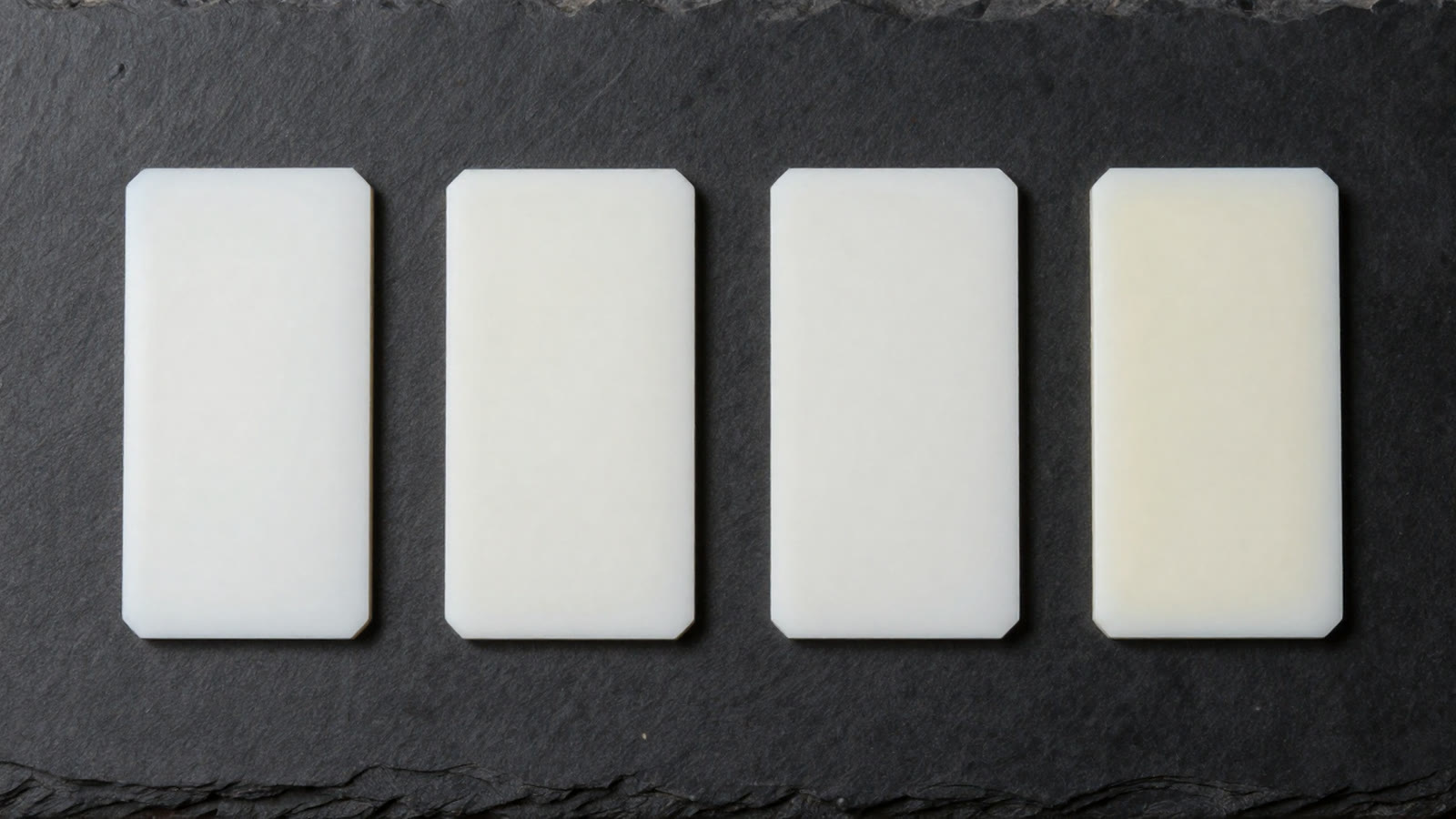
Moved from the bodyFirst data table in this article (as quoted)
| Indicator | TMP | 7020 | R101A |
|---|---|---|---|
| TCS (tinting strength) | 1860 | 1930 | 2013 |
| Transmittance | 23 | 20 | 18.7 |
| Dispersibility | 4.5 | 5.3 | 6.50 |
| Oil absorption g/100g | 19.09 | 18.56 | 16.30 |
| Brightness | 93.5 | 94.6 | 96.2 |
| Yellowing resistance (no discoloration or loss of gloss) | 110℃ | 150℃ | 150℃ |
Data source: official product data (product handbook and official on-site product data). All quotations and data in this article are transcribed as-is from the source text without inferential additions.
First, distinguish two things: encapsulation and coupling are not the same
Plastics colour matching, filled masterbatch, solvent-based coatings — wherever a "white system" or a "highly filled system" is involved, one question must be answered first: how must inorganic powders such as titanium dioxide (TiO₂), calcium carbonate and talc be treated before they can enter the resin in a "processing-friendly" manner?
The two corresponding models in the Californium Curium manual do not follow the same treatment logic:
- R101A (polyol-modified silicone coating agent) — positioned as a "coating agent for inorganic powders such as titanium dioxide and carbon black"; it forms a film layer on the powder surface and addresses the application performance of pigment-type powders;
- R6100 (organosilicone alkanolamide coupling-type dispersant) — positioned for "pre-dispersion activation treatment of calcium carbonate, talc, metal powders and the like"; it addresses the interfacial activation of filler-type powders.
In one sentence: R101A puts a "coating" on the powder; R6100 builds a "coupling" between the powder and the resin.
R101A: Organic Coating of Titanium Dioxide — What the Data Says
The coating of titanium dioxide is divided into inorganic coating and organic coating: inorganic coating focuses on pigment indicators, while organic coating focuses on application processing performance. Conventional organic coating agents (such as TMP) have 2 long-standing problems — "poor heat resistance, with defects such as yellowing and foaming readily occurring during use"; silicone coating agents, by contrast, offer outstanding heat resistance (above 300℃), but "their only drawback is that they are not easy to disperse and readily cause agglomeration". The approach behind R101A is to combine the dispersing performance of polyols with organosilicone. (Data source: official product data)
Mechanistically, R101A relies on hydrogen-bond chemical adsorption between siloxane groups and titanium dioxide, as well as chemical condensation or substitution reactions between hydroxyl/ether groups and the hydroxyl groups on the titanium dioxide surface, to "form a very uniform, dense and firmly bonded polyol-modified silicone film layer on the surface of the titanium dioxide", while at the same time forming steric hindrance functional groups that prevent particle agglomeration. (Data source: official product data)
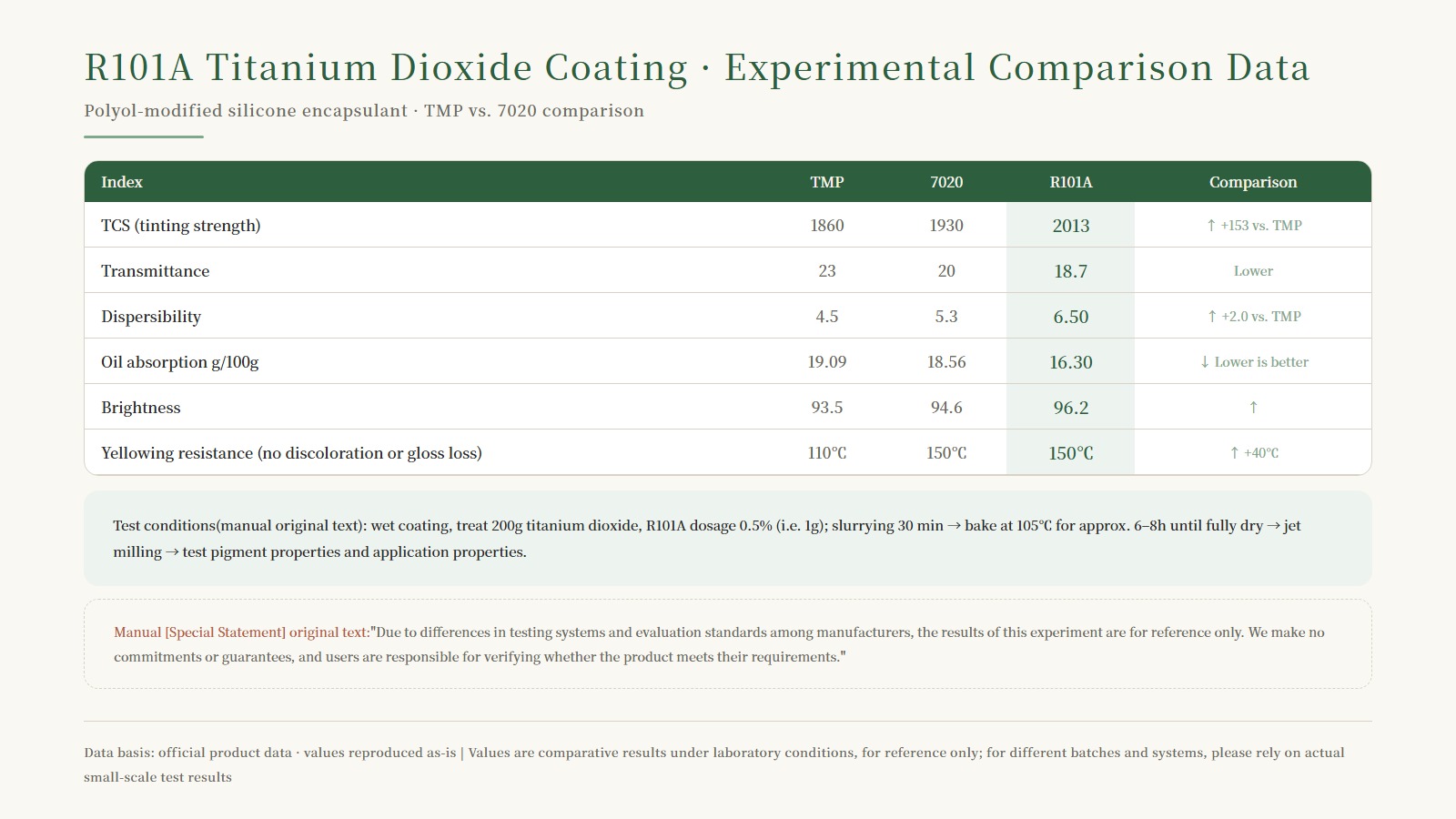
Experimental data (the handbook gives these based on a wet coating experiment with 200g of titanium dioxide treated and a 0.5% addition):
(Data source: official product data. The original wording of the handbook's [Special Statement] is retained: "Because the testing systems and evaluation criteria of individual manufacturers differ, the results of this experiment are for reference only; we make no commitment or guarantee of any kind, and users are responsible for verifying whether the product meets their own requirements.")
R6100: Coupling activation for 7 powder types, with dosage tiered by powder
Moved from the bodyOperation steps (original text, as is)
- Coloring-type powders such as titanium dioxide and carbon black — refer to R101A: it addresses pigment indicators and processing performance (tinting strength, dispersibility, oil absorption, yellowing resistance);
- Filling-type powders such as calcium carbonate, talc and barium sulfate — refer to R6100: after activation treatment, "increasing filler loading" is the direction stated in the handbook;
- Metal powders — the R6100 product catalog explicitly lists "pre-dispersion activation treatment for metal powders and similar materials".
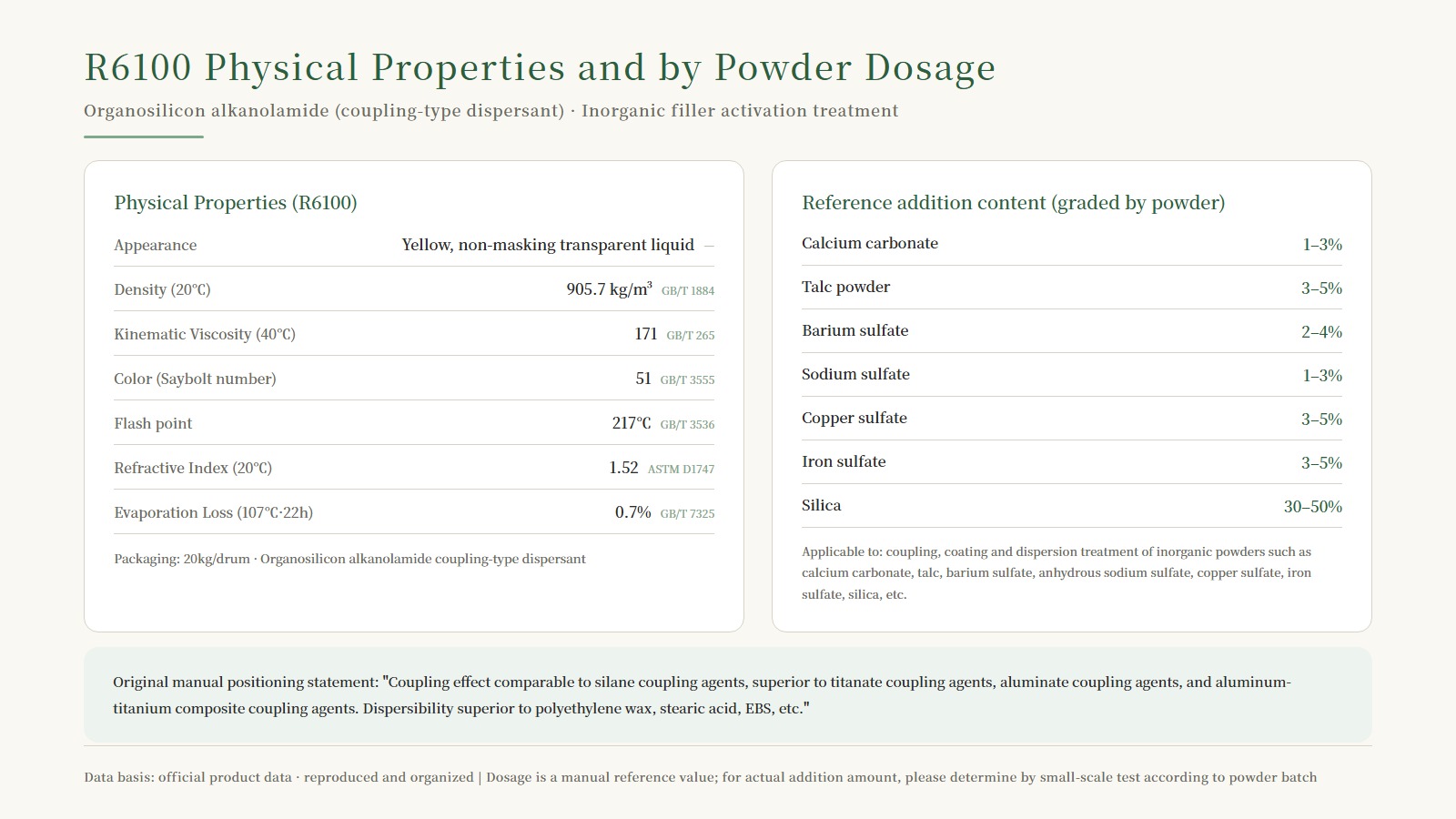
R6100 targets "activation treatment of inorganic fillers for plastics and oil-based coatings". The scope of application given in the handbook includes: calcium carbonate, talc, barium sulfate, anhydrous sodium sulfate, copper sulfate, iron sulfate, silicon dioxide and other inorganic powders. The performance positioning is stated very directly: "Coupling performance is comparable to that of silane coupling agents and better than titanate coupling agents, aluminate coupling agents and aluminum-titanium composite coupling agents. Dispersibility is better than that of polyethylene wax, stearic acid, EBS, etc." (Data source: official product data)
Physical properties (Data source: official product data):
| Item | Value | Test method |
|---|---|---|
| Appearance | Yellow, non-hiding transparent liquid | — |
| Density (20℃) | 905.7 kg/m³ | GB/T 1884 |
| Kinematic viscosity (40℃) | 171 | GB/T 265 |
| Color (Saybolt number) | 51 | GB/T 3555 |
| Flash point | 217℃ | GB/T 3536 |
| Refractive index (20℃) | 1.52 | ASTM D1747 |
| Evaporation loss (107℃, 22h) | 0.7% | GB/T 7325 |
Reference addition levels tiered by powder (Data source: official product data): calcium carbonate 1-3%, talc 3-5%, barium sulfate 2-4%, anhydrous sodium sulfate 1-3%, copper sulfate 3-5%, iron sulfate 3-5%, silicon dioxide 30-50%.
How to choose: routing by powder type and system
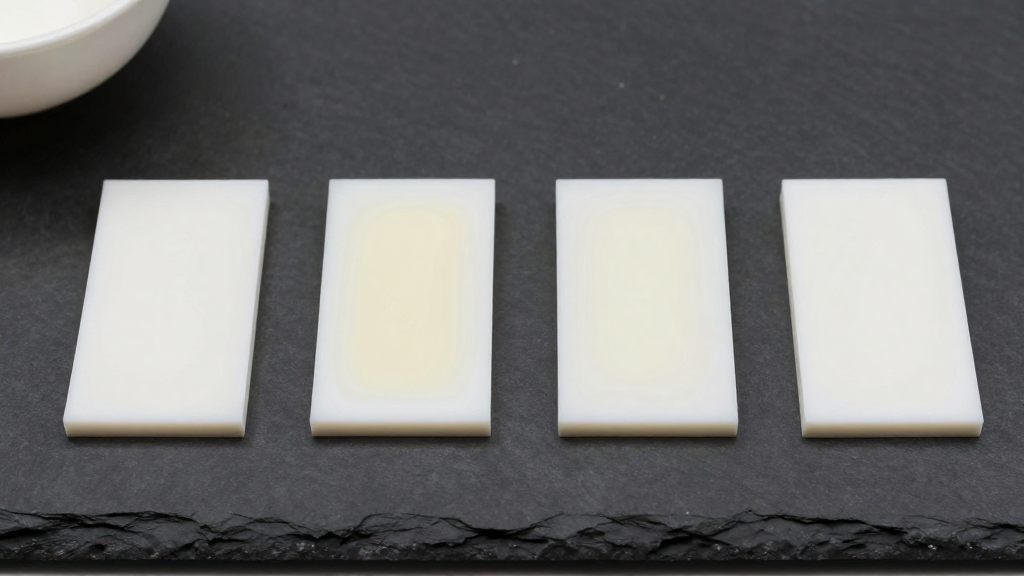
Placing the two models side by side, the selection logic can follow 3 lines:
The two are not an either-or choice: in a white masterbatch system, R101A can be used to treat titanium dioxide while R6100 activates calcium carbonate, each working in its own domain without conflict. Before actual combination, it is recommended to run a small-scale test on your powder batch and to take the measured results as the basis.
Notes on data and sources
- All data in this article is compiled from official product materials (product handbook and official on-site product data); no inferential additions.
- The disclaimer of the R101A experimental data is reproduced verbatim from the handbook; the values are comparative results under laboratory conditions and do not represent committed values for any specific batch.
- Product technical data are laboratory typical values; please carry out small-scale test verification before mass production.
Article actions
If this piece was useful, you can leave a mark — the like count comes from our back office at admin.kj9896.com; when the endpoint is unreachable the buttons are disabled and the count shows “—”. No invented figures are ever filled in.
Link: https://kj9896.com/en/news/r101a-vs-r6100-titanium-and-inorganic-powder-coating
Related reading
- 01R101A Polyol-Modified Organosilicon: the Third Generation of Titanium Dioxide Organic Coating Agents22 October 2026
- 02R1848 encapsulation-type hyperdispersant: approaches to the difficult dispersion and heavy dusting of aluminium silver powder in plastics2 October 2026
- 03Die build-up: the quietest cost on an extrusion coating line3 October 2026
Products mentioned in this article
Keep reading
More company announcements and product updates are in the newsroom.