
Product updates · 3 October 2026
Die build-up: the quietest cost on an extrusion coating line
Die build-up is the quietest cost on extrusion coating and cast film lines. Following the manual, this article summarises the approach of R902 plastic external lubrication modifier: the internal addition of a silicon compound powder, the reduction of die build-up together with increased rigidity without loss of toughness, its combination with erucamide for anti-blocking and slip, and a reference dosage of 0.5%—5% together with a parameter table.
- 01Anti-agglomeration
- 02Distribution rate
- 03Lubrication balance
Source of facts: Californium Curium – Functional Additives 1.09.pdf (page numbers are the physical pages of the PDF), product data for items currently listed on the official website, products.ts. The quotations and data in this article are reproduced verbatim from the source; no inferential additions have been made.
Die build-up: the quietest cost on an extrusion coating line
Once an extrusion coating or cast film line has been running for a long time, a dark layer of deposited material slowly forms on the die lip — the industry calls it die build-up, also die deposit. It brings a whole series of problems on site: gel spots (fisheye) appear on the film surface, production has to be interrupted time and again to stop the line and clean the die lip, and every stoppage costs a considerable amount of time and material losses.
One product in the additives manual addresses this matter in its very first line:
"Plastic modifier R902 (fluorine-free product), added internally to extrusion coating or agricultural film products: can increase pigment heat resistance by 4 to 5 degrees, can reduce die build-up, and reduce pigment exudation (effective for slight exudation)." (Source: Californium Curium – Functional Additives 1.09.pdf p71)
This article breaks down the things R902 handles on extrusion coating and cast film lines; all parameters are reproduced verbatim from the manual.
Named "external lubrication", yet used by "internal addition"
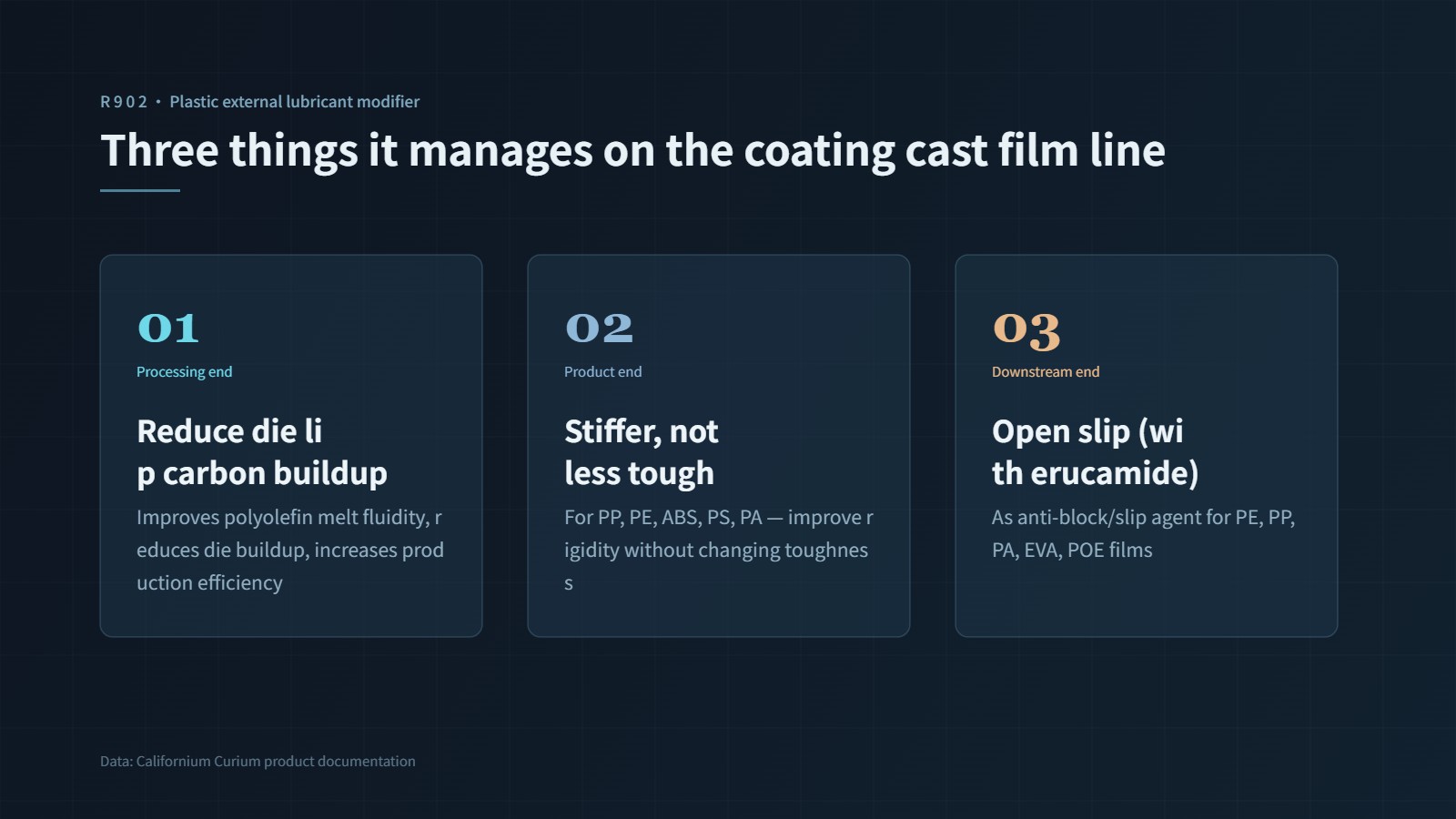
In the product catalogue R902 carries the name plastic external lubrication modifier, and its application directions are given as "extrusion coating, cast film" and "fluorescent masterbatch / anti-stick screw"; in the technical data sheet (TDS), however, it is positioned as a plastic modifier, its main component is a silicon compound, and its form is a white powder — the mode of use is internal addition (in-plastic addition): it is mixed into the formulation in proportion and then acts by itself during processing and on the surface of the finished article. (Source: p71)
In other words, it is not something applied to the equipment, but an additive that follows the formulation. The manual summarises its main functions in 3 levels:
"Prevents blocking problems in plastic films caused by vacuum adsorption, intermolecular forces, or thermal motion." (Source: p71)
- Reduces blocking — "forms a microscopic uneven structure or lubricating layer on the film surface, reducing interlayer friction and adhesion";
- Improves processing performance — "improves the melt flowability of polyolefin resins (such as PE, PP), reduces die deposit, and increases production efficiency";
- Improves film quality — "reduces surface defects (such as gel spots (fisheye) and shark-skin appearance), enhancing the smoothness and transparency of the film". (Source: p71)
Taken together, the 3 levels show that on the line R902 addresses both sides of the same matter: less deposit at the processing end, fewer defects at the finished-article end.
Beyond the die, a few other small matters it also takes care of
Moved from the bodyOperation steps (original text, as is)
- Pigment heat resistance increased by 4 to 5 degrees — for systems such as extrusion coating and agricultural film that require high-temperature processing, this amounts to a margin added to the pigment's tolerance window;
- Reduces pigment exudation — the manual specifically notes "effective for slight exudation", which is an honest statement: for systems that already show heavy exudation, one cannot expect a single lubrication modifier to cover them;
- Improves the dispersibility of pearlescent pigments and fluorescent pigments — effect pigments of the pearlescent and fluorescent kind are the most sensitive to the state of dispersion; a little agglomeration and the effect turns out uneven;
- Assists the hydrophobing agent in increasing hydrophobic performance — note "assists": the hydrophobing agent remains the main actor, and R902 does not overstep its role.
Taken sentence by sentence, the overview paragraph on p71 shows that the functional list of R902 is far longer than the phrase "anti-build-up" suggests:
Used in products such as PP, PE, ABS, PS and PA, another formulation given by the manual is: "can increase product rigidity without changing toughness (generally used as a rigidity-increasing, toughness-enhancing agent)". (Source: p71)
In combination with erucamide: anti-blocking and slip
Films sticking together after winding is another everyday problem at packaging film plants. The combination given by the manual is:
"In combination with erucamide, it can serve as an anti-blocking and slip agent for films such as PE, PP, PA, EVA and POE." (Source: p71)
That is to say, R902 plays a supporting role here: erucamide is the customary main agent for anti-blocking and slip, and the microscopic uneven structure and lubricating layer of R902 lend a hand alongside it. The specific ratio is a matter of on-site processing, and the manual gives no fixed answer — which is consistent with its usual formulation of "adjusted according to the final finished article".
Parameters and dosage
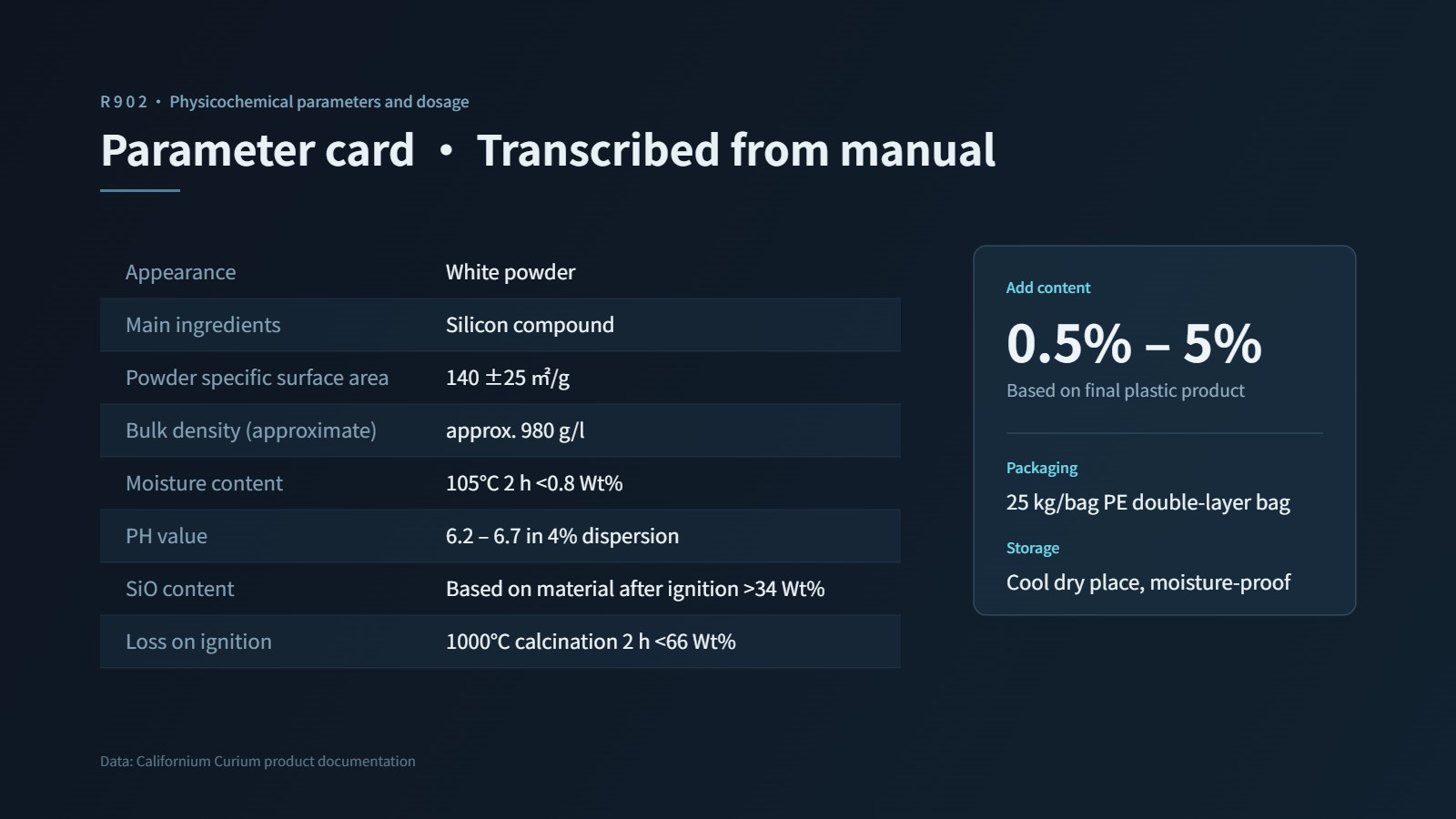
| Item | R902 |
|---|---|
| Appearance | White powder |
| Main component | Silicon compound |
| Powder specific surface area | 140 ±25 ㎡/g (the manual sets this as "140 +25㎡/g"; to be read as a ± value) |
| Bulk density (approximate value) | approx. 980 g/l |
| Moisture content | <0.8Wt•% at 105℃ for 2 hours |
| pH value | 6.2-6.7 in a 4% dispersion |
| SiO content | >34 Wt•% based on the material after ignition (the manual writes "Sio content") |
| Loss on ignition | material after drying at 105℃ for 2 hours, ignited at 1000℃ for 2 hours <66Wt•% |
| Addition level | 0.5%—5% of the final plastic product |
| Packaging | 25 kg/bag, PE double-layer bag |
| Storage conditions | cool and dry place, protected from moisture |
(Source: Californium Curium – Functional Additives 1.09.pdf p71)
Where it is used
The application fields listed in the manual fall into 3 categories (Source: p71):
- Packaging films — BOPP, CPP, LDPE and other films for food and pharmaceutical packaging;
- Industrial films — agricultural film, protective film, etc.;
- Other plastic products — pipe, fiber, sheet, etc.; the manual also notes "particularly suitable for film production requiring high transparency and high smoothness".
For process engineers on extrusion coating and cast film lines, R902 can be understood as an approach that starts from the formulation side: without changing the equipment or the process rhythm, first straighten out melt flowability and surface condition in the formulation, and then look back at whether the die's operating cycle has changed. Formulations and temperature profiles differ from plant to plant, so for the actual dosage it is recommended to follow the manual's 0.5%—5% range and begin with sampling trials based on one's own system.
(Model listing page: R902 plastic external lubrication modifier in the official website's product center.)
Article actions
If this piece was useful, you can leave a mark — the like count comes from our back office at admin.kj9896.com; when the endpoint is unreachable the buttons are disabled and the count shows “—”. No invented figures are ever filled in.
Link: https://kj9896.com/en/news/r902-die-lip-carbon-external-lubrication
Related reading
- 01How to Choose Between R101A and R6100? Two Processing Routes for Inorganic Powders such as Titanium Dioxide and Calcium Carbonate2 October 2026
- 02R1848 encapsulation-type hyperdispersant: approaches to the difficult dispersion and heavy dusting of aluminium silver powder in plastics2 October 2026
- 03How to Select a Halogen-Free Flame Retardant Supplier? A Model Selection Guide for PE Films and PET/PETG Transparent Articles1 October 2026
Products mentioned in this article
Keep reading
More company announcements and product updates are in the newsroom.