
Product updates · 1 October 2026
How to Select a Halogen-Free Flame Retardant Supplier? A Model Selection Guide for PE Films and PET/PETG Transparent Articles
Californium Curium's 6 halogen-free flame retardant models are matched to the substrate: R911 for PE films and woven tapes, R912B for PET fibres and sheets, R912 for translucent articles, R915 for high-transparency articles, R940 for UV and PU systems, and R218 as a synergist replacing antimony trioxide. The article gives the dosage, processing temperature window and formulation caveats, together with the compliance documentation checkpoints to verify when selecting a supplier. Every data item has an official product data basis.
- 01Anti-agglomeration
- 02Distribution rate
- 03Lubrication balance
Moved from the bodyFirst data table in this article (as quoted)
| Model | Name | Applicable Scenario | Key Specifications | Recommended Dosage |
|---|---|---|---|---|
| R911 | PE Halogen-Free Flame Retardant | PE flame retardancy, PE film, PE injection moulding | UL94 V-2 (film grade) / FV-2 per GB/T 2408-2008; processing temperature 150-200℃; shelf life 12 months | 10%-20% |
| R912B | PET Halogen-Free Flame Retardant | PET flame retardancy, fibre, film, sheet | UL94 V-0 (at 1.5%-5%); LOI ≥38%; processing temperature 230℃-280℃ | 1.5%-5% |
| R912 | Transparent Halogen-Free Flame Retardant | PET flame retardancy, PETG flame retardancy, TPU flame retardancy | Bulk density 0.87-0.93 g/cm³; effective flame retardant content ≥98.0%; thermal decomposition temperature ≥285℃ | TPU 2%-7%; PETG 1.5%-3%; PET 1.5%-3% |
| R915 | Transparent Halogen-Free Flame Retardant Dedicated for PET/PETG | PET flame retardancy, PETG flame retardancy, transparent PET articles | Phosphorus content 18%; melting point 210℃; onset temperature of thermal decomposition ≥260℃; fineness (325 mesh) ≥98% | V-2 (1.5mm) 1%-2%; V-0 (1.0-1.5mm) 2%-4% |
| R940 | Unsaturated Acrylic-Polyurethane Reactive Flame Retardant | Coatings, inks, adhesives | Total phosphorus content approximately 10.5%; viscosity (25℃) 800-2000 mPa·s; acid value ≤15 mgKOH/g | UV acrylic system 15-30%; PU/PUA system 12-25% |
| R218 | Flame Retardant Synergist | PP/PE flame retardant systems, PVC flame retardant systems, halogen-free flame retardant systems | Al(SiO₂)PO₄·2H₂O; density approximately 2.6-3.2 g/cm³; melting point typically 1300-1600℃ | 1-3% |
Data source: official product data.
Conclusion First: Match the Model to the Substrate
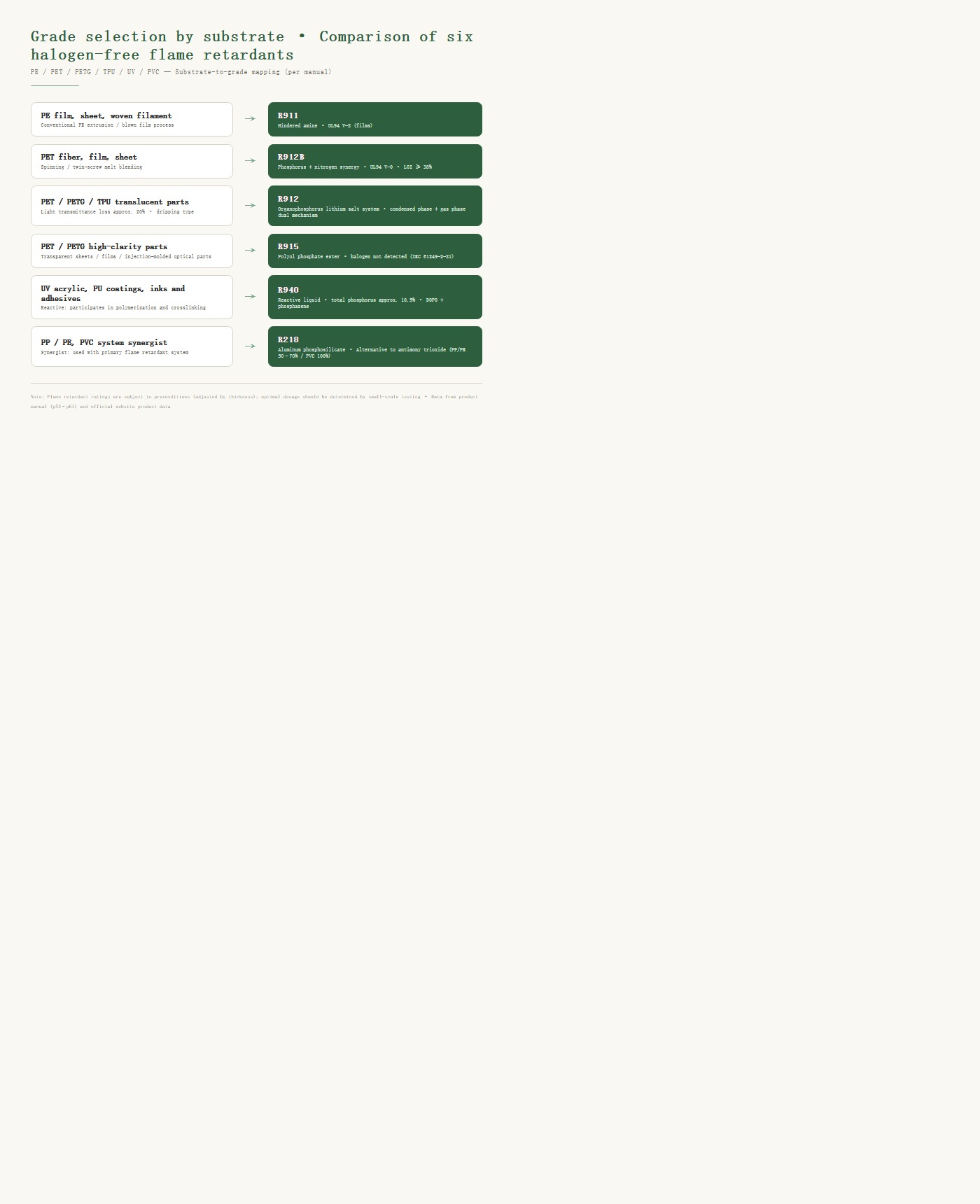
- PE film, sheet, woven tape → R911: with hindered amine compounds as the core component; contains no halogen. The manual states "UL94 V-2 (film grade) or FV-2 per GB/T 2408-2008 (subject to actual thickness)". (Based on official product data)
- PET fibre, film, sheet → R912B: phosphorus-based main agent with nitrogen-based synergist. The manual states "UL94 V-0 (subject to actual finished article thickness)"; LOI is raised to 38% or higher. (Based on official product data)
- PET/PETG/TPU translucent articles → R912: bulk density 0.87-0.93 g/cm³, effective flame retardant content ≥98.0%, phosphorus content ≥9.8%. The manual indicates an approximately 20% reduction in light transmittance. (Based on official product data)
- PET/PETG high-transparency articles → R915: polyol phosphate ester, phosphorus content 18%, melting point 210℃, onset temperature of thermal decomposition ≥260℃. "Halogen content: not detected (halogen-free) / IEC 61249-2-21". (Based on official product data)
- UV acrylic, PU coatings, inks and adhesives → R940: halogen-free reactive liquid flame retardant, total phosphorus content approximately 10.5%, viscosity (25℃) 800-2000 mPa·s, acid value ≤15 mgKOH/g. (Based on official product data)
- PP/PE, PVC system synergist → R218: phosphorus-silicon synergist, "may replace 50% to 70% of antimony trioxide at a 1:1 ratio" (PP/PE system); in PVC systems may replace 100% of antimony trioxide. (Based on official product data)
Two Questions to Ask a Supplier First
Model-by-Model Comparison
Key Specifications × Recommended Dosage scatter and trend
Dimension · ℃ → %X-axis = Key Specifications, Y-axis = Recommended Dosage; scatter points = paired data from source text; dashed line = fit line (correlation coefficient see figure caption).
- X-axis Key Specifications / ℃
- Y-axis Recommended Dosage / % · Trend line only describes 6 points in this table, r = 0.403, do not extrapolate ·
- Use the median of the interval values; the median is not the original source value, only used to see the trend.
- R911(175, 15)
- R912B(3.25, 3.25)
- R912(0.9, 4.5)
- R915(18, 1.5)
- ... 6 items in total, all data are shown in the table below.
Chart data (source text verbatim)
| Object | Key Specifications (℃)·Median | Recommended Dosage (%)·Median |
|---|---|---|
| R911 | 175 | 15 |
| R912B | 3.25 | 3.25 |
| R912 | 0.9 | 4.5 |
| R915 | 18 | 1.5 |
| R940 | 10.5 | 22.5 |
| R218 | 2.9 | 2 |
Source textScale 0.9–175 ℃
Same-dimension range intersection (℃ · 3 objects)
Dimension · ℃X-axis = dimension ℃; colored band = target interval where the object can fall; points outside the band = portions that cannot be reached.
- 150–200℃
- 230–280℃
- 1300–1600℃
- X-axis same dimension ℃ ·
- X-axis scale based on this article's max (150–1600 ℃); do not directly compare lengths across articles.
- R911150–200 ℃
- R912B230–280 ℃
- R2181300–1600 ℃
Chart data (source text verbatim)
| Object | Range |
|---|---|
| R911 | 150–200 ℃ |
| R912B | 230–280 ℃ |
| R218 | 1300–1600 ℃ |
Source textScale 135–1761 ℃
Moved from the bodyOperation steps (original text, as is)
- Whether the halogen-free claim and the rating are stated with conditions. The manual states no halogen for R911, R912B and R915; R915 additionally provides the test criterion "halogen content: not detected (halogen-free) / IEC 61249-2-21". All ratings carry qualifiers (R911: "subject to actual thickness"; R912B: "subject to actual finished article thickness"). (Based on official product data)
- Whether a dosage range is provided. See the table below; all data are taken from the dosage fields of the product data on the official website, and explicitly state that "the optimum ratio should be determined by small-scale trial testing". (Based on official product data)
(Based on official product data)
Boundaries: Where Guarantees Are Not Made
- The flame retardant ratings in the manual are all qualified ("subject to actual thickness"; "subject to actual finished article thickness"), and the dosage states that "the optimum ratio should be determined by small-scale trial testing": whether the target rating can be achieved in practice must be confirmed by actual testing on the specific substrate, finished article thickness and process. This page only relays the manual's stated values; no specific rating is guaranteed. (Based on official product data)
- R218 is a synergist
- in halogenated formulations it is commonly used to partially replace antimony trioxide; in halogen-free flame retardant systems, it is "typically used in combination with phosphorus-based and intumescent flame retardants". (Based on official product data)
Composition-Level Comparison: What Matters Is the Flame Retardant System, Not the Name
R940 formulation hierarchy
Dimension · %Each segment's width = proportion of that component, totaling exactly 100%; segment color shading = hierarchy (main agent / auxiliary agent / carrier).
- R940 DOPO
- Main · 49%
- lotriphosphazene (HPCTP)
- Synergist · 10%
- Main · 40%
- triphenylphosphine
- Additive · 0.8%
- Additive · 0.2%
- Fig. R940 formulation hierarchy
- Total 100.0% — Classification by share: Main ≥25% · Synergist 8~25% · Additive <8%
- R940 DOPO49 %
- lotriphosphazene (…10 %
- HEMA40 %
- triphenylphosphine0.8 %
- ... 5 items in total, all data are shown in the table below.
Chart data (source text verbatim)
| Component | Share |
|---|---|
| R940 DOPO | 49% |
| lotriphosphazene (HPCTP) | 10% |
| HEMA | 40% |
| triphenylphosphine | 0.8% |
| MEHQ | 0.2% |
Technical data sheet for modelScale 0–100 %
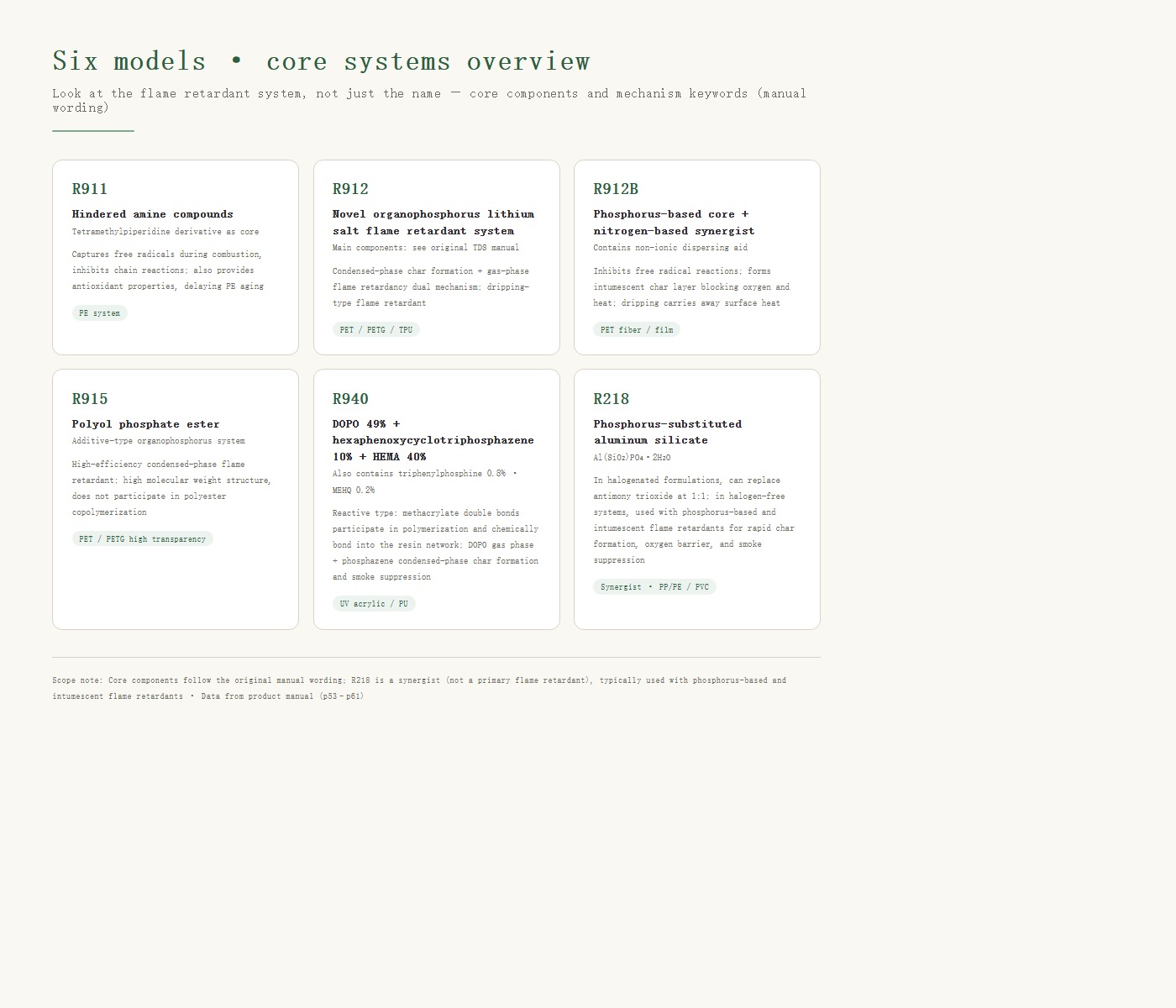
More meaningful than the "halogen-free" label alone when selecting a supplier is to look at the core composition of the 6 models side by side — different systems are suited to different substrates and operate by different mechanisms. (Based on official product data)
| Model | Core Composition (per the manual) | Mechanism Keywords |
|---|---|---|
| R911 | Hindered amine main agent: hindered amine compounds with tetramethylpiperidine derivatives as the core (also contains a small amount of non-ionic surfactant as a synergist dispersant) | Captures free radicals generated during combustion, suppresses the chain reaction and interrupts the combustion process; also provides some antioxidant effect, slowing the ageing of PE materials |
| R912 | Tris(lithium xylenyl carbonate) phosphate (new organic phosphorus-lithium salt flame retardant system) | Dual mechanism of condensed-phase char formation and gas-phase flame retardancy; this product is a dripping-type flame retardant |
| R912B | Phosphorus-based compound as the core + a small amount of nitrogen-based compound as synergist (also contains non-ionic surfactant as a dispersing aid) | Suppresses free-radical reactions; forms an intumescent char layer that blocks oxygen and heat transfer; dripping carries surface heat away |
| R915 | Polyol phosphate ester (additive-type organophosphorus system) | Highly efficient condensed-phase flame retardancy; high-molecular-weight polyol phosphate ester structure that does not participate in polyester copolymerisation |
| R940 | DOPO 49% + hexaphenoxy cyclotriphosphazene (HPCTP) 10% + HEMA 40% + triphenylphosphine 0.8% + MEHQ 0.2% | Reactive: methacrylate double bond participates in UV/free-radical polymerisation and is chemically bonded into the resin network; DOPO acts in the gas phase and phosphazene promotes condensed-phase char formation and smoke suppression |
| R218 | Aluminium phosphosilicate Al(SiO₂)PO₄·2H₂O | Synergistic effect with halogen-based systems; rapid char formation, blocks oxygen, suppresses smoke |
Processing Window and Prohibitions: What the Manual Specifies
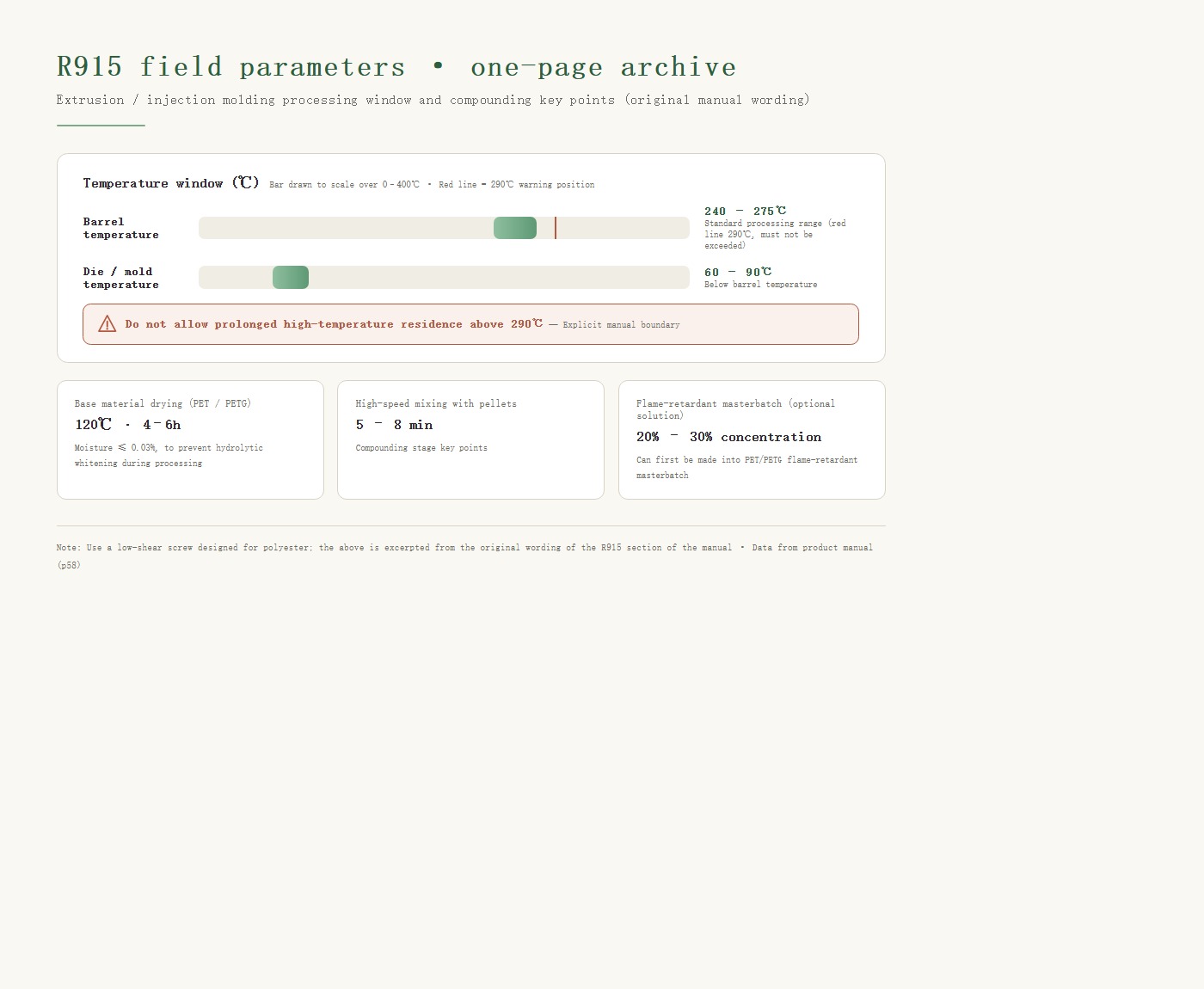
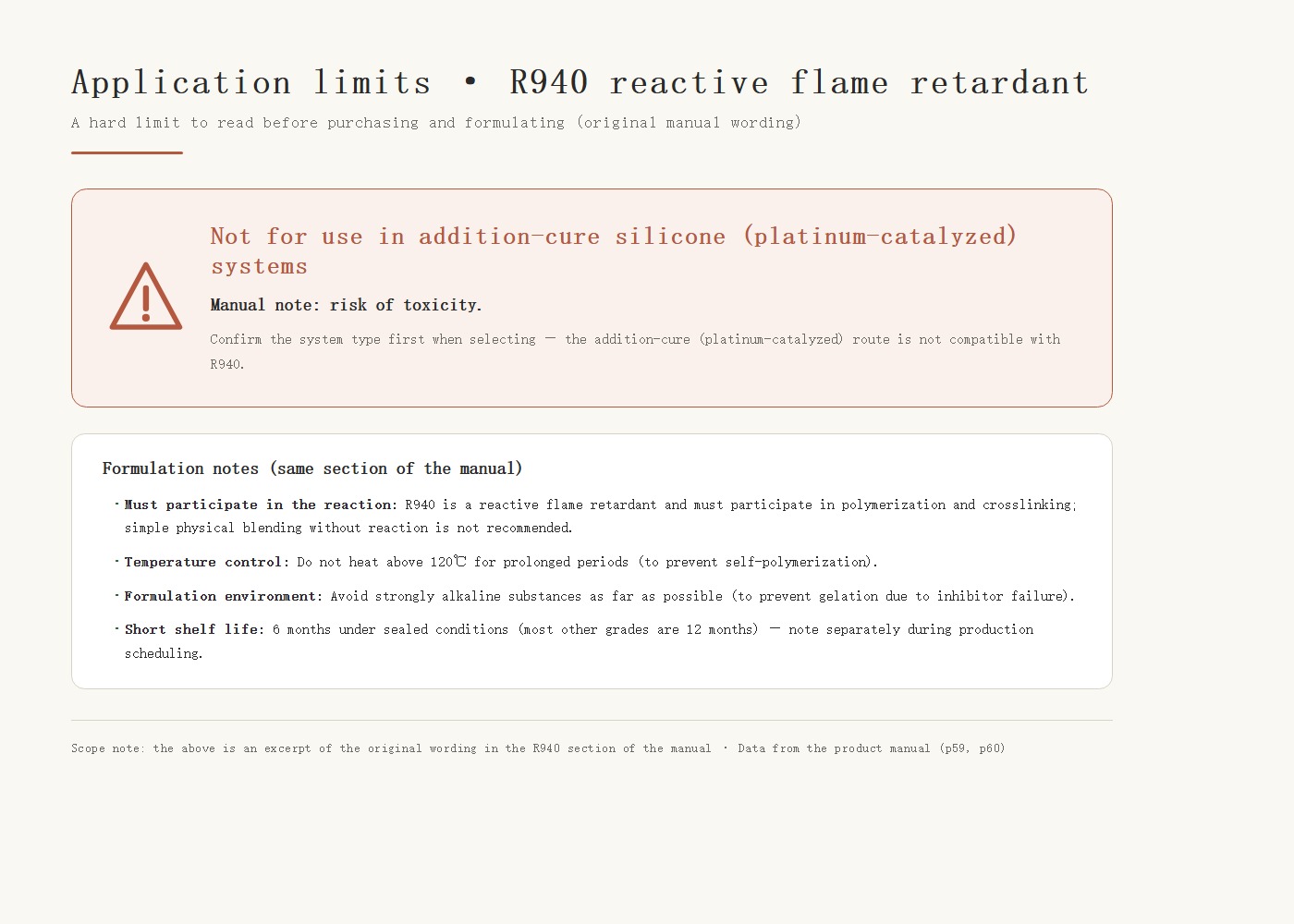
This is the section most easily skipped during procurement yet most likely to be tripped over on the shop floor: the manual specifies the boundary conditions for each model. (Based on official product data)
R912 is a drip-type flame retardant. The manual states: "This product is a drip-type flame retardant; where non-dripping is required, it can only be used as a flame retardant synergist in combination." It can be combined with char-forming agents and anti-dripping additives. The dosage is subdivided by TPU type: polyester type 2-4%, polyether type 5-7%; the applicable substrate temperature windows are PET 230–280℃, PETG 190–250℃, TPU 160–225℃. The processing recommendation is low-temperature compounding with uniform-speed extrusion. (Based on official product data)
R912B requires lower processing temperatures. The manual recommends control at 230℃-280℃, noting that this is "20-30℃ lower than standard PET processing temperatures" to avoid high temperatures reducing PET viscosity, making forming difficult and affecting fibre spinning. The addition method is to fully blend with PET chip during the melt processing stage of the PET resin, melt-compound via twin-screw extruder, and then pelletise. (Based on official product data)
R915 has a complete set of plant-floor parameters. Extrusion/injection moulding barrel temperature 240–275℃, die/mould temperature 60–90℃, with the note "long-term hold-up above 290℃ is prohibited". Compounding essentials: the PET/PETG substrate should be pre-dried at 120℃ for 4–6h (moisture ≤0.03%, to prevent hydrolysis-induced whitening during processing); R915 should be high-speed blended with the pellets for 5–8min; a low-shear polyester-specific screw should be used; alternatively, a 20%–30% concentration PET/PETG flame retardant masterbatch may be pre-compounded. (Based on official product data)
R940 is a reactive type and must not be used as an additive type. The manual states: "R940 is a reactive flame retardant and must participate in polymerisation/crosslinking; simple physical blending without reaction is not recommended." For UV-curable acrylic systems, the total phosphorus content of the formulation is recommended to be controlled at 1.5-3.0%. For PU systems, it can be directly blended with polyol and then reacted with isocyanate, but the NCO/OH ratio must be controlled—R940 contains hydroxyl groups that consume -NCO groups, so the isocyanate dosage must be adjusted. 3 cautions: temperature should not exceed 120℃ for prolonged heating (to prevent auto-polymerisation); avoid strong alkaline substances in the formulation (to prevent polymerisation inhibitor failure and gelation); where a higher rating is required, it can be combined with a small amount of aluminium hydroxide or phosphate ester. There is also a hard boundary: the manual states "R940 cannot be used in addition-cure silicone (platinum-catalysed) systems due to toxicity risk". For storage, the shelf life is 6 months under sealed conditions—shorter than the 12 months of the other models, which is worth noting separately in production scheduling. (Based on official product data)
R911 has the simplest addition method. The manual specifies fully blending the flame retardant with PE pellets and then feeding directly into the film-blowing machine or extruder, melt-compounding and processing into film. Processing temperature is controlled at 150-200℃ (consistent with standard PE film processing), with the caution "avoid excessively high temperatures that may cause decomposition of the flame retardant". (Based on official product data)
R218 has a comparison benchmark. The manual states: in PP/PE flame retardant systems, when antimony trioxide is replaced at a 1:1 ratio at 50% to 70% replacement level, "its flame retardant performance is superior to that of antimony trioxide combined with brominated flame retardants alone"; in PVC flame retardant systems, it can replace antimony trioxide 100%. Physically, it is a white crystalline powder, odourless and non-toxic, appearing fibrous or needle-shaped under the microscope, with a density of approximately 2.6–3.2 g/cm³ and pH value 6.5-7, and it can chemically react with hydrofluoric acid and hot concentrated alkali. (Based on official product data)
How the Compliance Benchmarks Are Written in the Document
Subitem ⊂ Total (ppm nesting, not additive)
Dimension · ppmOuter bar = total amount, inner bar = a part of it; the difference between the two = the rest, the right end marks the remaining amount.
- … ≤ 1500 ppm
- Br + Cl ≤ 900 ppm
- Unit unified as ppm · Nested bars only express inclusion relationship; detection scope of two limit values follows source text, no conversion performed.
- Bar length indicates inclusion relationship, two bars are not additive
- Total halogens1500 ppm
- Br + Cl900 ppm
Chart data (source text verbatim)
| Level | Limit |
|---|---|
| Total halogens | ≤ 1500 ppm |
| Br + Cl | ≤ 900 ppm |
Source textScale 0–1500 ppm
Halogen-free criterion ppm red line
Dimension · ppmScale = criterion limit (unit ppm); the side marked in red = exceedance direction; values are taken directly from source criteria.
- Br+Cl < 900 ppm
- Fig. Halogen-free criterion ppm red line
- ← Lower value means more "halogen-free"; dashed line = red line from source, segment = judgment interval cut by red line
- Claim permitted only below the red line:
- Br+Cl< 900 ppm
Chart data (source text verbatim)
| Criterion | Limit | Description |
|---|---|---|
| Br+Cl | < 900 ppm | Criterion: Br+Cl 900 ppm |
Main text criteria layerScale 0–900 ppm
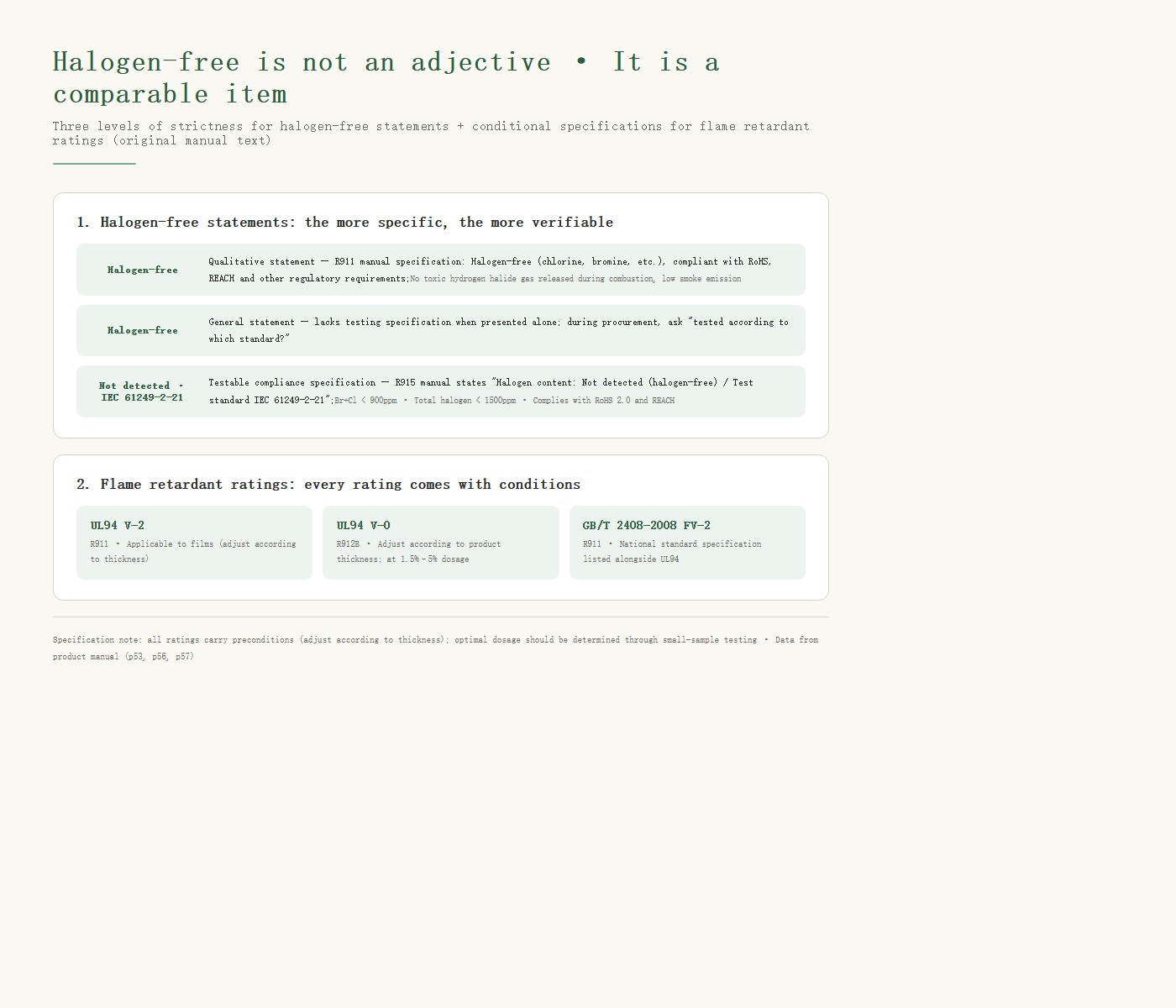
"Halogen-free" cannot be used merely as an adjective. The manual presents compliance benchmarks as comparable items for two models: R915 specifies "halogen content: not detected (halogen-free) / test standard: IEC 61249-2-21", and states that it meets the IEC 61249 halogen-free standard (Br+Cl<900ppm, total halogens <1500ppm), RoHS 2.0 (free of lead, mercury, cadmium, hexavalent chromium, polybrominated biphenyls (PBB) and polybrominated diphenyl ethers (PBDE)), and REACH (free of SVHC high-concern substances); R911 specifies that it does not contain halogens (chlorine, bromine, etc.) and complies with environmental and RoHS, REACH and other international regulatory requirements, with no toxic hydrogen halide gases released during combustion and low smoke emission. By contrast, for R218, the manual states "complies with EU 2002/95/EC and REACH and other environmental regulations"—R218 is itself a synergist, not a halogen-free flame retardant main agent, and the two benchmarks should not be mixed. (Based on official product data)
Frequently Asked Questions (FAQ)
Q1: For PET/PETG transparent parts, how do you choose between R912 and R915? R912 is a transparent flame retardant dedicated to PET/PETG/TPU, and the manual notes "substrate light transmittance decreases by approximately 20%", making it suitable for translucent or low-transparency flame-retardant modification; R915 is targeted at high-transparency PET/PETG finished articles, suitable for transparent sheets, films, and injection-moulded optical parts. (Based on official product data)
Q2: Is R218 a flame retardant or a synergist? It is a synergist (aluminium phosphosilicate): in PP/PE flame retardant systems it can replace antimony trioxide at a 1:1 ratio at 50% to 70% replacement level, and in PVC systems it can replace 100%. In halogen-free systems, it is combined with phosphorus-based and intumescent flame retardants, providing rapid char formation, an oxygen barrier, and smoke suppression. (Based on official product data)
Q3: What are the core components of the 6 models? Per the manual: R911 is a hindered amine compound with a tetramethylpiperidine derivative as the core (the synergistic dispersant is a non-ionic surfactant); R912 is tri(dimethylbenzene lithium carbonate) phosphate (a novel organophosphorus lithium salt system); R912B has a phosphorus-based core + a small amount of nitrogen-based synergist; R915 is a polyol phosphate ester; R940 is DOPO 49% + hexaphenoxy cyclotriphosphazene 10% + HEMA 40% + triphenylphosphine 0.8% + MEHQ 0.2%; R218 is aluminium phosphosilicate Al(SiO₂)PO₄·2H₂O. (Based on official product data)
Q4: Does the R912 dosage need further subdivision for TPU? Yes. The manual differentiates by TPU type: polyester type 2-4%, polyether type 5-7%; for both PETG and PET, the dosage is 1.5%–3%. The manual also states a key boundary: "this product is a drip-type flame retardant; where non-dripping is required, it can only be used as a flame retardant synergist in combination." (Based on official product data)
Q5: What parameters for R915 need to be set in advance on the production floor? The manual provides a set: barrel temperature 240–275℃, die/mould temperature 60–90℃, long-term hold-up above 290℃ prohibited; substrate pre-drying at 120℃ for 4–6h, moisture ≤0.03%; high-speed blending with the pellets for 5–8min; use a low-shear polyester-specific screw; a 20%–30% concentration flame retardant masterbatch may be pre-compounded. (Based on official product data)
Q6: Are there systems that R940 must not come into contact with? There is one explicit one: the manual states "R940 cannot be used in addition-cure silicone (platinum-catalysed) systems due to toxicity risk". The other 2 are processing-side restrictions—temperature should not exceed 120℃ for prolonged heating (to prevent auto-polymerisation); avoid strong alkaline substances in the formulation (to prevent polymerisation inhibitor failure and gelation); in PU systems, R940 contains hydroxyl groups that consume -NCO, so the isocyanate dosage must be adjusted. (Based on official product data)
Data and Basis Notes
- The data in this article come only from Californium Curium official product data; every data item is annotated with its basis in the text and can be checked item by item.
- Flame retardant ratings, dosages, and processing temperatures are quoted verbatim from the manual and the official website; actual results for different substrates, thicknesses, and processes should be based on small-scale trials.
Article actions
If this piece was useful, you can leave a mark — the like count comes from our back office at admin.kj9896.com; when the endpoint is unreachable the buttons are disabled and the count shows “—”. No invented figures are ever filled in.
Link: https://kj9896.com/en/news/halogen-free-fr-supplier-selection
Related reading
- 01Californium Curium R915 Polyester-Grade Transparent Halogen-Free Flame Retardant: Technical Data Sheet and Processing Window27 September 2026
- 02Californium Curium R200 Magnesium Hydroxide/Aluminium Hydroxide Flame-Retardant Aid: Measured Comparison and Usage27 September 2026
- 03Three Product Lines in the Flame Retardant Series: PE Film, Transparent Polyester and Synergist Replacement25 September 2026
Products mentioned in this article
Keep reading
More company announcements and product updates are in the newsroom.