
Technology explained · 1 October 2026
Hyperdispersant and Wetting-Type Dispersant: Division of Roles in Plastics Colouring and Four Operational Guidelines
Hyperdispersants and wetting-type dispersants play complementary roles in plastics colouring rather than acting as substitutes for one another: TPS wetting-type dispersant handles wetting and internal/external lubrication, can replace polyethylene wax, and is particularly suited to matte-finish masterbatch; the R1800 series provides wetting, dispersion and encapsulation stabilisation. The article gives the dosage guidelines for both, the troubleshooting sequence when a colour masterbatch surface is not glossy (with titanium dioxide (TiO₂) treatment conditions included), and the two are also frequently used in combination within the same formulation. Every data item has an official product data basis.
- 01Anti-agglomeration
- 02Distribution rate
- 03Lubrication balance
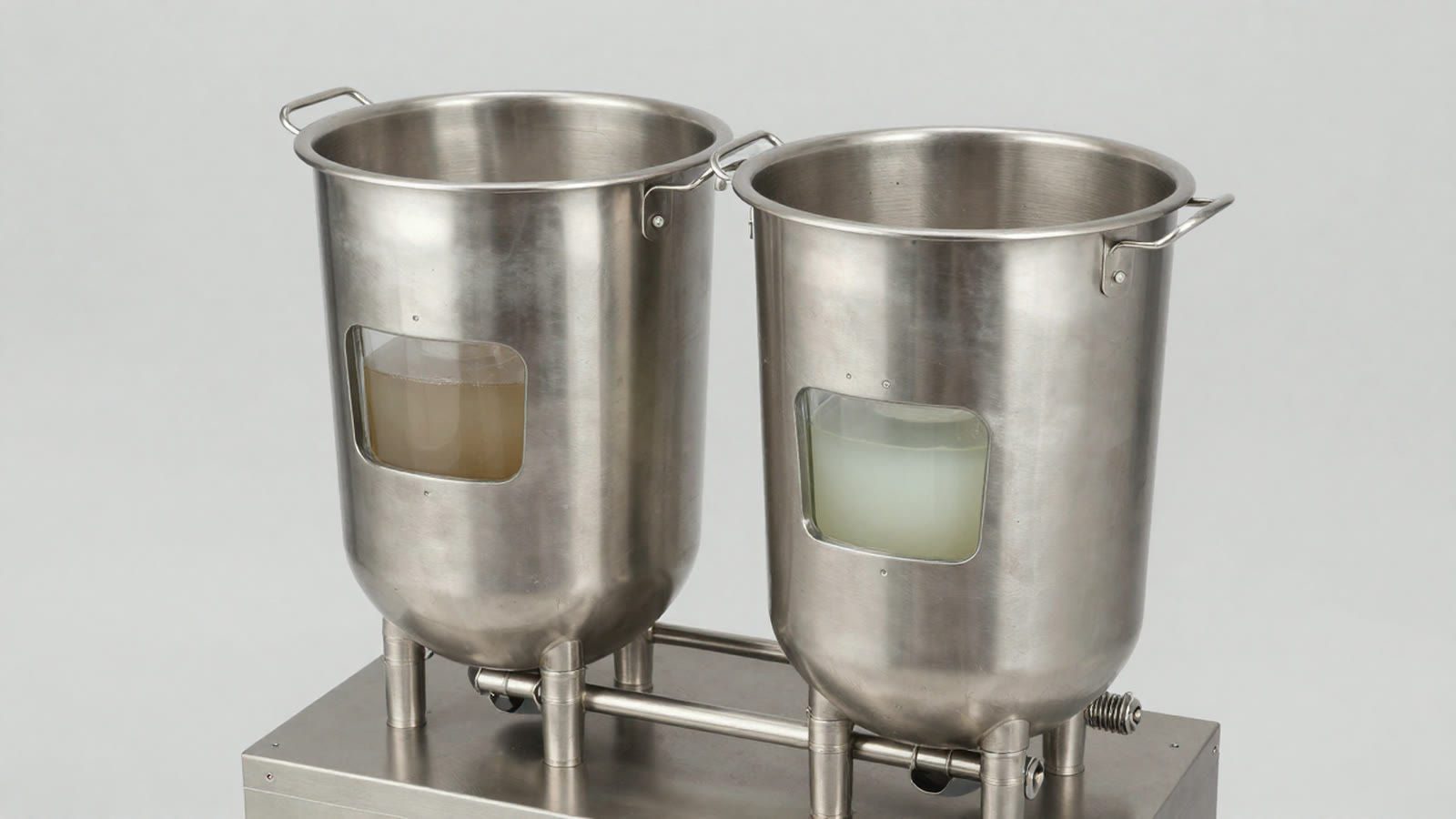
Moved from the bodyFirst data table in this article (as quoted)
| Item | TPS (alkyl acid ester) wetting-type dispersant | R1800-S / R1800-SK / R1800-SH hyperdispersant |
|---|---|---|
| Composition | White friable solid produced by high-temperature polymerisation of alkyl and fatty acids | R1800-S/SK: polyolefin ether-type polymer; R1800-SH: silicon and resin ether-type polymer (all blue paste) |
| Main function | Wetting and lubrication; used as a lubricant and a wetting-type dispersant to improve processing flowability and surface wetting | Dispersion and encapsulation, lubricating and release, toughening and brightening, slip and easy opening, can replace maleic anhydride graft, can adjust product flow rate, etc. |
| Applicable scenarios | Matte-finish masterbatch (can replace polyethylene wax), plastics and rubber industry; in rubber, used as a vulcanisation activator and dispersant | R1800-S: colour masterbatch, garment coatings, powder coatings, oil-based coatings/inks; R1800-SK: white masterbatch, metal-powder colour masterbatch, titanium dioxide (TiO₂) surface treatment; R1800-SH: black masterbatch, carbon black wet/dry granulation |
| Key indicators | Molecular weight 320; open-cup flash point ≥205℃; solidification point ≤55℃; boiling point 229℃; auto-ignition point 434℃; kinematic viscosity (100℃) 5.87 mm²/s | R1800-S: amine value ≤ 9 mgKOH/g, acid value 6.8-7 mgKOH/g, density 1.190 g/cm³, degree of dispersion III |
| Recommended dosage | 0.5-2.0% for pigment/filler pre-treatment | 0.5%—1% in the final plastic product |
| Precautions stated in the manual | Not recommended for high-gloss masterbatch (may affect gloss) | R1800-S: must not be used in cold-processed powders, must not be used in waterborne coatings or waterborne inks |
Data source: official product data.
Conclusion: A Division of Roles, Not a Substitution
- Wetting-type dispersant (TPS, alkyl acid ester): The manual states that it "offers better wetting and lubricity than polyethylene wax (PE wax), markedly better wetting than EBS (ethylene bis-stearamide), lubricity comparable to EBS, but without the exudation issues associated with EBS"; in the plastics industry it is used as a lubricant and a wetting-type dispersant, and is "particularly suited to matte-finish masterbatch, and can replace polyethylene wax", while being "not recommended for high-gloss masterbatch (may affect gloss)". (Based on official product data)
- Hyperdispersant (R1800 series): Performs "wetting + dispersion + encapsulation stabilisation". The manual text states that R1800-S "is a special polymeric multifunctional wetting and encapsulation-type dispersant produced by combining an encapsulation agent and a dispersant in precise proportions under high-temperature, high-pressure conditions", and that it "effectively prevents further agglomeration of pigment and powder particles". (Based on official product data)
In short: matte finish, replacing wax, processing- and wetting-oriented → consider TPS; agglomeration prevention, dispersion stability, high-gloss → consider the R1800 series.
Item-by-Item Comparison
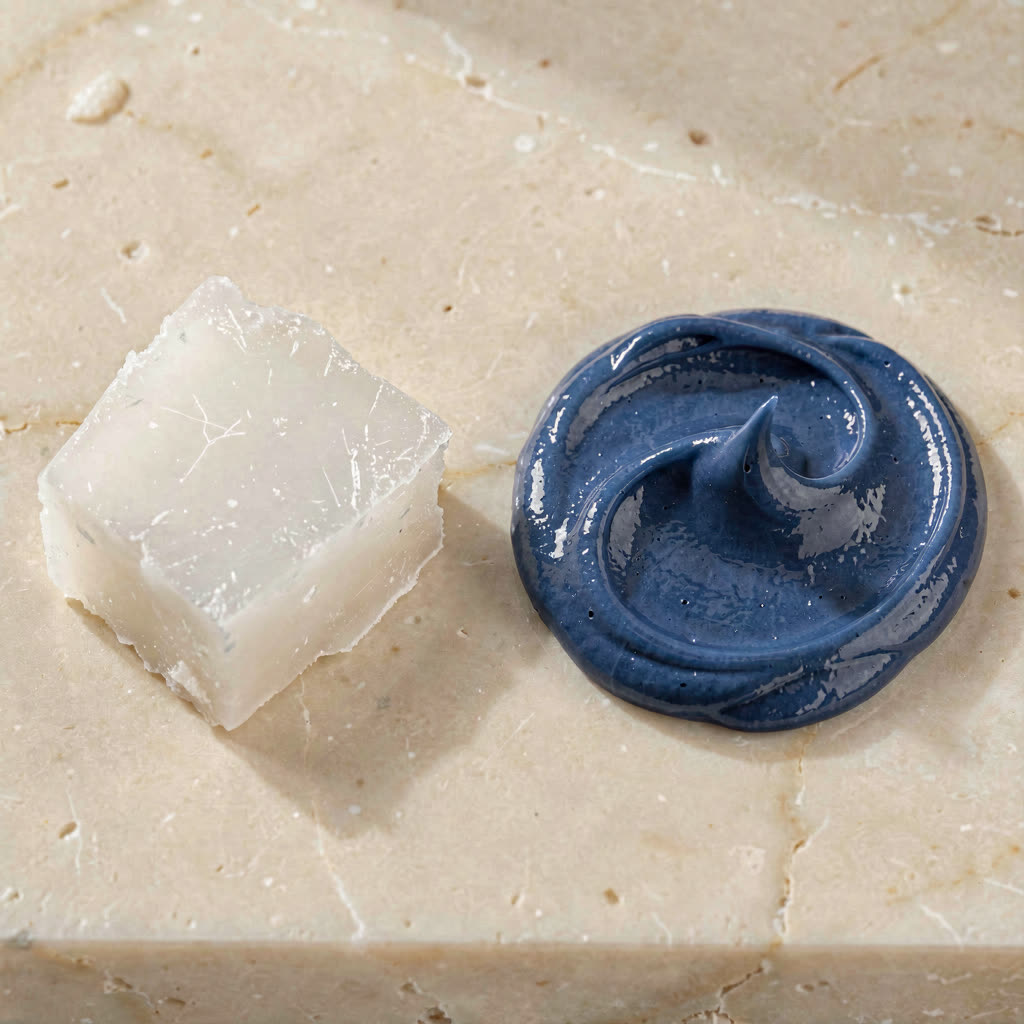
(Based on official product data)
Four practical guidelines for plastics colouring
Moved from the bodyOperation steps (original text, as is)
- Do not use TPS for high-gloss parts. The manual states "not recommended for high-gloss masterbatch (may affect gloss)"; for high-gloss applications, refer to the R1800 series. (Based on official product data)
- For matte-finish masterbatch, or when replacing polyethylene wax, refer to TPS. The manual states "particularly suitable for matte-finish masterbatch, can replace polyethylene wax". (Based on official product data)
- White/black masterbatches have dedicated surface treatment conditions. R1800-SK for titanium dioxide: pH = 6.8, 70℃, dosage 0.5%; R1800-SH for carbon black: pH = 6.2, 80℃, dosage 1% — for treatment at the titanium dioxide plant, the manual recommends diluting with an alcohol-based solvent so that the powder distribution becomes more uniform. (Based on official product data)
- The two products have different dosage bases — do not mix them up. TPS: 0.5-2.0% based on pigment/filler pre-treatment; R1800 series: 0.5%–1% based on the final plastic product. (Based on official product data)
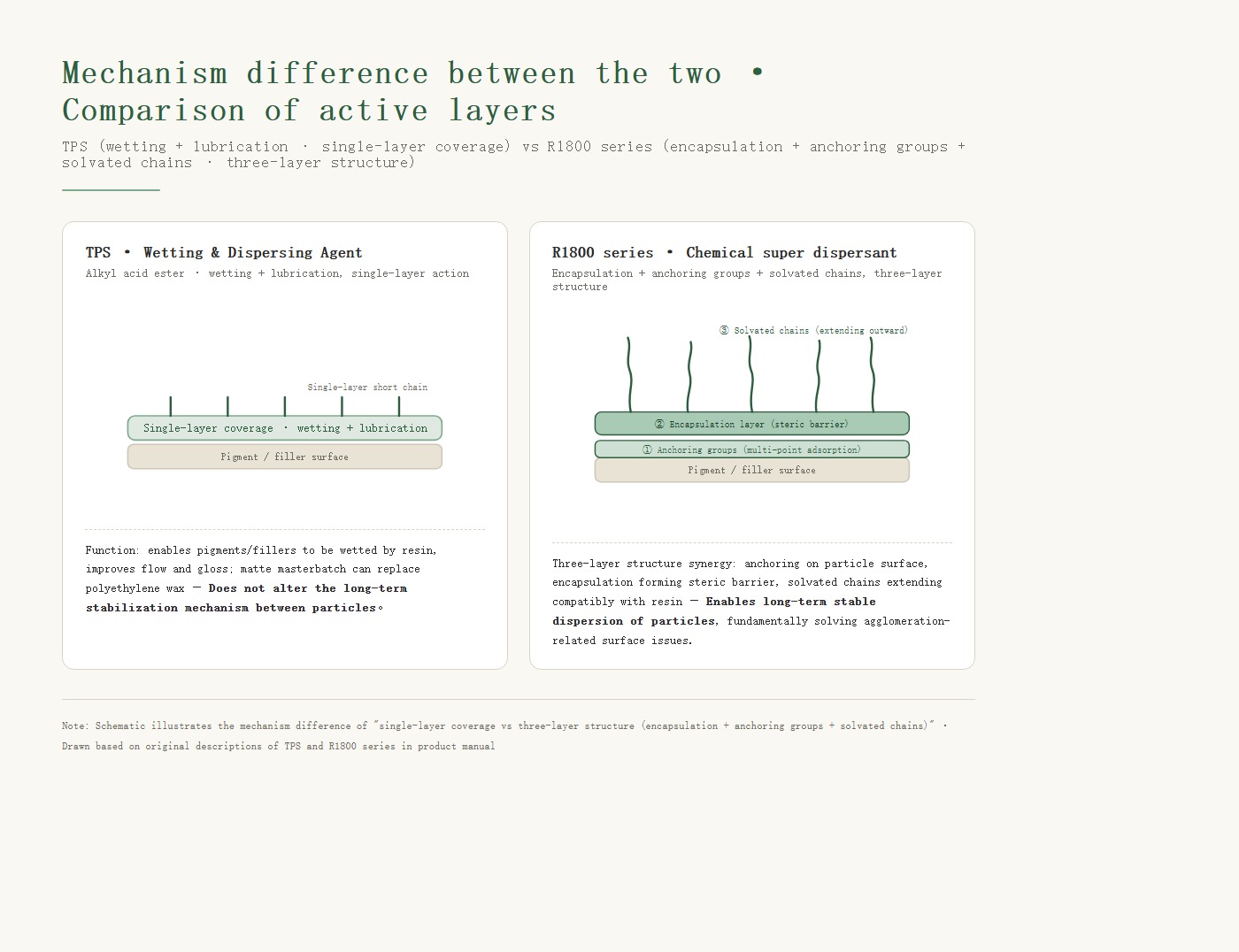
Remaining technical parameters of TPS and another application area

A few further reference items for TPS were not listed in the table above, and may also be requested at the time of purchase: density (20℃) 0.871 kg/m³ (tested per GB/T 1884), open-cup flash point ≥205℃ (GB/T 267), solidification point ≤55℃ (GB/T 3536), boiling point 229℃ (GB/T 616-1988), auto-ignition point 434℃ (DL/T 706-99), kinematic viscosity (100℃) 5.87 mm²/s, carbon-type analysis CA% = 12%; shelf life 36 months (when stored in a cool, dry environment). (Based on official product data)
Another application area is rubber: the manual describes TPS in the rubber industry as "used as a vulcanisation activator and dispersant, promoting uniform vulcanisation". In other words, TPS is positioned as a "universal wetting-type dispersant applicable to both plastics and rubber", whereas the R1800 series hyperdispersant is covered in the manual mainly around pigment and powder treatment. (Based on official product data)
Application example 6: troubleshooting sequence for a dull surface on colour masterbatch (the role of wax)
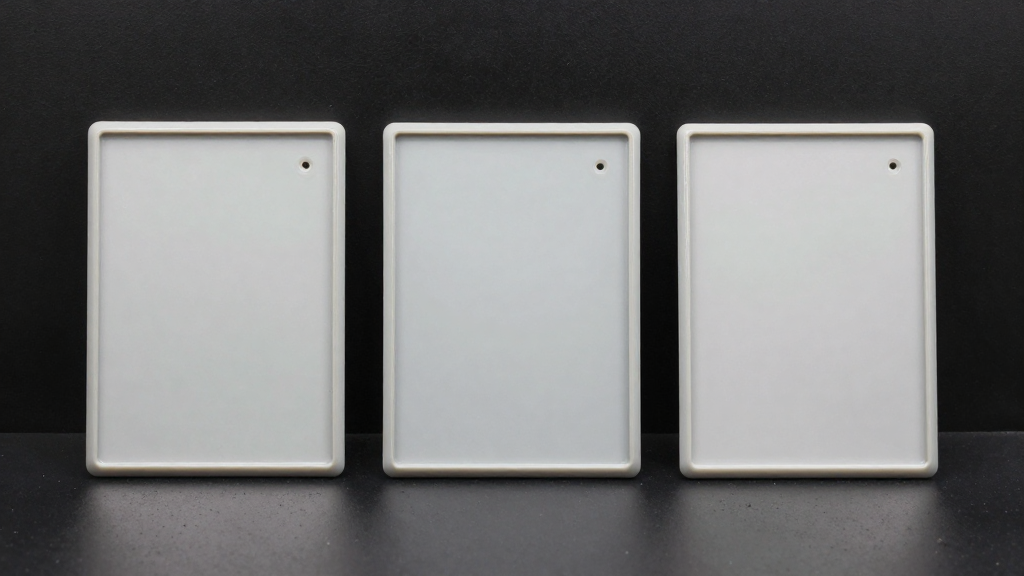
The manual devotes a section to "a dull surface on colour masterbatch" — a section that neatly clarifies how "wetting/lubricating additives" and "hyperdispersant" divide the work on this same on-site problem. The troubleshooting sequence given in the manual is: (Based on official product data)
- First, check the extrusion temperature. "If the extrusion temperature or die temperature is too high or too low, the surface will become rough; in this case, the extrusion temperature should be adjusted."
- Then check the dispersibility of the pigment itself. "If the pigment particles are too hard, they will be poorly dispersed in the plastic, resulting in a non-smooth surface."
- Only then check the quality and dosage of the dispersant (low molecular weight polyethylene wax). The text reads: "Whether the dispersant (low molecular weight polyethylene wax) is of acceptable quality and used at an appropriate dosage. For example, if some low molecular weight polyethylene wax is blended with paraffin wax, or is a high-density low molecular weight polyethylene wax, the pigment dispersibility will be affected."
- Finally, examine the lubrication treatment of the pigment. "If the lubrication treatment of the pigment is inadequate, no other means can produce a colour masterbatch product with good dispersibility and a smooth surface."
Putting these four steps together with the role distribution discussed earlier: TPS is the alternative to polyethylene wax (wetting + lubrication, for matte-finish masterbatch), while the manual's recommendation for R1800-S is "R1800-S hyperdispersant is preferred, to fundamentally resolve such issues" — that is, once the third step shows that wax quality or dosage has become the bottleneck, the product to consider is a hyperdispersant, rather than adding more wax. (Based on official product data)
The same section of the manual also highlights two common forms of adulteration of polyethylene wax: blending with paraffin wax, or a high-density low molecular weight polyethylene wax — both of which "will affect the pigment dispersibility". This is a point that is easy to miss for plants that only carry out incoming inspection and do not perform dispersibility verification. (Based on official product data)
FAQ
Q1: What is the difference between a hyperdispersant and a wetting-type dispersant? A wetting-type dispersant (TPS alkyl acid ester) primarily addresses wetting and lubrication, can substitute for polyethylene wax, and is particularly suitable for matte-finish masterbatch; a hyperdispersant (R1800 series) goes one step further beyond wetting and dispersion in performing an "encapsulation (coating) stabilization" — adsorbing onto the pigment and powder surface to form a protective layer, passivating the active sites prone to agglomeration, and preventing further particle agglomeration. (Based on official product data)
Q2: Will the two of them interfere with each other when used together in plastics colouring? The manual does not provide a conclusion on "co-use in the same formulation". What can be cross-checked are the respective boundaries: TPS is not recommended for high-gloss masterbatch; R1800-S is prohibited for use with cold-processed powder and waterborne systems. For co-use in the same formulation, please confirm via small-scale test on the actual substrate. (Based on official product data)
Q3: Whose specification should the dosage follow? The two dosage bases differ: TPS is 0.5-2.0% for pigment/filler pre-treatment; the R1800 series is 0.5%-1% in the final plastic product (graded by powder mesh, e.g., calcium carbonate 800→3000 mesh corresponding to 0.2%→0.5%). (Based on official product data)
Q4: Apart from plastics, where else can TPS be used? The manual states that TPS is also applicable to the rubber industry, where it "acts as a vulcanization activator and dispersant, promoting uniformity of the vulcanization reaction". Its full technical parameters also include density (20℃) 0.871 kg/m³, open-cup flash point ≥205℃, solidification point ≤55℃, boiling point 229℃, auto-ignition point 434℃, kinematic viscosity (100℃) 5.87 mm²/s, carbon-type analysis CA% 12%, and a shelf life of 36 months. (Based on official product data)
Q5: The colour masterbatch surface is not glossy — where should the check start? The manual provides a 4-step sequence: ① First check the extrusion temperature (excessively high or low die head temperature will both cause surface roughness); ② Then check the dispersibility of the pigment itself (pigments with rigid molecules will disperse poorly in the plastic); ③ Next check whether the dispersant (low molecular weight polyethylene wax) quality is qualified and the dosage is appropriate; ④ Finally check whether the pigment's lubricity treatment is appropriate. (Based on official product data)
Q6: What quality issues can occur with polyethylene wax? The manual identifies 2 cases: blending with paraffin wax, or a high-density low molecular weight polyethylene wax — both of which "will affect the pigment dispersibility". The same chain of issues also involves heat-sealing performance: to cut costs, some manufacturers add paraffin wax to low molecular weight polyethylene wax at dosages of 10%-40%; paraffin wax has a low molecular weight and melting point, and during processing it decomposes, sublimes, and migrates to the film surface, forming frosting (bloom) and affecting seal strength. (Based on official product data)
Data and Basis Notes
- The data in this article come only from Californium Curium official product data; every data item is annotated with its basis in the text and can be checked item by item.
- All values and boundaries are taken from the source text; same-formulation co-use and substitution ratios should be confirmed by small-scale test verification (Based on official product data).
Article actions
If this piece was useful, you can leave a mark — the like count comes from our back office at admin.kj9896.com; when the endpoint is unreachable the buttons are disabled and the count shows “—”. No invented figures are ever filled in.
Link: https://kj9896.com/en/news/hyperdispersant-vs-wetting-dispersant
Related reading
- 01Three Action Points of Hyperdispersants in Colour Masterbatch: Preventing Agglomeration, Distribution Rate and Lubrication Balance25 September 2026
- 02Same “0.5–2%,” Two Denominators in Manuals: Why Conductive Carbon Black Additive Dosages Cannot Be Directly Converted11 October 2026
- 03Whitening Does Not Equal Greater Whiteness: Criteria for Interpreting Hiding Power, Tinting Strength, and Dispersibility4 October 2026
Products mentioned in this article
Keep reading
More company announcements and product updates are in the newsroom.