
Technology explained · 3 October 2026
Why Plastics Are Naturally Hydrophobic: The Hydrophilic Approach of Hydrophilic Agent R78
Plastics are naturally hydrophobic, yet nonwoven liquid transport, anti-fog films and soil-resistant textiles all demand surfaces that welcome water. Following the technical manual, this article walks through the hydrophilic approach of rubber & plastics hydrophilic agent R78: polyether polyol chemistry that plants hydrophilic groups into the material, the pelletize-first-process-later two-step workflow, a water-soluble route dedicated to textiles, and the antistatic and anti-soil benefits that come with hydrophilicity.
- 01Anti-agglomeration
- 02Distribution rate
- 03Lubrication balance
Moved from the bodyFirst data table in this article (as quoted)
| Route | Method | Target |
|---|---|---|
| Blend modification | Mix with resin, pelletize, then form | Hydrophobic polymer articles such as PE and PP |
| Textile treatment | Apply alone to textiles in water-soluble form | Polyester, nylon, cotton, wool, rayon and other fibers |
Source of facts: Californium-Curium Functional Additives 1.09.pdf (page numbers are physical PDF pages) and the live product data in products.ts on this site. All quotations and figures are transcribed verbatim; nothing has been inferred or supplemented.
An everyday question: why do droplets refuse to stay on some films
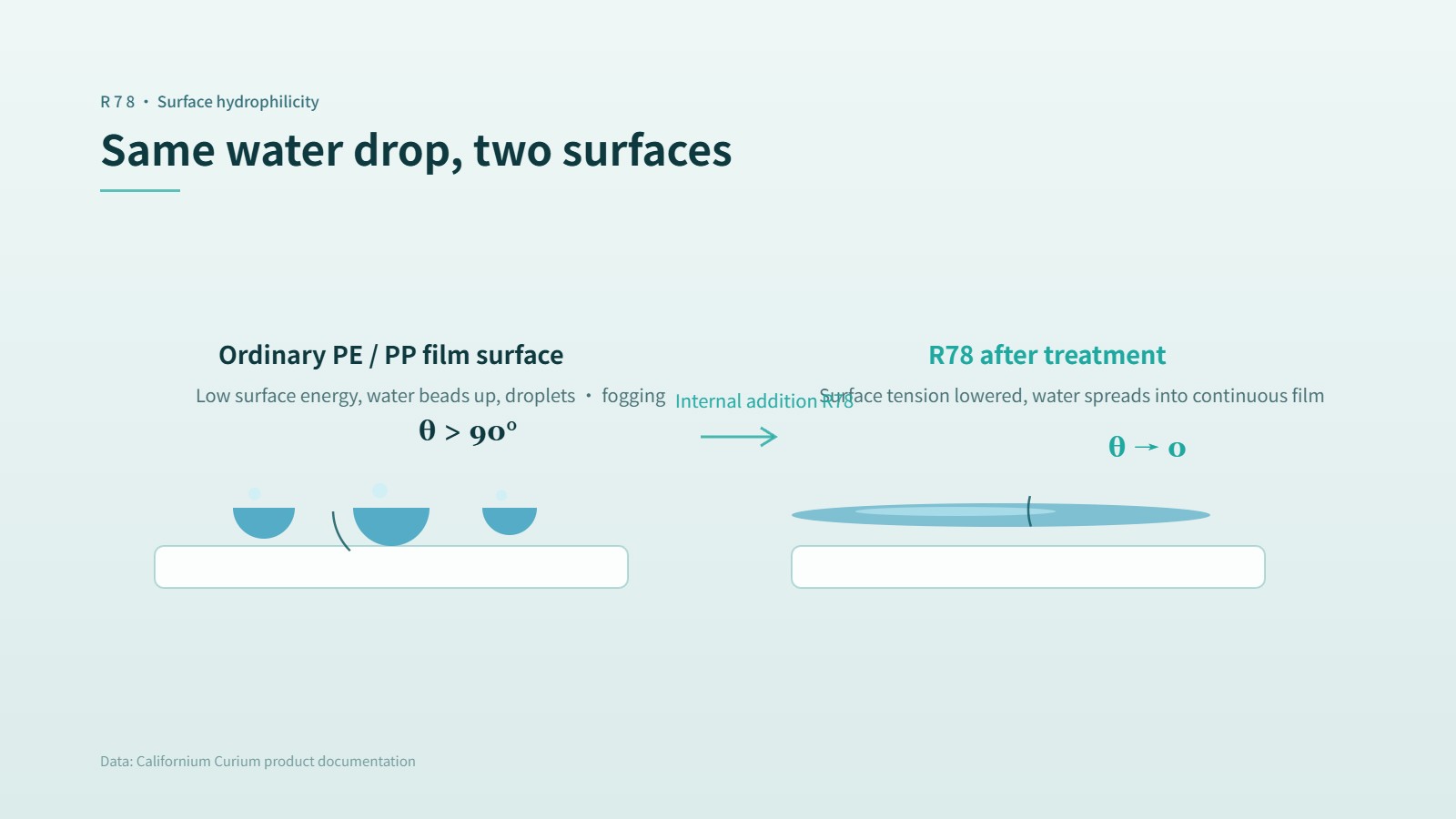
Compare an ordinary PE bag with a sheet of water-laid tissue: water soaks into the tissue almost instantly, while on the PE film it shrinks into beads that roll around. Both are solid surfaces; the difference is how much the material welcomes water — tissue is hydrophilic, while polyolefins such as PE and PP are hydrophobic by nature.
That hydrophobicity is an advantage in most packaging scenarios (moisture and water barrier), yet in others it is precisely the weakness: nonwovens need hydrophilic treatment before they can transport liquid; fogging and condensation on the inside of films happen because water cannot form a continuous layer on the surface and only beads up; and textiles that need a better hand feel, antistatic behaviour and soil resistance all hinge on making the surface willing to deal with water. Rubber & plastics hydrophilic agent R78 was developed for exactly this shortcoming. (Source: Californium-Curium Functional Additives 1.09.pdf p63)
The R78 approach: planting hydrophilic groups into the material
Hydrophilic treatment on the market is either applied on the surface (coatings, impregnation) or built into the material. R78 belongs to the latter — a hydrophilic agent used with blend modification. The manual positions it plainly:
"Hydrophilic agent R78 is a hydrophilic agent developed by our company that gives plastics, rubber and other products a super-hydrophilic function." (Source: p63)
Its main component is polyether polyol, supplied as a white powder with 100% active content, readily soluble in water, flash point 315°C. (Source: p63) "Blend modification" means the hydrophilic component is not a film floating on the finished surface: it is fused with the resin at the mixing stage, so the finished article carries its hydrophilic layer naturally — this is the fundamental difference between the internal-addition route and surface coating.
The manual's note on its character is also worth reading:
"This product is a non-ionic surfactant, soluble in water, alcohols and other solvents. Non-toxic, non-corrosive, no pollution to the environment." (Source: p63)
Pelletize first, then process — two steps that cannot be merged into one
Moved from the bodyOperation steps (original text, as is)
- Blend R78 with the resin and run pelletizing first — so the hydrophilic component disperses evenly in the resin;
- Then use the pelletized compound for injection molding or extrusion.
The manual is explicit about how to use R78:
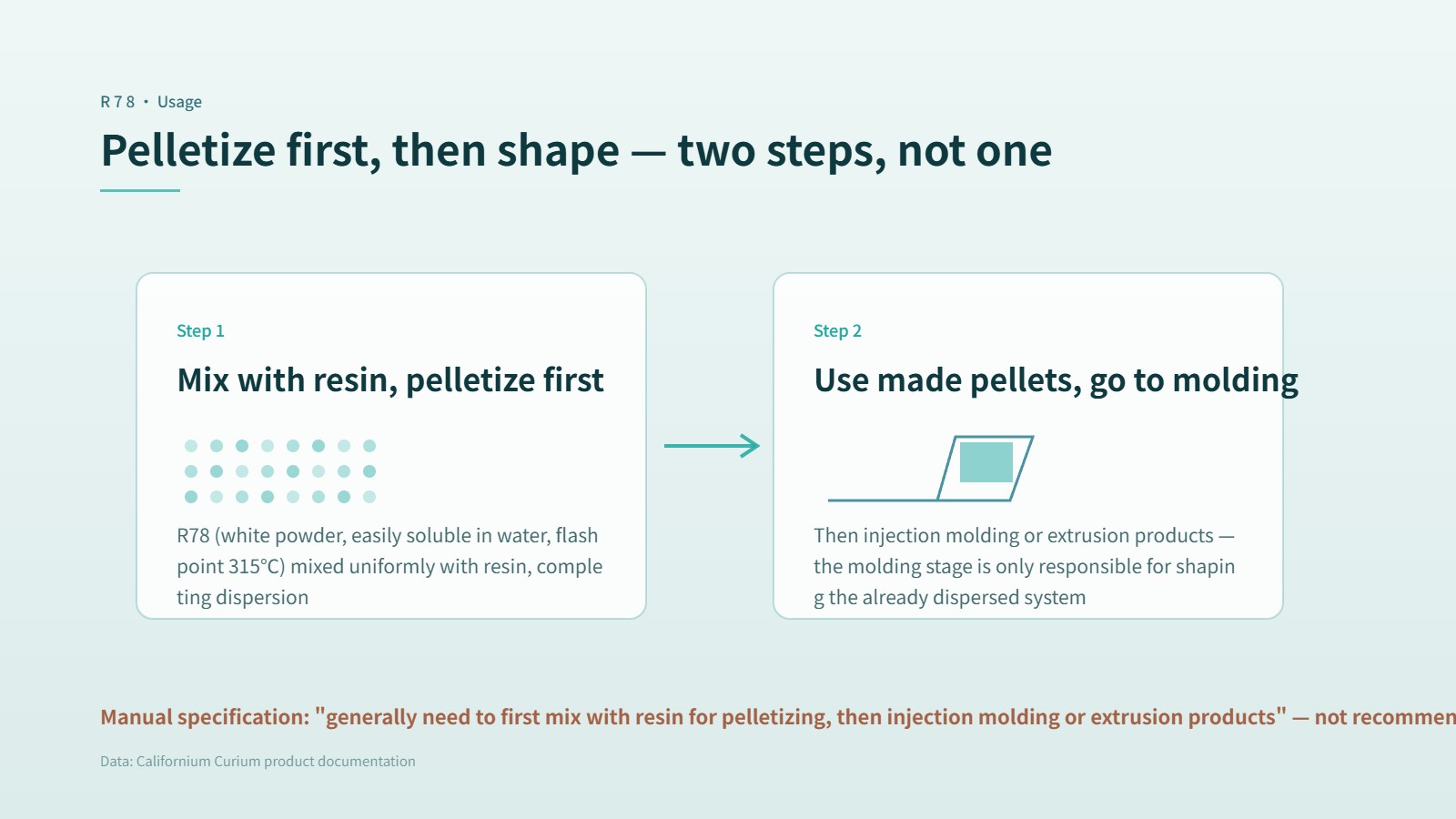
"Rubber & plastics hydrophilic agent R78 is used for blend modification of hydrophobic polymers such as plastics, rubber and elastomers, raising the hydrophilic performance of hydrophobic polymers. Generally it needs to be mixed with the resin and pelletized first, then injection-molded or extruded into products." (Source: p63)
Broken down into shop-floor actions, that is two steps:
R78 is a white powder, which makes weighing and feeding more straightforward than with viscous liquids; but note the manual's wording of "generally needs" for the pelletizing step — dispersion uniformity is a question you settle at the pelletizing stage, and the forming stage only fixes the already-dispersed system in place. (Source: p63) The manual gives no fixed dosage range; the working ratio should be settled by trial. (Source: p63)
Two routes: into the resin, or directly onto textiles
R78 has one branch many hydrophilic agents do not have — textile treatment. From the manual:
"It can be used alone on textiles in water-soluble form, or added into resins. Suitable for all kinds of fibers, such as polyester, nylon, cotton, wool, rayon and so on. It can markedly improve fabric hand feel and antistatic behaviour, and can enhance wash fastness and soil resistance." (Source: p63)
In other words, R78 opens in two ways:
Both routes arrive at the same destination: a surface that welcomes water. On textiles it also brings better hand feel, antistatic behaviour, wash fastness and soil resistance — not several independent functions, but the knock-on effects of a changed surface. (Source: p63)
Parameters and packaging
| Item | R78 |
|---|---|
| Main component | Polyether polyol |
| Appearance | White powder |
| Flash point | 315°C |
| Density | (25, g/cm) 0.91-0.96 |
| Active content | 100% |
| Water solubility | Readily soluble in water |
| Packaging | 25 kg bags, double-layer PE |
| Storage | Cool, dry place; keep away from moisture |
(Source: Californium-Curium Functional Additives 1.09.pdf p63. Note: the manual gives no dosage range on this page; nothing has been inferred or supplemented.)
Selection notes
For hydrophilic modification of rubber and plastics articles, R78 offers a formulation-side starting point: a powder form, pelletize first then process, and set the grade by the actual hydrophilic performance of the finished article; for textile treatment, take the water-soluble route applied on its own. Every system differs in resin, fiber and process — the final recipe should be settled by trial.
(Product page on this site: R78 rubber & plastics hydrophilic agent.)
Article actions
If this piece was useful, you can leave a mark — the like count comes from our back office at admin.kj9896.com; when the endpoint is unreachable the buttons are disabled and the count shows “—”. No invented figures are ever filled in.
Link: https://kj9896.com/en/news/r78-hydrophilic-modification-plastics
Related reading
- 01Same “0.5–2%,” Two Denominators in Manuals: Why Conductive Carbon Black Additive Dosages Cannot Be Directly Converted11 October 2026
- 02When National Standard FV-2 and UL94 V-2 Are Both Listed: Why Do Both Conclusions Hold for the Same Formulation?11 October 2026
- 03Flame-Retardant Ratings Cannot Be Looked Up in a Table: Loading, Thickness, and UL94 Must Be Considered Together11 October 2026
Products mentioned in this article
Keep reading
More company announcements and product updates are in the newsroom.