
High-temperature hyperdispersant for masterbatchPolyolefin ether · dedicated to fluoroplastics and high-temperature engineering plastics
A high-efficiency additive dedicated to improving the dispersion of fluoropolymers (PTFE, PVDF, FEP and others) in solvents or substrates — withstanding extreme high temperatures of 200–400 ℃.
- 🔥 Withstands 200–400 ℃
- ⚡ Lowers interfacial tension and melt viscosity
- 🛡️ Steric hindrance + electrostatic repulsion
- 🧪 Chemically inert · corrosion-resistant and insulating
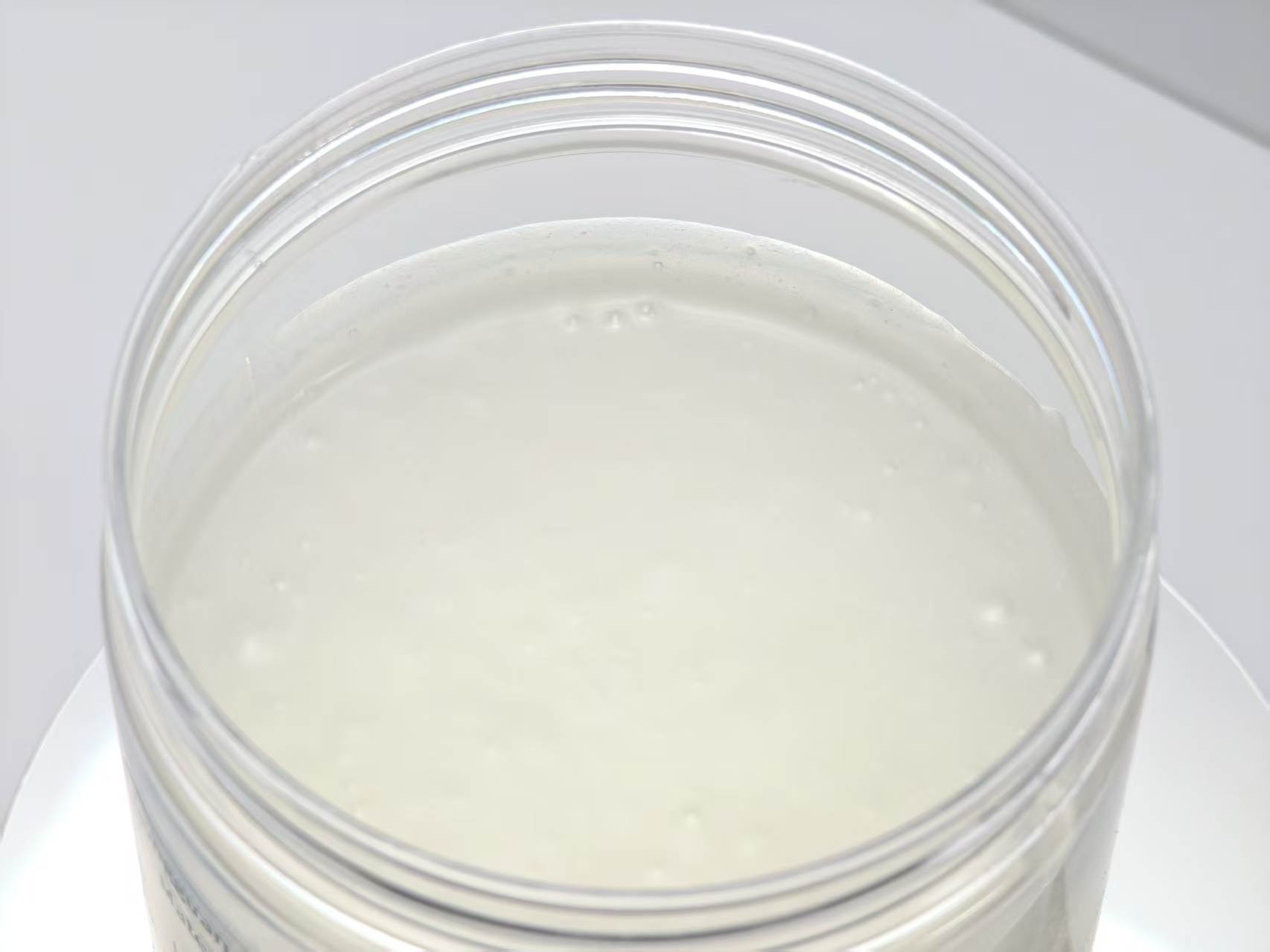 White with a yellowish cast · polyolefin ether
- 200–400 ℃
- 200 – 400 ℃
- Density
- 0 g/ml
- pH value
- 0 – 0
- Solubility
- Insoluble in water, soluble in alcohols and esters
Overview and mechanism of action
By lowering interfacial tension and preventing particle agglomeration it markedly improves the processing performance and final quality of fluoroplastics.
Steric hindrance or electrostatic repulsion prevents fluoroplastic particles (such as PTFE micropowder) from agglomerating in solvents or resins.
Improves the compatibility of fluoroplastics with non-polar/polar systems, acting as a key bridge in coatings, inks and composites.
Steric hindrance + electrostatic repulsion
Through steric hindrance or electrostatic repulsion, fluoroplastic particles (such as PTFE micropowder) are prevented from agglomerating in solvents or resins — two mechanisms working together for long-term dispersion stability.
A bridge between non-polar and polar systems
It improves the compatibility of fluoroplastics with non-polar/polar systems, acting as a key bridge in coatings, inks and composites — interfacial tension drops markedly.
Lower melt viscosity
Lower melt viscosity greatly improves flow in high-temperature processing such as extrusion and injection moulding of engineering plastics — processing efficiency rises markedly.
Specification (TDS)
Typical ex-works values; a COA test report accompanies every batch.
Applications and suitable material systems
Three application tracks: high-temperature engineering resins, high-performance composites and advanced electronic materials.
High-temperature engineering resins
- Silicone resins
- Fluoroplastics (PTFE, PVDF, FEP)
- PA (nylon), POM (acetal)
- PC (polycarbonate), PET (polyester)
High-performance composites
- Fluoroplastic + metal substrate
- Fluoroplastic + ceramic substrate
- Markedly stronger interfacial bonding
Advanced electronic materials
- Fluoroplastic insulating layers
- Even dispersion of thermally conductive fillers
- Electrical insulation preserved
Technical advantages and performance
The 200–400 ℃ tolerance window made visible — extreme high-temperature capability you can read off the scale.
1. Excellent high-temperature resistance
Easily handles the extreme high-temperature processing environment of 200 ℃ – 400 ℃ for fluoroplastics and high-temperature engineering plastics.
2. Outstanding chemical inertness
Fully matched to fluoroplastics and does not affect their intrinsic corrosion resistance and electrical insulation.
3. High efficiency at low dosage
Usually only 0.5% – 5% is needed to markedly improve the dispersion of pigments and fillers.
Packing and storage · sample request
Submit the form and a technical consultant will contact you within 24 hours to arrange a sample.
Recommended dosage
Adjust the amount according to the specific surface area of the pigment/filler and system requirements to markedly improve dispersion.
Packing and storage
01Product positioning
E099 belongs to the "hyperdispersant" category (English category name Hyperdispersant), official full name "Rubber & Plastics Hyperdispersant E099"; page title "High-Temperature Masterbatch Hyperdispersant". Handbook table-of-contents line verbatim: "E099: Rubber & Plastics Hyperdispersant, Ultra-High-Temperature Masterbatch for Specialty Plastics, PTFE Masterbatch, etc."; official positioning line "For ultra-high temperature use, first choice for PTFE masterbatch"; official mechanism field "Chemical dispersion (ultra-high-temperature resistant)". (Data source: product handbook / official product data)
[Product Overview] verbatim: "E099 is a new type of hyperdispersant developed and produced by our company specifically for the coloring of high-temperature plastics and specialty plastics. The E099 hyperdispersant is a class of high-efficiency additives dedicated to improving the dispersion performance of fluoropolymers (such as PTFE, PVDF, FEP, etc.) in solvents or substrates. By reducing interfacial tension and preventing particle agglomeration, they significantly enhance the processability of fluoroplastics and the performance of the final product." (Data source: product handbook / official product data)
Three core functions (verbatim): "Dispersion stability: through steric hindrance or electrostatic repulsion, prevents fluoroplastic particles (such as PTFE micropowder) from agglomerating in solvents or resins." "Compatibility improvement: improves the compatibility of fluoroplastics with non-polar/polar systems, especially critical in coatings, inks, and composites." "Processing optimization: reduces melt viscosity and improves the smoothness of processes such as extrusion and injection molding." (Data source: product handbook / official product data)
Three technical advantages (verbatim): "High-temperature resistance: suitable for the high-temperature processing environment of fluoroplastics (200-400°C)." "Chemical inertness: compatible with fluoroplastics, without affecting their intrinsic properties such as corrosion resistance and insulation." "Low addition level: typically only 0.5%-5% is needed to significantly improve the dispersion effect." (Data source: product handbook / official product data)
- High-temperature resistance — "suitable for the high-temperature processing environment of fluoroplastics (200-400°C)", official positioning line "for ultra-high temperature use".
- Chemical inertness — "compatible with fluoroplastics, without affecting their intrinsic properties such as corrosion resistance and insulation".
- Low addition level — "typically only 0.5%-5% is needed to significantly improve the dispersion effect".
- Dispersion stability — "through steric hindrance or electrostatic repulsion, prevents fluoroplastic particles (such as PTFE micropowder) from agglomerating in solvents or resins".
- Compatibility improvement — "improves the compatibility of fluoroplastics with non-polar/polar systems, especially critical in coatings, inks, and composites".
- Processing optimization — "reduces melt viscosity and improves the smoothness of processes such as extrusion and injection molding".
02Formulation system & mechanism of action
The main component is polyolefin ether; the overview sentence is composed of three parts: a positioning clause (coloring of high-temperature plastics and specialty plastics) + a qualitative clause (improving the dispersion performance of fluoropolymers in solvents or substrates) + an effect clause (reducing interfacial tension, preventing particle agglomeration, enhancing processability and final product performance). The specific grade designation, polymerization structure, and formulation ratio are not provided in the materials — not to be supplied on their behalf. (Data source: product handbook / official product data)
The three core functions are the elaboration of the mechanism (verbatim): "Dispersion stability: through steric hindrance or electrostatic repulsion, prevents fluoroplastic particles (such as PTFE micropowder) from agglomerating in solvents or resins." "Compatibility improvement: improves the compatibility of fluoroplastics with non-polar/polar systems, especially critical in coatings, inks, and composites." "Processing optimization: reduces melt viscosity and improves the smoothness of processes such as extrusion and injection molding." (Data source: product handbook / official product data)
Boundaries of effect: the overview, core functions, and technical advantages are all directional statements — there are no quantitative values for interfacial tension, melt viscosity, or dispersion efficiency, and no comparative data; this page does not extrapolate or make commitments. (Data source: product handbook / official product data)
- Dispersion stability — steric hindrance + electrostatic repulsionPrevents fluoroplastic particles (such as PTFE micropowder) from agglomerating in solvents or resins.
- Compatibility improvement — a bridge for polar systemsImproves the compatibility of fluoroplastics with non-polar / polar systems; critical in coatings, inks, and composites.
- Rheology optimization — reducing melt viscosityImproves the smoothness of processes such as extrusion and injection molding.
- Temperature resistance and inertness — throughout the entire processing"Suitable for the high-temperature processing environment of fluoroplastics (200-400°C)"; "compatible with fluoroplastics, without affecting their intrinsic properties such as corrosion resistance and insulation".
03Key parameters
The four physicochemical items recorded in the official product data and the product handbook are reproduced verbatim below (inter-layer differences in notation are reproduced layer by layer and not reconciled). The values in the table are as recorded in the source; a small-scale test is recommended before use.
| Item | Value / description |
|---|---|
| Main component | Polyolefin ether |
| Density | 0.91g/ml |
| pH value | 6.1-6.7 |
| Color | White with a yellowish hue |
| Solubility | Insoluble in water, soluble in alcohols and lipids. |
| High-temperature resistance | Suited to the high-temperature processing environment of fluoroplastics (200-400°C) |
| Chemical inertness | Compatible with fluoroplastics; does not affect their intrinsic properties such as corrosion resistance and insulation |
| Packaging | 20 kg PE plastic drums |
| Storage | Cool, dry place; protect from moisture |
| Documents supplied with shipment | Typical values at factory release; a COA test report accompanies each batch |
| Shelf life · Transport · Detailed processing temperature window · Test methods | Not listed in the source — not drafted on the source's behalf |
Reading notes: ① Inter-layer differences in notation are reproduced verbatim and not merged ("0.91g/ml" / "0.91 g/ml"; "6.1-6.7" / "6.1 – 6.7"); ② Apart from the four physicochemical items there are no other physicochemical items such as solid content or viscosity, and none are filled in from other grades; ③ The values in the table are as recorded in the source; a small-scale test is recommended before use. (Data source: product handbook / official product data)
04Recommended dosage window
The quantitative statement appears in item 3 of the "Technical Advantages" section of the handbook and is identical at both levels to the "Recommended dosage" column on the detail page: 0.5%-5% ("Low dosage: usually only 0.5%-5% is needed to significantly improve the dispersion effect"). The basis of the denominator is not specified at either level — this page reproduces the range verbatim and does not draft a denominator.
| Scenario | Dosage | Conditions & notes |
|---|---|---|
| General addition ratio (pigment/filler dispersion) | 0.5% – 5% | Identical at both levels: item 3 of the "Technical Advantages" section of the handbook and the "Recommended dosage" column on the detail page; basis for adjustment: "adjusting the dosage appropriately according to the specific surface area of the pigment/filler and the system requirements will significantly improve the dispersion effect" |
The dosage follows a "low dosage" approach: the source records "usually only 0.5%-5% is needed to significantly improve the dispersion effect"; the basis for adjustment is the specific surface area of the pigment/filler and the system requirements. The basis of the denominator is not specified in the source; this page neither drafts it nor converts it. This grade has no "thickness–dosage" directional clause (the source records nothing on "thinner" or "thickness") — directional clauses of other grades do not apply.

To be verified: ① the basis of the denominator for the addition level (not specified in the source); ② the quantitative statement appears in the "Technical Advantages" section (not a standalone dosage column) — it is recommended that the source list a standalone dosage column; ③ the above are as recorded in the source; for actual use, please confirm by a small-scale test with your own system.
05Applications
The "Application Fields" section of the handbook is reproduced verbatim below, together with the application layer of the detail page; the page block notes "Three major application tracks: high-temperature engineering resins, high-performance composites, and high-end electronic materials".
- High-temperature engineering resins
- Used in silicone resins, fluoroplastics, PA plastics, POM plastics, PC plastics, PET plastics, etc.; the detail page records a 200–400℃ processing window.
- High-performance composites
- "Composites: enhance the interfacial bonding between fluoroplastics and metals, ceramics, etc."
- High-end electronic materials
- "Electronic materials: used for the uniform dispersion of fluoroplastic insulation layers and thermally conductive fillers."
- Target systems
- "Fluoropolymers (PTFE, PVDF, FEP, etc.) dispersed in solvents or substrates"; ultra-high-temperature color masterbatch for specialty plastics (catalog line).
- Formulation and processing
- "Reduces melt viscosity and improves the smoothness of processes such as extrusion and injection molding"; the specific feeding sequence / mixing method / detailed processing temperature window are not listed in the source.
- Distinguishing boundaries
- This product differs in grade category and target from the conductive carbon black, mirror / high-gloss, waterborne, and other directions — values are not interchangeable; no entry corresponding to this grade was found on the masterbatch side — stated as "none" and not inferred.
Field issues & application examples (as recorded in the source material)
| Field issue | What the source material states |
|---|---|
| What problem does it specifically address? | Targeted at the "high-temperature plastics and specialty plastics coloring" direction: improves the dispersion performance of fluoropolymers (PTFE, PVDF, FEP, etc.) in solvents or substrates, "by reducing interfacial tension and preventing particle agglomeration". |
| Is it stable under high-temperature processing? | The Technical Advantages section records "High-temperature resistance: suited to the high-temperature processing environment of fluoroplastics (200-400°C)"; "Chemical inertness: compatible with fluoroplastics, does not affect their intrinsic properties such as corrosion resistance and insulation". |
| How much to add? | 0.5%-5% ("usually only 0.5%-5% is needed to significantly improve the dispersion effect"); adjust according to the specific surface area of the pigment/filler and the system requirements. The basis of the denominator is not specified in the source. |
| In which systems can it be used? | Handbook "Application Fields": silicone resins, fluoroplastics, PA plastics, POM plastics, PC plastics, PET plastics, etc.; composites (fluoroplastic–metal / ceramic interfaces); electronic materials (fluoroplastic insulation layers, thermally conductive fillers). |
06How it differs from related grades
Within the hyperdispersant series, the ones most easily associated with this grade are adjacent item numbers in the same brochure and same-series grades for different directions — identification is always based on the four items of official full name, category, mechanism, and target, not by analogy from number or appearance. The comparison is as follows:
| Model | Official Full Name · Category | Target | Main Component / Appearance | Dosage System |
|---|---|---|---|---|
| E099 | Rubber and plastics hyperdispersant · Hyperdispersant (high-temperature-resistant masterbatch direction) | Coloring of high-temperature-resistant plastics and specialty plastics; fluoropolymers (PTFE, PVDF, FEP, etc.) | Polyolefin ether / white, yellowish tone | 0.5%-5% (low-dosage route; denominator not specified) |
| R1618 | Conductive carbon black hyperdispersant for plastics · Conductive hyperdispersant | Conductive carbon black for plastics (plastics / rubber products, cable compounds) | Polyolefin ether / white milky liquid | 0.5-2% based on total carbon black weight / 0.5%—2% of the final plastic product (two lines) |
| PT50 | Hyperdispersant for mirror-surface plastics · Mirror-surface agent | Mirror-surface plastics / high-gloss direction | Amide type / not listed in the source | Not listed in the source on this page |
| R900A | Liquid masterbatch base · Liquid masterbatch base | Liquid masterbatch direction | Not listed in the source on this page | Not listed in the source on this page |
| R902 | External lubricant modifier for plastics · External lubricant | External lubrication direction | Not listed in the source on this page | Not listed in the source on this page |
Reading notes: (1) E099 ≠ R1618 (adjacent in the same brochure but entirely different in category / target / appearance / dosage system); E099 ≠ PT50 (both listed in the hyperdispersant series, but different in category and target); E099 ≠ R900 / R900A / R902 (similar numeric digits, but each a different category); (2) none of the three grades has a substitute / derivative relationship with this grade (the source does not state any such relationship); (3) the values in each row come from the source records of each grade itself and are not interchangeable. (Data source: product handbook / official product data)
07Usage & storage
The following points are taken item by item from the source records; items not listed in the source are not improvised.
Dosage (both levels recorded as-is)
- 0.5%-5% ("usually only 0.5%-5% is needed to significantly improve the dispersion effect").
- Basis for adjustment: "appropriately adjust the dosage according to the specific surface area of the pigment and filler and system requirements to significantly improve the dispersion effect".
- The denominator basis is not specified in the source; not improvised and not converted.
Temperature Resistance and Service Environment
- "High-temperature resistance: suitable for the high-temperature processing environment of fluoroplastics (200-400°C)."
- "Chemical inertness: compatible with fluoroplastics, without affecting their intrinsic properties such as corrosion resistance and insulation."
Packaging and Storage
- Packaging: 20 kg PE plastic drums.
- Storage: cool, dry place, protected from moisture.
Not Stated in the Source (not compiled on this page)
- Standalone dosage section, shelf life, shipping terms, detailed processing temperature window, feeding order / mixing method, safety notes, and test methods — not listed in the source for this grade; please request the accompanying technical documents by specific item number.
08FAQ
What kind of product is E099?
A rubber and plastics hyperdispersant (high-temperature-resistant masterbatch direction): developed specifically for coloring high-temperature-resistant plastics and specialty plastics, used to improve the dispersion performance of fluoropolymers (PTFE, PVDF, FEP, etc.) in solvents or substrates.
How much should be added?
0.5%-5% ("usually only 0.5%-5% is needed to significantly improve the dispersion effect"); adjust according to the specific surface area of the pigment and filler and system requirements. The denominator basis is not specified in the source and is not improvised on this page.
What processing temperature can it withstand?
The technical advantages record "suitable for the high-temperature processing environment of fluoroplastics (200-400°C)"; in addition, "compatible with fluoroplastics, without affecting their intrinsic properties such as corrosion resistance and insulation." A more detailed processing temperature window is not listed in the source.
Is it the same category as R1618 and PT50?
No. R1618 is a conductive hyperdispersant (conductive carbon black for plastics direction); PT50 is a mirror-surface agent (mirror-surface plastics direction); E099 is a hyperdispersant (high-temperature-resistant coloring / fluoroplastics direction). The three are independent in category, target, and dosage system; adjacent numbers or names both containing "hyperdispersant" are not grounds for treating them as the same category.
What are the packaging and storage conditions?
Packaging: 20 kg PE plastic drums; store in a cool, dry place, protected from moisture. A COA test report (typical factory values) is supplied with the goods. Shelf life is not stated in the source. (Data source: product handbook / official product data)
Is there any quantitative data?
The source gives only directional statements: no quantitative values for interfacial tension, melt viscosity, dispersion efficiency, etc., and no comparative data; this page does not extrapolate or make commitments.
AppendixData sources
The data on this page come from two types of sources and are traceable item by item:
- Product handbook: the entire technical data page for this grade (overview / three core functions / main components / four physical and chemical properties / application fields / three technical advantages / packaging / storage conditions); the catalog line and the company profile listing sentence.
- Official product data: all fields for this grade (name, category, positioning, description, mechanism, application, parameters, main components); the hyperdispersant series entries; the official detail page copy.
Not covered by the source material (not written on this page — to be added later)
- The dosage denominator basis is not specified; the quantitative sentence is located in the [Technical Advantages] section (not a standalone dosage section) — it is recommended that a standalone dosage section be provided on the source side.
- Differences in notation between levels (0.91g/ml ↔ 0.91 g/ml; 6.1-6.7 ↔ 6.1 – 6.7) — recorded as-is per level, not harmonized across levels.
- Specific grades, polymerization structures, and compounding ratios of the main components — not given in the source.
- Standalone dosage section, shelf life, shipping terms, detailed processing temperature window, feeding order / mixing method, safety notes, disclaimers, and test methods — not listed in the source.
- No quantitative values for interfacial tension / melt viscosity / dispersion efficiency, and no comparative data — not extrapolated.