
Technology explained · 28 September 2026
Where Adding 2% and Adding 8% Differ: The Real Impact of Flame Retardant Dosage on System Performance
For the same flame retardant, the difference between adding 2% and adding 8% is not six percentage points, but four things: flame retardant rating, mechanical and surface properties, processing window, and finished article grammage. This article first finds a denominator for the percentage (four denominators coexist in the source documents), then compares the three tiers of M922 at 3.5%/4-6%/8%, the measured comparison table for R200 with 2% added, and the original text of two "adding more makes it worse" inflection points, and provides a trial-scale practice and moisture content and shelf life reminders.
- 01Anti-agglomeration
- 02Distribution rate
- 03Lubrication balance
Moved from the body2% added: before/after comparison table · full table moved up
| Variable | Source evidence (key points from original text) | Source (printed page) |
|---|---|---|
| Flame retardant rating | R915: use 1%–2% for V-2 and 2%–4% for V-0; R912B: 1.5%-5% achieves V-0, LOI ≥38%; R200: adding 2% raises the rating from V-2 to V-0 (0.8mm) | -54-, -52-, -46- |
| Mechanical properties | R912B “has relatively little effect on the mechanical properties of PET materials (such as tensile strength and impact strength)”; R915 “does not significantly reduce the impact, tensile or flexural properties of PET/PETG and does not impair printing, bonding or heat sealing properties”; R912 “causes relatively little damage to the original mechanical properties of the substrate, with toughness and weather resistance”; R100 “improves the tensile strength, impact strength, flexural strength and other mechanical properties of the finished article” | -52-, -53-, -50-, -44- |
| Surface and appearance | R912 “no blooming, no exudation, no mould sticking”; R915 “no whitening, no yellowing and no exudation during processing” and “after double-85 hygrothermal ageing, no blooming and no exudation, and no oil mist on the surface of the finished article”; for transparency, R912 “reduces substrate light transmittance by about 20%”, R912B “causes only about 20% light transmission loss”, and the R915 column states “no negative effect on substrate light transmittance or haze” | -50-, -53-, -52- |
| Processing window | See the 5 temperature boundaries under Mechanism 4 above | -54-, -52-, -47-, -56-, -84- |
| Article grammage and density | M922 1.10 g/cm³, M915 1.21 g/cm³, M918 1.22 g/cm³, M911 0.89 g/cm³; synergist R218 density approximately 2.6–3.2 g/cm³ | Masterbatch volume -9-/-2-/-3-/-1-; -57- |
Three tiers of the same model (source text)
- 3.5%
- 4-6%
- 8%
Grow measured values from this article's table into bar columns frame by frame: bar height equals original value, grows as it scrolls.Scroll-driven, animated frame by frame with requestAnimationFrame; when the system requests reduced motion or the screen is narrow, the final frame is shown directly.
First, find a denominator for "2%" and "8%"
The most common sentence in flame retardant technical data is "recommended dosage X%," and it is also the easiest to get wrong—because a percentage must be preceded by a denominator. At least four denominators are used simultaneously in the source document:
- Calculated on the basis of inorganic filler mass: R100 "recommended dosage is 0.5% - 3% of inorganic filler mass"; R200 "added at 1-3% of hydroxide filler mass, recommended 2% (increase to 3% when filler specific surface area >20m²/g)". (Source: Californium Curium – Functional Additives 1.09, PDF page 48, printed page -44-; page 51, printed page -47-)
- Calculated on the basis of powder amount and varying with fineness: the dosage table for R1800-S gives values by mesh size for calcium carbonate, talc, and kaolin in successive tiers (the full table is quoted in Section 3 below). (Source: Californium Curium – Hyperdispersant Series, PDF page 2, printed page -11-)
- Calculated on the basis of the final article: R1800-S "0.5%—1% of the final plastic product"; R902 "0.5%—5% of the final plastic product"; R333 "conventional condition dosage 0.5%-1.2%; medium-to-high irradiation dose (above 50 kGy), long-term ageing condition dosage 1.2%-1.8%". (Source: Californium Curium – Hyperdispersant Series, PDF page 4, printed page -13-; Californium Curium – Functional Additives 1.09, PDF page 71, printed page -67-; page 88, printed page -84-)
- Calculated on the basis of total resin mass or a specific component: R940 "UV acrylic system (light-curing) recommended dosage: 15-30% (based on total resin mass)"; "polyurethane system (PU/PUA) recommended dosage: 12-25% (based on polyol component)". (Source: Californium Curium – Functional Additives 1.09, PDF page 60, printed page -56-)
Four denominators coexist in the same document. This is the first question that must be answered for "adding 2% vs adding 8%": 2% of what? Only after the denominator is clarified is it possible to compare the real tiers below.
There is also a more subtle way of writing than a missing denominator: mixing per-mille and percentage symbols. The source document contains two instances of per-mille wording, transcribed verbatim—R1800-S states "when processing kaolin, adding 2 per mille can improve insulation properties"; R100A states "recommended addition ratio: 3 to 10 per mille (typically calcium carbonate 3‰-7‰, talc 8‰-10‰, barium sulfate 5‰-7‰, titanium dioxide 3‰-5‰)". 3‰ is 0.3%, ten times different from 3%. (Source: Californium Curium – Hyperdispersant Series, PDF page 2, printed page -11-; Californium Curium – Functional Additives 1.09, PDF page 49, printed page -45-)
Three tiers for the same model: M922 at 3.5% / 4-6% / 8%
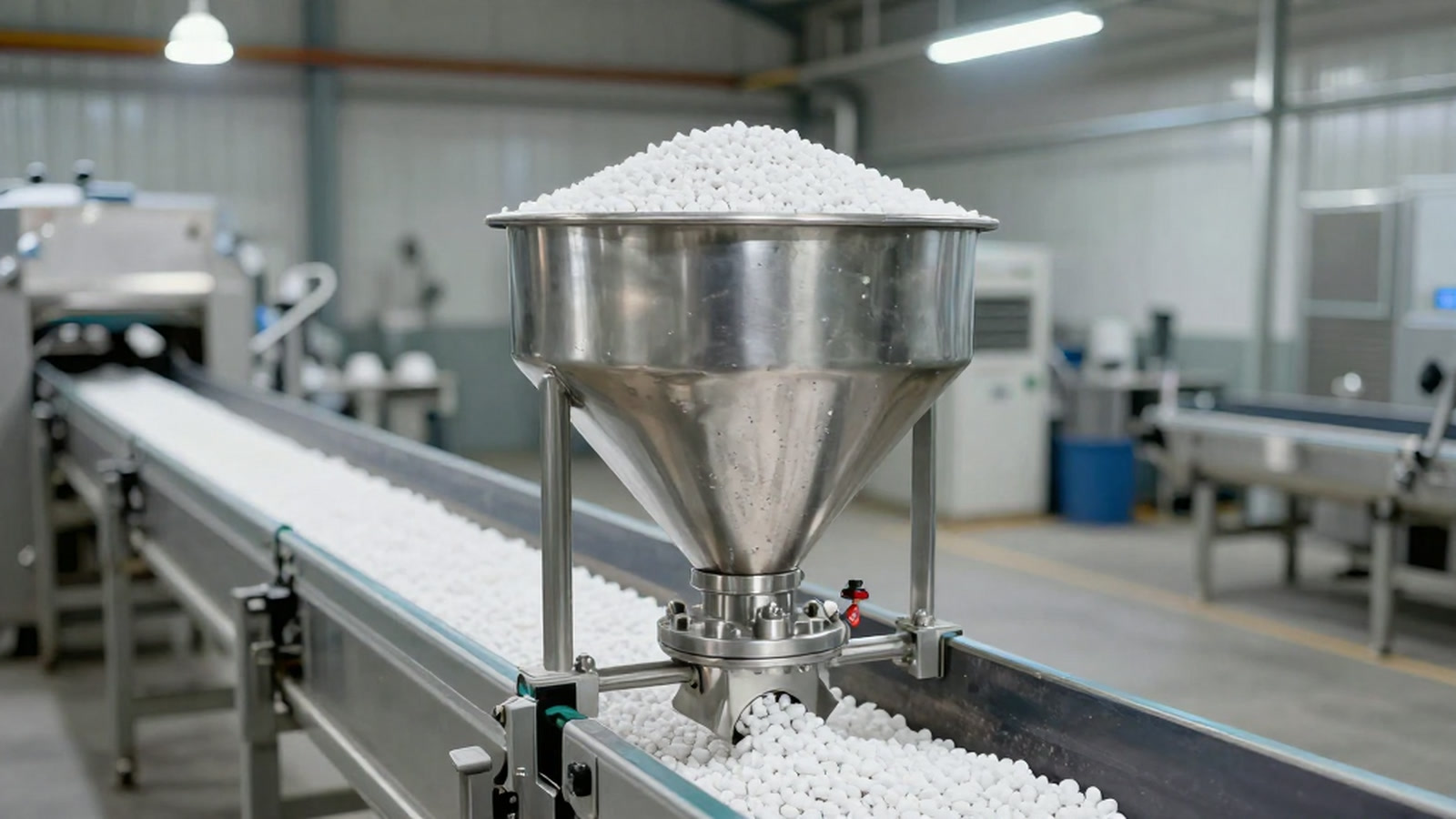
In the technical data sheet for flame retardant masterbatch M922, the "dosage" line gives three tiers, which serves as the best anchor point for this article. Transcribed verbatim:
Dosage: homopolymer 3.5%, homopolymer-copolymer blend 4-6%, copolymer 8%
Other indicators on the same page are also transcribed verbatim: environmental standard ROHS; flame retardant rating UL94 V2; appearance white cylindrical granules; effective flame retardant content 25; density 1.10 g/cm³; moisture content ≤0.1%; melting point ≥160℃; melt flow index (MFI) 15 g/min (200℃, 5 kg); decomposition temperature 230℃ (TGA1%). (Source: Californium Curium – Functional Masterbatch 1.05-4, PDF page 13, printed page -9-)
The meaning of the three tiers is: the same masterbatch, when used in homopolymer PP, homopolymer/copolymer blend PP, and copolymer PP, takes 3.5%, 4-6%, and 8%, respectively. In other words, on this line, "adding 2% and adding 8%" are not two arbitrarily chosen figures, but two real tiers for the same product under two different substrate states, with only one variable in between: the molecular structure of the matrix.
Why does copolymer PP require 8%? The document does not elaborate on the mechanism on this page (this item is not elaborated in the document).
However, in the same document, another halogen-free masterbatch gives a statement in the opposite direction and must be read together: M933 (PP halogen-free V0 flame retardant masterbatch) under [reference dosage] states "15-25%" and notes "the thinner the product, the better the flame retardant effect and the smaller the addition ratio; the actual dosage is subject to the customer's actual results." On the same page, a measured case is given: "In a PP sheet with a thickness of 0.4mm, when 25 parts of this product are added, dripping does not ignite cotton." (Source: Californium Curium – Functional Masterbatch 1.05-4, PDF page 14, printed page -10-)
Meanwhile, the [usage method] for PE halogen-free flame retardant R911 states: "Based on the thickness of thin PE articles and flame retardant requirements, the recommended dosage is 10%-20% (the thinner the article, the higher the dosage is recommended), and the optimal ratio can be determined through small-sample testing." (Source: Californium Curium – Functional Additives 1.09, PDF page 53, printed page -49-)
One says "the thinner the article, the smaller the addition ratio" (M933, PP system), and the other says "the thinner the article, the higher the dosage is recommended" (R911, PE system). The two statements point in opposite directions. The premise for each is a different system and mechanism: M933 is a phosphorus-based masterbatch with synergist and surface coating, while R911 is a hindered amine type that follows the thin-film/thin-sheet route. The conclusion is straightforward—dosage tiers cannot be applied across systems; someone else's 8% is not your 8%.
Calculated by flame retardant rating: that 1 percentage point between V-2 and V-0
A more common denominator than "substrate" is the "target flame retardant rating." The cleanest comparison in the document comes from R915 (transparent halogen-free flame retardant for PET/PETG):
UL94 V-2 (1.5mm): 1%–2%; UL94 V-0 (1.0–1.5mm): 2%–4%; a small amount of phosphorus-nitrogen synergist may be added as needed to reduce dosage, without affecting transparency throughout the process.
(Source: Californium Curium – Functional Additives 1.09, PDF page 58, printed page -54-)
The same page also gives process-side boundaries: "Extrusion/injection moulding barrel temperature: 240–275℃; die/mould temperature: 60–90℃; prohibit long-term high-temperature residence above 290℃ to avoid slight thermal degradation and yellowing of the flame retardant."
By putting these figures and several other models into one table, it becomes clear how much additional dosage is required between V-0 and V-2:
| Model | Flame retardant rating and dosage | Source (printed page) |
|---|---|---|
| R915 (PET/PETG, phosphorus content 18%) | V-2 (1.5mm) 1%–2%; V-0 (1.0–1.5mm) 2%–4% | -54- |
| R912B (PET, phosphorus-based + small amount of nitrogen-based synergist) | 1.5%-5% → UL94 V-0, LOI raised to above 38% | -52- |
| R911 (PE, hindered amine type) | 10%-20% → UL94 V-2 (film type) / GB/T 2408-2008 FV-2 | -49- |
| R200 (magnesium hydroxide/aluminium hydroxide system additive) | Add 2% (based on filler mass) → UL94 V-0 (0.8mm thickness), V-2 when not added | -46- |
| M918 (PA6 nylon halogen-free masterbatch) | 8%-12% → UL94V0, processing temperature <325℃ | Masterbatch volume -3- |
| M915 (PETG transparent halogen-free masterbatch) | 6%-10% → UL94V0, processing temperature <280℃ | Masterbatch volume -2- |
| M911 (PE halogen-free masterbatch) | 10%-25% → UL94V1, processing temperature <250℃ | Masterbatch volume -1- |
| M933 (PP halogen-free masterbatch) | 15-25%; 0.4mm PP sheet with 25 parts, dripping does not ignite cotton | Masterbatch volume -10- |
(Source: Californium Curium – Functional Additives 1.09, PDF pages 54–58 and page 50, printed pages -50-/-52-/-49-/-46-; Californium Curium – Functional Masterbatch 1.05-4, PDF pages 5–7 and page 14, printed pages -1-/-2-/-3-/-10-)
When reading this table, one thing should be noted: for the same goal of "reaching V-0", R915 uses 2%–4%, R912B uses 1.5%-5%, R911 takes the V-2 route rather than V-0, and M911 takes the UL94V1 route. Rating and dosage do not form a smooth curve, but are cut into several segments by three variables: system, substrate, and thickness. Any claim that "adding X% will reach a certain rating" must simultaneously provide these three conditions.
What actually happens in the system after adding 2%: the measured data table for R200
Same-dimension range intersection (% · 2 objects)
Dimension · %X-axis = dimension %; colored band = target interval where the object can fall; points outside the band = portions that cannot be reached.
- Target band
- Peak heat release …
- Effective utilisa…
- X-axis same dimension % ·
- X-axis scale based on this article's max (20–70 %); do not directly compare lengths across articles.
- Peak heat release …20–30 %
- Effective utilisat…60–70 %
Chart data (source text verbatim)
| Object | Range |
|---|---|
| Peak heat release rate | 20–30 % |
| Effective utilisation rate of the flame retardant | 60–70 % |
Source textScale 18–77 %
The data for flame-retardant aid R200 contains a complete "without vs with 2%" comparison table. This is the only place in the document where "how much to add" and "how much improvement" are quantified item by item in the same table. Transcribed line by line:
(Source: Californium Curium – Functional Additives 1.09, PDF page 50, printed page -46-; also on the same page in Californium Curium – Hyperdispersant Series, PDF page 37, printed page -46-)
The mechanism explanation on the same page explains why these 2% are effective: "Organophosphorus groups form covalent bonds with the hydroxide surface, dispersing agglomerated particles (average particle size reduced from 5 μm to below 1 μm) into nanoscale units, increasing the contact area between the flame retardant and the matrix by more than 3 times, and significantly improving endothermic cooling efficiency during combustion." It also gives three layers of protection during combustion: organophosphorus decomposition forms a phosphoric acid char layer (200-300℃) that blocks heat transfer; magnesium hydroxide/aluminium hydroxide dehydration and endothermic absorption (300-450℃) reduce matrix temperature; metal oxides and the char layer combine to form a barrier layer that suppresses the release of flammable gases.
In the indicator table on the same page, there are two more figures directly related to "how much to add": interfacial tension reduction ≥40% (with PP matrix); melt viscosity reduction of 15-20% (60% filler system), and the effect is noted as "allowing higher filler loading (up to 60%), with flame retardant dosage increaseable by 20%."
The next section of R200 gives three scenarios where percentages translate into production line results. This article transcribes the quantified parts:
- Electrical & electronics housings: In a PP flame retardant system, adding 2% of this product, together with 60% magnesium hydroxide, can make the finished article reach UL94 V-0 (1.5mm), while raising the heat deflection temperature by 10℃.
- Automotive interior parts: After using this product in PE-based composite materials, the oxygen index rises from 24% to 30%, meeting the automotive industry FMVSS 302 flame retardant standard (burning rate ≤100mm/min).
- Cable insulation layer
- After adding this product in a PVC system, the vertical burn test rating rises from V-1 to V-0, and smoke density is reduced by 15% (GB/T 8323.2 test).
(Source: Californium Curium – Functional Additives 1.09, PDF page 51, printed page -47-)
Note that the two figures in the first row are read together: 2% additive + 60% magnesium hydroxide. If one only remembers "adding 2%" and omits the 60% filler loading, this result cannot be reproduced.
The "adding 8%" side: three costs that can first be read from the document
First, a note: the document does not provide a separate set of comparison experiments for "adding 8%", so this article does not fabricate performance figures for 8%. However, the three indicators given on the M922 page have already made clear the three things that must be watched for high-dosage tiers:
- Specific gravity 1.10 g/cm³. Masterbatch is not pure resin; the higher the dosage, the greater the specific gravity of non-resin components in the finished article. In the same volume, M915 has a specific gravity of 1.21 g/cm³, M918 is 1.22 g/cm³, and M911 is 0.89 g/cm³ (Source: Masterbatch volume -2-/-3-/-1-). On-site reminder: dosage is calculated by weight percentage, while finished articles are formed by volume; a high-specific-gravity additive will occupy a larger volume share at the same weight percentage—when calculating grammage and cost, do not estimate by weight intuition alone. (This site's position)
- Decomposition temperature 230℃ (TGA1%). This is M922's own line. Viewed together with the conventional processing temperature of PP, the 8% tier requires closer attention to the temperature profile and residence time than the 3.5% tier. (This site's position)
- Effective flame retardant content 25. The active ingredient in the masterbatch is fixed; raising the dosage to exchange for a higher flame retardant rating means bringing more non-resin components into the system. (Source: Masterbatch volume -9-)
(Source: Californium Curium – Functional Masterbatch 1.05-4, PDF page 13, printed page -9-; pages 5–6, printed pages -1-/-2-; page 7, printed page -3-)
4 Mechanisms Where “Adding More Makes It Worse” (Source Text)
Moved from the bodyVariables and documentary evidence · full table
| Test item | Without dispersant | With 2% R200 | Efficiency improvement |
|---|---|---|---|
| Limiting oxygen index (LOI) | 24-26% | 28-32% | +16.7%~+23.1% |
| Peak heat release rate | 350-400 W/g | 280-320 W/g | Reduced by 20%~30% |
| UL94 vertical burn test rating | V-2 | V-0 (0.8mm thickness) | Directly raised by 1 rating |
| Effective utilisation rate of the flame retardant | 60-70% | Above 90% | Improved by more than 30% |
adding more makes it worse,
Mechanism 1: Bridging flocculation (the classic inflection point for dispersants and pigments). The surface-treatment experiment of R1800-SH on carbon black produced a complete curve: “As the dosage of R1800-SH hyperdispersant increased, the optical density gradually increased and reached its maximum; thereafter, as the dosage increased further, it fell sharply instead. When the hyperdispersant dosage was 3%, the film had the maximum optical density, reaching 0.487.” The source also explains the reason clearly: “At first, as the content of R1800-SH hyperdispersant increased, more and more anchoring groups were adsorbed onto the pigment surface, and saturation was reached at 3%... As the dosage increased further, interactions between hyperdispersants produced ‘bridging flocculation,’ and pigment particles flocculated through entanglement of the solvated chains of the hyperdispersant, so the optical density decreased instead.” In the same volume, the corresponding experiment with R1800-SK on titanium dioxide (TiO₂) had an inflection point at 1.6% and an optical density of 0.386. (Source: Californium Curium – Hyperdispersant Series PDF page 10, printed page -19-; page 7, printed page -16-)
Mechanism 2: Filler overload (coating failure of flame retardant masterbatch). Original text under R200 [Key Operating Points]: “When preparing the masterbatch, it is recommended to control the filler content at 60-70%; excessive filler loading (>80%) may affect the dispersant coating effect and lead to a decrease in flame retardant efficiency.” (Source: Californium Curium – Functional Additives 1.09 PDF page 51, printed page -47-)
Cannot be used in addition-cure silicone (platinum-catalysed) systems because of toxicity risk
Do not heat at temperatures above 120℃ for extended periods; prevent self-polymerisation
The Zipper Relationship Between Dosage and the 3 Other Variables
By putting all statements in the source that interact with dosage into a single table, it becomes clear why “how much to add” is never a decision made in isolation:
only one aspect improves and nothing else changes.
4 Field Methods for Working Out the Dosage by Testing (All with Source References)
- First check the table, then start. The dosage of R1800-S is determined from a table based on powder oil absorption value and particle size: calcium carbonate 800 mesh 0.2%, 1250 mesh 0.3%, 1500 mesh 0.35%, 3000 mesh 0.5%; talc 800 mesh 0.32%, 1250 mesh 0.38%, 1500 mesh 0.47%, 3000 mesh 1%; kaolin 800 mesh 0.3%, 1250 mesh 0.35%, 1500 mesh 0.45%, 3000 mesh 0.8%; organic/inorganic pigments (such as carbon black, titanium dioxide, ultramarine, chrome yellow, etc.) are typically added at about 0.3-1.2%, adjusted according to the actual formulation. (Source: Californium Curium – Hyperdispersant Series PDF page 2, printed page -11-)
- First pre-treat, then compound. Original text under R200 [Best Process Recommendation]: “Pre-treat this product with hydroxide at a 1:50 ratio in a high-speed mixer (1200rpm, 15 minutes), which can achieve a filler surface coating rate of more than 95% and improve flame retardant dispersion uniformity by 40%.” On the same page there is another statement: during filler pre-treatment, 3% silane coupling agent may be added to form a dual “organophosphorus-silane” interfacial modification. (Source: Californium Curium – Functional Additives 1.09 PDF page 51, printed page -47-)
- First make a masterbatch, then blend. R915 [Mixing Operation Points] states: “Masterbatch preparation: a PET/PETG flame retardant masterbatch with a concentration of 20%–30% can be prepared first; it is more convenient to use and gives better dispersion.”; R100 provides 3 addition methods: direct addition method, pre-treatment method and direct grinding treatment method (“According to the ratio, use R100 as a grinding aid and feed it directly with the ore into a vertical mill for grinding; the resulting powder is an activated powder (performance far exceeds that of a grinding aid)”). (Source: Californium Curium – Functional Additives 1.09 PDF page 58, printed page -54-; page 48, printed page -44-)
- Finally, finalise the grade through small-scale samples. The source repeats the same statement for several products: R911 “The optimum ratio can be determined specifically by small-sample testing”; R912B “The optimum ratio can be determined specifically by small-sample testing”; R915 notes “Different product thicknesses, equipment and processes, and synergistic systems will slightly adjust the dosage; customers are advised to conduct small-scale trials in advance to determine the optimum formulation”; the storage and use notes for R218 follow the same approach. (Source: Californium Curium – Functional Additives 1.09 PDF page 53, printed page -49-; page 56, printed page -52-; page 58, printed page -54-)
The 2nd Group of Parameters That Also Affect Results Beyond Dosage: Moisture and Shelf Life
The percentage on a formulation sheet is the figure that is “put in”, not the figure that “takes effect”. The source describes this intermediate stage in specific terms:
- Substrate moisture
- R915 requires “PET/PETG substrates should be dried in advance at 120℃ for 4–6h, with moisture ≤0.03%, to prevent hydrolysis and whitening during processing.”
- Moisture protection of the additive itself: R911 “After opening, keep sealed to prevent moisture absorption, which affects dispersibility”; M933 storage condition “cool, dry place, protected from moisture.”
- Shelf life
- R911, R912, R912B and R915 all have a shelf life of 12 months when sealed and stored at room temperature; R940 has 6 months under sealed conditions, and notes “If the shelf life is exceeded, it is recommended to conduct a small-scale trial first and confirm that there is no gel and the viscosity is normal before use”; R218 generally 2 years at room temperature; R333 is 24 months, and “after opening, it is recommended to use within 1 month; if it becomes damp and agglomerates, it can be dried and crushed and then used normally without affecting performance.”
(Source: Californium Curium – Functional Additives 1.09 PDF page 58, printed page -54-; page 53, printed page -49-; page 60, printed page -56-; page 61, printed page -57-; page 88, printed page -84-; Californium Curium – Functional Masterbatch 1.05-4 PDF page 14, printed page -10-)
Editorial note: Damp, agglomerated powders often cannot be fully dispersed in high-speed mixing, and the effective dosage that actually enters the resin will be lower than the figure on the formulation sheet. In this case, when changing the dosage from 2% to 3%, what often solves the problem is not that 1%, but the drying and mixing step. (This website’s position)
A Worked Example That Pulls the Entire “Zipper”: R915 from 1% to 4%
Applying the rules from the previous 7 sections to R915, increasing the dosage from 1% to 4% causes 4 things to happen at the same time, all with verifiable page numbers:
- The rating cell moves: from the 1%–2% range for V-2 (1.5mm) into the 2%–4% range for V-0 (1.0–1.5mm).
- The transparency cell has a clearly stated source position: the R915 column states “no negative effect on substrate light transmittance or haze”; in the same volume, R912 is described as “reduces substrate light transmittance by about 20%”, and R912B as “causes only about 20% light transmission loss” — the transparency cost of the 3 transparent routes is not the same, so when selecting the dosage, the source statement for each model should be read.
- The processing window cell does not change, but it must be watched even more closely: the barrel temperature of 240–275℃ and “do not remain at high temperature above 290℃ for long periods” are product-level boundaries and are not relaxed as the dosage increases.
- The cost and grammage cell follows the structure in Section 5: the higher the dosage, the greater the proportion of non-resin components in the formulation.
(Source: Californium Curium – Functional Additives 1.09 PDF page 58, printed page -54-; page 57, printed page -53-; page 55, printed page -51-; page 56, printed page -52-)
Frequently Asked Questions (FAQ)
Q1: Should 2% or 8% be added? First answer 3 questions: what the denominator is based on, whether the matrix is a homopolymer or copolymer, and whether the target rating is V-2 or V-0. If these 3 questions are not answered, 2% and 8% are only adjectives. The closest direct answer in the source is the 3 tiered dosage levels for M922: homopolymer 3.5%, homopolymer/copolymer blend 4-6%, copolymer 8%. (Source: Masterbatch volume -9-)
falls sharply instead
bridging flocculation
relatively little effect
Q5: How should cost be calculated? The source contains no dosage-cost data, and this article does not cover price information. What can be said is structural: the dosage determines the proportion of non-resin components in the formulation, and that proportion simultaneously affects cost per unit weight and article grammage (see the specific gravity row in Section 5). (This website’s position + not listed in this document)
effective flame retardant content 25
The thinner the product, the better the flame retardant effect and the smaller the addition ratio
can be fully dispersed
effective flame retardant content
Q10: If the dosage is increased to 8%, does the processing temperature need to be adjusted accordingly? The processing temperatures given in the source are all product-level boundaries and are not relaxed with higher dosage: the decomposition temperature of M922 is 230℃ (TGA1%), and its melt flow index (MFI) is 15 g/min (200℃, 5kg); M911 <250℃, M915 <280℃, M918 <325℃. The higher the dosage, the more the upper limit and residence time must be respected — this is a shared on-site consensus and is also why the source places decomposition temperature and processing temperature side by side on the same page. (Source: Californium Curium – Functional Masterbatch 1.05-4 PDF page 13, printed page -9-; pages 5–7, printed page -1-/-2-/-3-)
Source citations (item-by-item traceable)
| # | Data / quotation | Source | PDF page | Printed page |
|---|---|---|---|---|
| 1 | R100 recommended dosage 0.5%-3% of inorganic filler weight; three addition methods | Californium Curium – Functional Additives 1.09 | 48 | -44- |
| 2 | R100A recommended addition ratio 3‰-10‰ (calcium carbonate 3‰-7‰, etc.) | Californium Curium – Functional Additives 1.09 | 49 | -45- |
| 3 | R200 1-3% of filler weight, recommended 2%, increased to 3% at specific surface area >20m²/g | Californium Curium – Functional Additives 1.09 | 51 | -47- |
| 4 | R200 2% comparison table, four rows (LOI, peak heat release rate, UL94, effective utilisation rate) and three technical indicators | Californium Curium – Functional Additives 1.09 | 50 | -46- |
| 5 | R200 three quantified scenario results, pretreatment process, filler content 60-70%, viscosity and interfacial tension | Californium Curium – Functional Additives 1.09 | 51 | -47- |
| 6 | R1800-S dosage table (three powders × four mesh grades + pigment 0.3-1.2%), prohibited items | Hyperdispersant Series | 2 | -11- |
| 7 | R1800-S 0.5%-1% in final plastic articles | Hyperdispersant Series | 4 | -13- |
| 8 | R1800-SK titanium dioxide (TiO₂) experiment: inflection point 1.6%, optical density 0.386 | Hyperdispersant Series | 7 | -16- |
| 9 | R1800-SH carbon black experiment: inflection point 3%, optical density 0.487, bridging flocculation explanation | Hyperdispersant Series | 10 | -19- |
| 10 | R911 dosage 10%-20% and thickness guidance, small-sample testing | Californium Curium – Functional Additives 1.09 | 53 | -49- |
| 11 | R912 substrate-specific dosages (TPU 2%-7%, PETG/PET 1.5%-3%), drip-type limitation, light transmittance reduction approx. 20% | Californium Curium – Functional Additives 1.09 | 54-55 | -50-/-51- |
| 12 | R912B dosage 1.5%-5%, V-0, LOI ≥38%, processing temperature 230-280℃ | Californium Curium – Functional Additives 1.09 | 56 | -52- |
| 13 | R915 tiered dosages, processing temperature and >290℃ prohibition | Californium Curium – Functional Additives 1.09 | 58 | -54- |
| 14 | R940 two dosage sets, total phosphorus 1.5-3.0% achieving V-0, temperature and prohibitions | Californium Curium – Functional Additives 1.09 | 60 | -56- |
| 15 | R902 0.5%-5% in final plastic articles | Californium Curium – Functional Additives 1.09 | 71 | -67- |
| 16 | R333 tiered dosages (0.5%-1.2% / 1.2%-1.8%) and >280℃ prohibition, migration rate ≤0.05% | Californium Curium – Functional Additives 1.09 | 87-88 | -83-/-84- |
| 17 | R218 density approx. 2.6-3.2 g/cm³ | Californium Curium – Functional Additives 1.09 | 61 | -57- |
| 18 | M922 three dosage tiers and full physical properties (specific gravity 1.10, decomposition temperature 230℃, effective content 25) | Californium Curium – Functional Masterbatch 1.05-4 | 13 | -9- |
| 19 | M933 reference dosage 15-25%, 0.4mm sheet 25 parts no ignition of cotton by drips, thickness guidance | Californium Curium – Functional Masterbatch 1.05-4 | 14 | -10- |
| 20 | M911/M915/M918 addition ratios and processing temperature, specific gravity, melt flow index (MFI) | Californium Curium – Functional Masterbatch 1.05-4 | 5-7 | -1-/-2-/-3- |
Note: All values and quotations in this article come solely from the sources in the table above; items not listed in the source material have been marked throughout the text as "not listed in source material". This article contains no price figures, customer names or performance commitments; sentences marked "site editorial note" are editorial reminders, not quotations from the sources.
Source scope and boundaries
- The rationale behind M922's three dosage tiers (homopolymer 3.5% / blend 4-6% / copolymer 8%) and the corresponding thickness conditions.
- The complete set of test thicknesses used for determining V-0/V-2 ratings across all models, specimen preparation methods, and test laboratories.
- Quantitative retention rates of mechanical properties after increasing dosage (tensile strength and impact strength retention percentages) — current source material contains only qualitative statements such as "minor impact".
- Mechanistic explanations for the two opposing statements: "the thinner the product, the lower the addition ratio" (M933) versus "the thinner the product, the recommended dosage should be appropriately increased" (R911).
- Any dosage-cost data (as required, this article contains no pricing information).
- The complete physical and chemical indicator table for R912B (currently only mechanism and performance descriptions are available).
Article actions
If this piece was useful, you can leave a mark — the like count comes from our back office at admin.kj9896.com; when the endpoint is unreachable the buttons are disabled and the count shows “—”. No invented figures are ever filled in.
Link: https://kj9896.com/en/news/fr-dosage-2-vs-8-percent
Related reading
- 01Same “0.5–2%,” Two Denominators in Manuals: Why Conductive Carbon Black Additive Dosages Cannot Be Directly Converted11 October 2026
- 02Anchoring and Solvation: How a Single Dispersant Molecule Divides the Work at the Powder Surface4 October 2026
- 03Melt Viscosity Goes Up: Which Figures Can Be Compared, and Which Are Not Stated in the Documentation4 October 2026
Products mentioned in this article
- R200R200 Phosphorus Coupling Hyperdispersant R200
- M922M922 PP Flame Retardant Masterbatch
- R1800-SR1800-S Hyperdispersant R1800-S
- R1800-SKR1800-SK Hyperdispersant R1800-SK
- R1800-SHR1800-SH Hyperdispersant R1800-SH
- R100R100 Coupling Dispersant R100
- R100AR100A Multifunctional Filler Activator R100A
- R911R911 PE Halogen-Free FR R911
- R912R912 Transparent Halogen-Free FR R912
- R912BR912B Halogen-Free Flame Retardant for PET R912B
Keep reading
More company announcements and product updates are in the newsroom.