
Technology explained · 31 October 2026
Plastic Is Not a Single Material: It Is a Formulation, a Set of Processing Windows, and a Chain from Resin to Finished Product
Plastic is not one material but resin, pigment, filler, lubricant and additives blended by formula, then shaped via extrusion, injection molding, film blowing and spinning through equipment and heat. This article splits formulation and process: what each component solves, why the processing window varies with the substrate, and how to choose additives.
Plastic = Resin + Pigment + Filler + Additive
Processing window varies by substrate
Moved from the body加工窗口:同一支助剂,不同基材的工艺温度区间
| Powder | 800 mesh | 1250 mesh | 1500 mesh | 3000 mesh |
|---|---|---|---|---|
| Calcium carbonate | 0.2% | 0.3% | 0.35% | 0.5% |
| Talc | 0.32% | 0.38% | 0.47% | 1% |
| Kaolin | 0.3% | 0.35% | 0.45% | 0.8% |
区间随基材而变
- 180℃
- 260℃
- 280℃
"Plastic" is often used on purchase orders as if it were a single category name — one ton of plastic, what is the price. Yet the plastic an engineer handles is never a single substance: it is a blend of resin, fillers, colorants, lubricants, and functional additives mixed per a formulation, then run through a series of equipment and temperatures — extrusion, injection molding, blown film, spinning. The same complaint of "yellowing plastic product" may stem from the resin itself, from a compatibility issue with a particular additive, or simply from temperature that was not controlled. Treating plastic as a single material keeps the discussion spinning at the wrong level.
This article takes apart the word "plastic" along two threads: formulation and process.
Resin Is the Backbone; the Remaining Components Determine What It Can Do
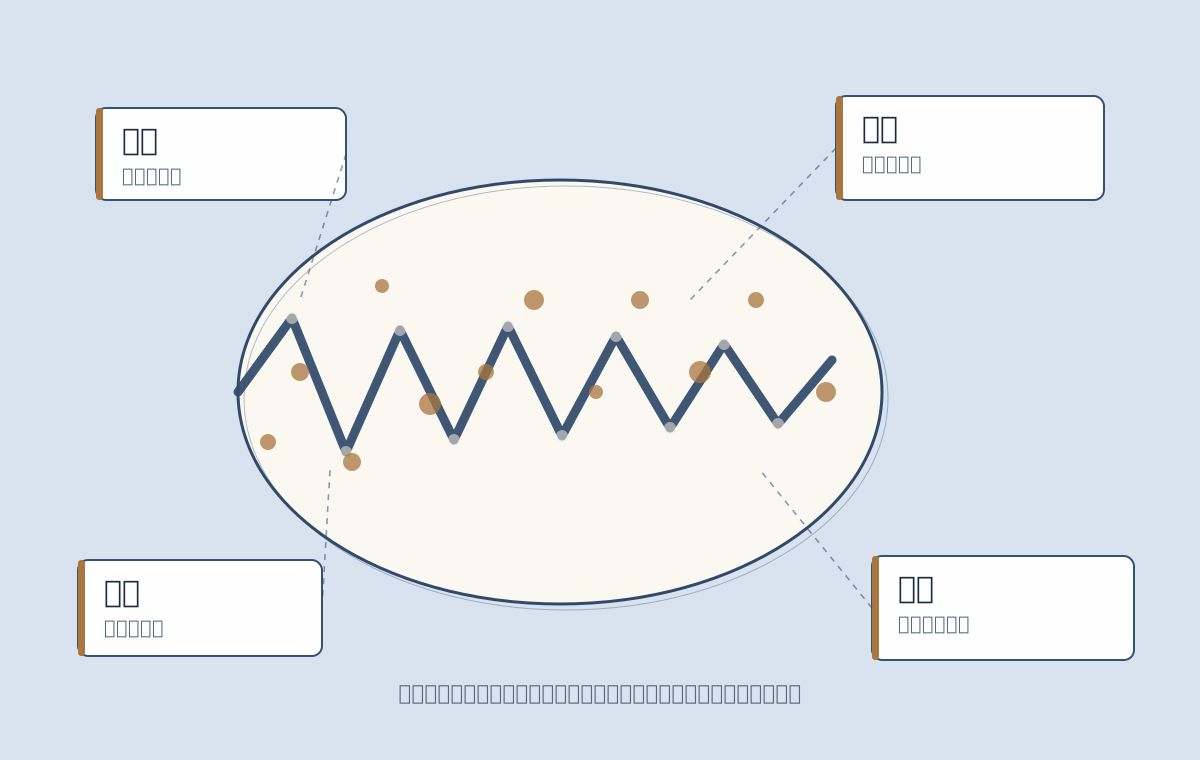
A masterbatch is made by compounding plastic resin, dispersant, colorant, filler, lubricant, coupling agent, and certain functional additives per a formulation, then subjecting them to high-speed mixing, extruder plasticizing, extrusion, and pelletizing. Each class of raw material solves a specific problem:
- Plastic resin (base material) is the backbone. The manual states: resins vary widely in type and manufacturer, and therefore differ in processing temperature, melt viscosity, and melt flowability, and the appropriate super-dispersant model and dosage should be selected on that basis.
- Colorant (pigment) is mostly in powder form. The manual's position is: different pigment types, different fineness, and different oil absorption values require different dispersant amounts; generally, the finer the powder, the higher the oil absorption value, and the larger the specific surface area, the higher the dispersant dosage added.
- Filler (calcium carbonate, talc) is used to reduce cost. The manual notes: as filler dosage increases, plasticizing slows, melt strength drops, melt pressure falls, and the powder in the melt is hard to disperse, producing gel specks that affect masterbatch quality and raise the scrap rate.
- Lubrication system is divided into internal and external. The manual's position is that internal and external lubrication in the formulation must be mutually balanced: insufficient internal slip easily causes poor dispersion in the masterbatch and gel specks; too much internal lubricant lowers melt strength and readily reduces the strength of the plastic product; insufficient external lubrication leads to high convergence-core temperature and over-plasticizing, causing difficult discharge, increased machine current, rough and coarse particle surfaces, and yellowing; too much external lubrication makes blooming severe, manifesting as die buildup inside the mold and blooming of external lubricant on the masterbatch surface.
These four classes of raw material are not interchangeable equivalents. An additive formulation depends on which resin, which pigment, how much filler, and which set of equipment is used — additive selection must follow the specific formulation, not the generic term "plastic."
The Processing Window Is Harder Than the Formulation
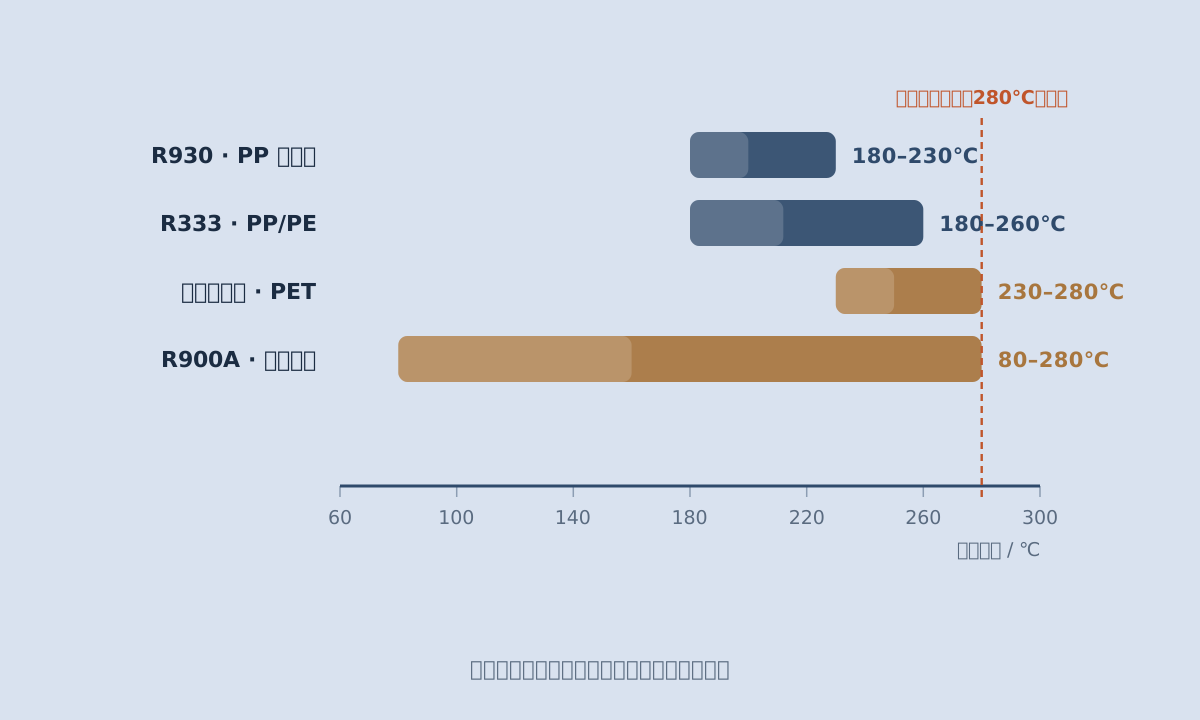
The manual records different processing temperatures for different additives:
The thermal stability of the additive itself imposes a hard constraint on the processing temperature. The manual states in the precautions for the anti-gamma-radiation aging agent: "Strictly prohibit ultra-high-temperature (>280℃) processing to prevent trace decomposition of the additive from affecting the use effect"; in the technical data for the same product, the thermal decomposition temperature is recorded as ≥ 285℃. Taken together, the meaning is: the processing temperature should be below the decomposition temperature of the additive, with a margin left.
The thermal stability of the additive itself is a hard constraint on the formulation. The manual states in the precautions for the anti-gamma-radiation aging agent: "Strictly prohibit ultra-high-temperature (>280℃) processing to prevent trace decomposition of the additive from affecting the use effect" — no matter how wide the temperature is set, it cannot cross the line where the additive begins to decompose.
Melt temperature itself is also a dual parameter. The manual states: melt temperature is a key parameter of plasticizing, and at the same time an important process affecting product color and dispersion. If the melt temperature is too low, the material is under-plasticized and dispersion is "incomplete," and the pigment or filler in the melt cannot unfold and fuse with the plastic; if the melt temperature is too high, on one hand the material is over-plasticized with low melt strength, and on the other hand it readily causes poor pelletizing and difficulty in strand pulling.
Equipment also determines the formulation. The manual states: extruder screws from different equipment manufacturers differ in plasticizing capacity and disperse-mixing capacity — the plasticizing capacity of twin-screw pelletizing machines and single-screw pelletizing machines "differs enormously"; elsewhere it states "different plastic masterbatch manufacturers produce different products, and differ in equipment, process, raw materials, lubrication system, and cost range, therefore we developed different models of super-dispersant."
Whether "Dispersion Is Good" Is Itself Part of Plastic Quality
Once powder and pigment form (primary particles), they readily re-agglomerate in subsequent processing if untreated. Taking the experiment of titanium dioxide treated with R1800-SK as an example, the microscopy comparison given by the manual is the difference between "smaller particles with uniform distribution" and "severe agglomeration"; on the product, this translates to differences in surface finish, color specks, and gel specks.
The manual's criterion is: generally, the finer the powder, the higher the surface gloss and saturation of the product; because the powder surface has a coating layer, the oil absorption value and friction coefficient are greatly reduced. Conversely, insufficiently dispersed powder raises the oil absorption value and friction coefficient, hindering smooth subsequent processing. So dispersion is not merely a "color-matching issue."
What Should Not Change After the Additive Goes In
For plastic modification, a good additive should improve the target property without changing the original properties of the base material. The criterion recorded by the manual in the section on R1800-S super-dispersant is inertness: correct use produces no side effects on the resin's original properties — melt index, viscosity, melting point/softening point, stress/strain, hardness/softness, light resistance, impact resistance, aging resistance, low-temperature flexibility, and so on.
The clause "melt index unchanged" is often overlooked in procurement communication. The manual requires: correct use produces no side effects on the resin's original melt index, viscosity, and other properties — treating it as a checkbox during selection is more practical than merely hearing "adding it has no effect."
How to Judge Whether an Additive Is "Right for Your Plastic"
Numerical matrix heatmap (unit unified %)
Dimension · %Each cell = one value (unit %); darker color = larger value; rows can be directly compared across columns.
- 800 mesh
- 1250 mesh
- 1500 mesh
- 3000 mesh
- Calcium carbon…
- Relative size within same table (unit unified %) · Color depth does not represent cross-table comparability
- Calcium carbonate0.2–0.5 %
- Talc0.32–1 %
- Kaolin0.3–0.8 %
Chart data (source text verbatim)
| Row | 800 mesh | 1250 mesh | 1500 mesh | 3000 mesh |
|---|---|---|---|---|
| Calcium carbonate | 0.2 % | 0.3 % | 0.35 % | 0.5 % |
| Talc | 0.32 % | 0.38 % | 0.47 % | 1 % |
| Kaolin | 0.3 % | 0.35 % | 0.45 % | 0.8 % |
Source textScale 0.2–1 %
From the perspective of formulation and use conditions, this breaks into three questions:
- What is the base material: different resin types and grades mean different processing temperatures and melt flowability, requiring a matched additive system. This also covers grade level — the manual, in the applicable base materials for the anti-gamma-radiation aging agent, lists item by item the grades to be used preferentially for the main material PE (HE2590, HDPE23050, DGDA6098, DMDA-8920, etc.), and on the PP side lists J-560M, GA260R, SE410MO, PF511. The manual listing these grades one by one itself shows that base material grade is a condition that must be checked individually.
- What are the physical properties of the pigment: type, fineness (mesh), and oil absorption value determine the dosage. The manual gives this comparison:
The higher the mesh, the larger the addition amount: as mesh rises from 800 to 3000, the calcium carbonate addition rises from 0.2% to 0.5%, talc from 0.32% to 1%, kaolin from 0.3% to 0.8%.
- What equipment is used: twin-screw and single-screw differ "enormously" in plasticizing capacity and also in disperse-mixing capacity, so the formulation must follow the equipment.
There is also an easily overlooked premise: it is recommended to run a small-scale trial first. The manual's position in the carbon black dispersant section is: customers must run a small-scale trial combined with their own formulation and carbon black grade for confirmation before bulk production.
What This Article Does Not Decide for You
Several issues are not given data in the manual, and this article makes no assumptions:
- Quantitative differences between grades: the manual gives a recommended base material grade list, but does not give a comparison table of melt index, tensile strength, or yellowing index for each grade under the same formulation.
- Correspondence between equipment parameters and formulation: the manual records that twin-screw and single-screw differ "enormously" in plasticizing capacity, but gives no conversion such as "what speed matches what addition amount."
- Quantitative upper limit of color: in the R1800-S section the manual gives effect ranges such as coloring strength increased by more than 25% and pigment dosage reduced by 10%~20%, but does not give how far a specific color number can be pushed.
- Specific grades and ratios of lubricant: the manual only writes the balance logic and imbalance consequences of internal and external lubrication, and gives no recommended grades or addition amounts for the supporting lubricant.
These items generally need to be filled in by small-scale trials — the manual in the carbon black dispersant section also explicitly reminds: customers must run a small-scale trial combined with their own formulation and carbon black grade for confirmation before bulk production. Until measured data from your own production line is obtained, the conclusions of this article apply only to the temperature ranges given in the manual.
Common Misconceptions
"Plastic is a universal material; switching grades makes little difference." The difference shows up across three lines — processing temperature, melt viscosity, and melt flowability — and these three directly determine additive selection; the manual records different temperatures for different additives.
"Good dispersion means adding more." The addition amount is set by powder fineness (mesh) and oil absorption value; exceeding the range produces reverse effects such as bridging flocculation — molecular chains entangle with each other and pull particles back together, and dispersion actually worsens.
"The additive changed the product, which means it is better." The reverse is more accurate: if an additive causes unexpected changes in melt index, impact strength, or low-temperature flexibility, it is matched to another system, not your production line.
"Switch supplier, switch batch, the effect should be the same." The manual names specific grades in the applicable base materials and specifies moisture-proof and cool-ventilated storage conditions, which itself admits that batch and base material state are variables.
One-Line Summary
Plastic is not a single material; it is the combined result of "resin + formulation + processing window." The manual's wording is: different plastic masterbatch manufacturers produce different products, and differ in equipment, process, raw materials, lubrication system, and cost range, therefore we developed different models of super-dispersant to meet users' different needs. The same additive model can perform completely differently on different resins, different pigments, and different equipment — which is why additives must be matched to the formulation, not selected by the two characters "plastic." Understanding that plastic is the result of a formulation, not a category name, is the starting point for talking with additive suppliers.
Article actions
Link: https://kj9896.com/en/news/what-is-plastic
Related reading
- 01Melt Viscosity Goes Up: Which Figures Can Be Compared, and Which Are Not Stated in the Documentation4 October 2026
- 02Where Adding 2% and Adding 8% Differ: The Real Impact of Flame Retardant Dosage on System Performance28 September 2026
- 03Anchoring and Solvation: How a Single Dispersant Molecule Divides the Work at the Powder Surface4 October 2026
Products mentioned in this article
Keep reading
More company announcements and product updates are in the newsroom.