
Technology explained · 31 October 2026
What Dispersants Actually Do: The Three Process Steps That Turn "Powder" Into "Something Usable"
A dispersant is an additive that improves the dispersion of solid or liquid materials. Its action splits into three steps—wetting, refining, stabilization; the first two rely on equipment and shear, while only the dispersant can do the third: building a coating on the particle surface with an anchoring end and a solvating end. This article clarifies its two-stage structure, four measurable indicators, and why dosage beyond the saturation point reverses.
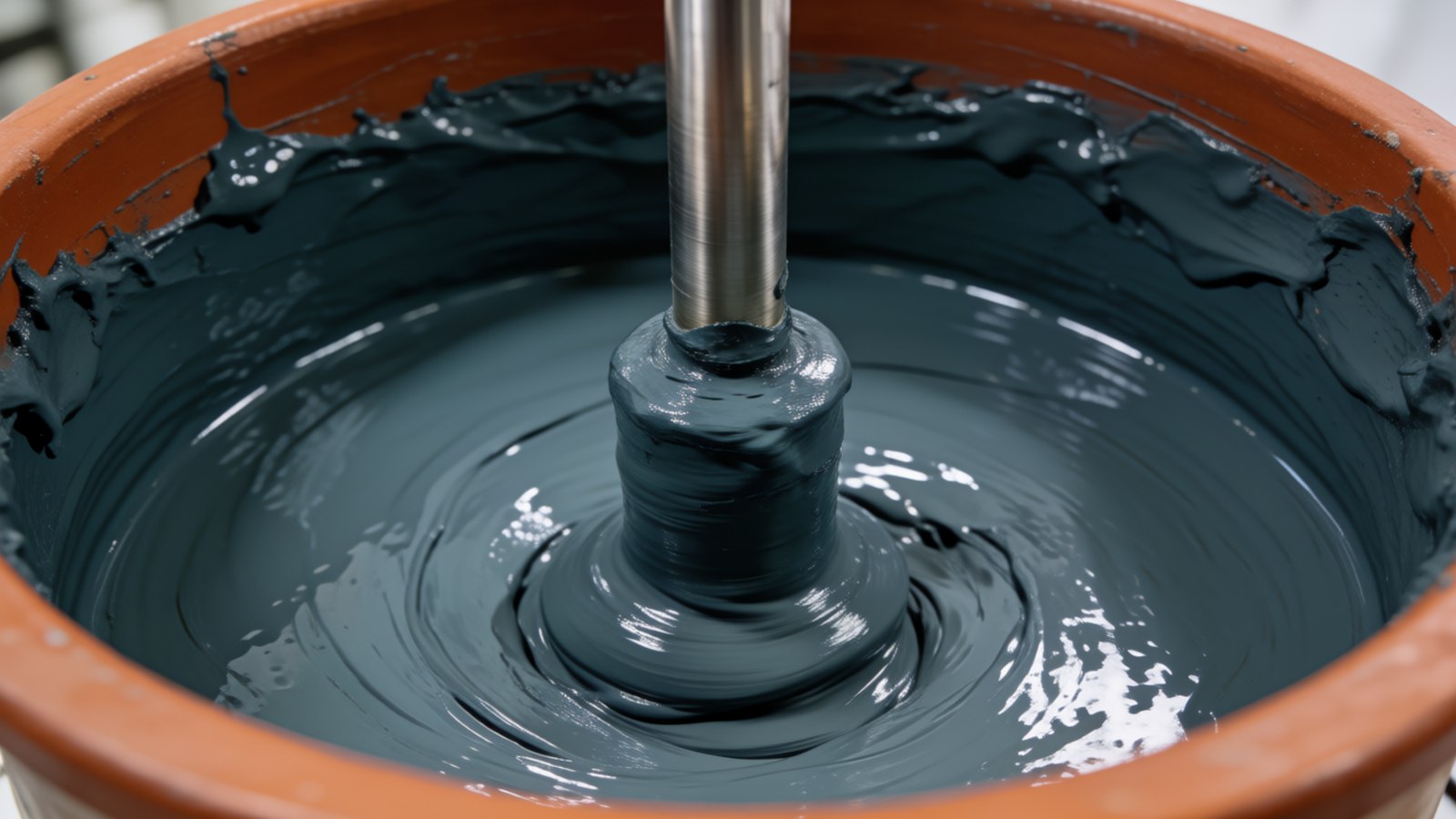
- Three dispersion steps
- 01WettingMedium first replaces surface air
- 02RefiningShear breaks up agglomerates between primary particles
- 03StabilizingCoating layer repels particles from each other
Moved from the body用量与色度Measured:1.6% 是吸附饱和点
| Hyperdispersant dosage | Lightness | Tauber whiteness | Yellowness |
|---|---|---|---|
| 0 | 88.27 | 75.15 | 4.63 |
| 0.5% | 88.89 | 75.76 | 4.21 |
| 1.0% | 89.12 | 76.31 | 4.34 |
| 1.2% | 89.87 | 76.35 | 4.23 |
| 1.6% | 90.18 | 77.76 | 3.84 |
| 1.8% | 88.26 | 75.81 | 3.97 |
| 2.0% | 87.83 | 75.79 | 3.89 |
越过饱和点即架桥絮凝
- 1.6%
- 0.386
- 2.0%
Powder added into resin will not disperse on its own. Pigment particles have an innate tendency to agglomerate: primary particles attempt to re-agglomerate at every step of synthesis, filtration, compaction, drying, and transportation; when they are poured into the melt, interfacial tension causes them to repel and push away from each other. The result is that the same batch of powder, when compounded into plastic in its native state versus in a treated state, yields products that are not the same thing.
Dispersants are what manage this. The manual defines the hyperdispersant as: an additive that improves and enhances the dispersing performance of solid or liquid materials. The same page also states why it works—an oil-based liquid insoluble in water disperses into very fine droplets under high-shear stirring, and after stirring stops it rapidly separates again under interfacial tension; when a hyperdispersant is added during stirring, a stable emulsion forms, and its main function is to lower the interfacial tension between liquid–liquid and solid–liquid phases, which is why a hyperdispersant is also a surfactant. This article discusses precisely this class—the manual's examples are primarily R1800-S (rubber/plastic hyperdispersant) and R1800-SK (for white masterbatch). It sounds like a definition, but behind that sentence lies a whole division of labor.
Hyperdispersants Are Divided into Six Types
The types recorded in the manual include anionic, cationic, nonionic, amphoteric, polymeric, and hyperdispersant types, of which the anionic type is used most (the manual does not state the basis for this classification); taking R1800-S as an example, its physical and chemical specifications are density 1.190g/cm³, viscosity 980-3600mPa·s, flash point 285℃, amine value ≤ 9mgKOH/g, dispersibility III; the addition level columns for both R1800-S and R1800-SK state "0.5%–1% of the final plastic product," and R1800-S additionally includes a reference table scaled by powder mesh count (see later); the manual does not provide this specification in the R1800-SH section.
From these six names, the classification basis points to ionic properties and structural differences, but the manual does not explain their molecular characteristics one by one; more practical for the user is another dimension—when it takes effect and at which stage. The same additive may complete its job during the powder treatment stage, or may rely on shear during extrusion. Only by clarifying this can one know at which step to add it.
It should be noted that the manual only gives the classification names of these six types and the statement that "the anionic type is used most." The molecular structures and mechanisms of action for the anionic, cationic, nonionic, amphoteric, and polymeric types (except the already detailed hyperdispersant type) are not given in the manual, and this article does not supply them on its behalf.
The Two-Segment Structure of Hyperdispersants: Anchoring + Solvation
The manual's description of the R1800-S hyperdispersant is: in the manual's own words, it is a special polymeric, multifunctional, wetting-and-coating type dispersing additive produced by combining a coating agent and a dispersant in precise proportions under high-temperature and high-pressure conditions; its molecular structure can be divided into two parts, one being the anchoring group and the other the solvating chain.
These two segments each manage one end:
- The anchoring group is firmly adsorbed onto the surface of pigments and powder. Taking R1800-SK as an example, the manual states: these polar groups (-COOH) are firmly adsorbed onto the pigment surface through ionic bonds, hydrogen bonds, and van der Waals forces, preventing the desorption of R1800-SK.
- The solvating chain rapidly dissolves in the dispersing medium and has good compatibility with it. (This sentence appears in the R1800-S section of the manual; in the theoretical analysis of R1800-SK the same term is written as "dissolving chain (dispersion)," and it is stated that this part directly determines the stability of the dispersed pigment in the solvent.)
The result is the formation of a coating layer of a certain thickness on the pigment particle surface, with the solvating chains relatively extended in the dispersant. When pigment particles carrying adsorbed dispersant approach each other, the repulsive force of the adsorbed layer causes the particles to bounce apart, thereby achieving stable dispersion of the pigment particles in the medium.
In plain terms: the anchor is responsible for "staying put," and the dissolving part for "mixing in." Judging from the cooperative mechanism described in the manual, the two-segment structure may need to act synergistically, but the manual does not explicitly state that both are indispensable.
Three Process Steps: Wetting → Refinement → Stabilization
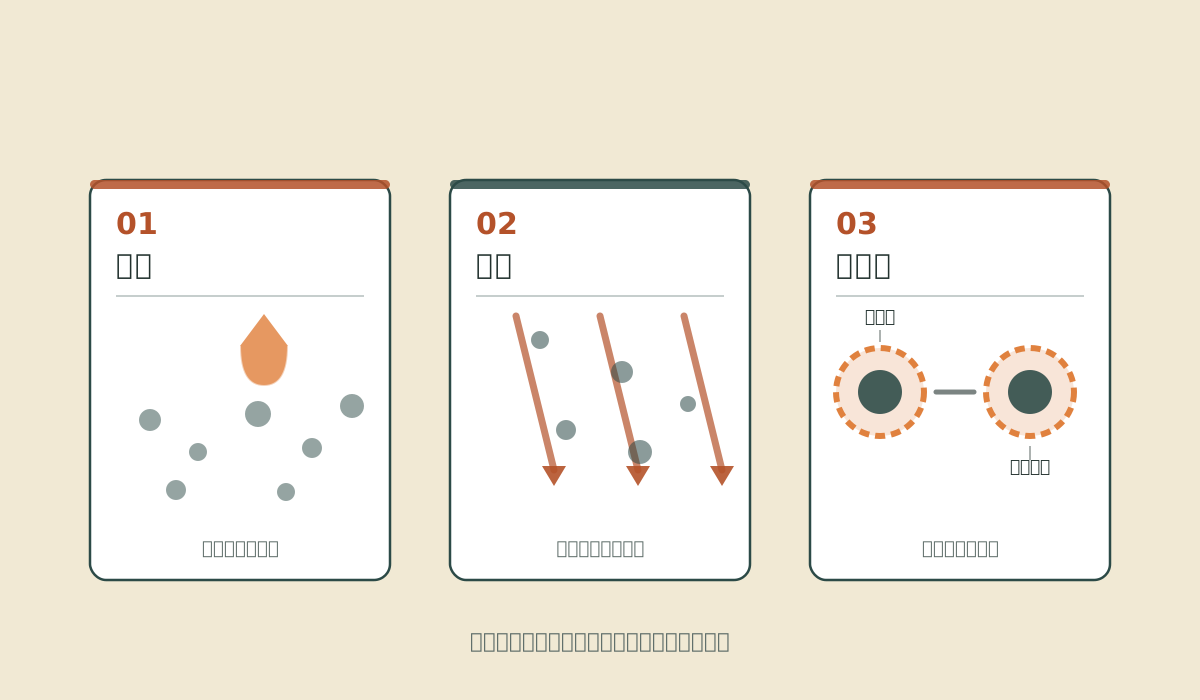
The manual divides the dispersion process into three stages: wetting, refinement (dispersion), and post-refinement stabilization (coating).
- Wetting
- The dispersing medium must first displace the air on the powder surface. The powder is dry and the medium is wet; interfacial tension pushes the liquid away to form droplets, and at this point the powder is still "dry." This is why the finer the powder and the higher its oil absorption value, the harder the oil-based system can take it in—a larger specific surface area means more interface needs to be wetted. (The manual also gives a general conclusion: usually, the finer the powder, the higher its surface gloss and saturation; this describes a downstream effect after coating and is included here only as background.)
- Refinement
- Uses shear to break apart the agglomerates between primary particles. This step is mainly a matter of equipment; the manual states that the plasticizing and dispersive-mixing capabilities of extruder screws differ among equipment manufacturers, and that the plasticizing capability of twin-screw pelletizers versus single-screw pelletizers "differs enormously." The manual does not give a unified process parameter table; whether the melt temperature is too high or too low, dispersion deteriorates, and this part must be determined through trial runs.
- Stabilization (coating): After breaking apart, it must also be kept from re-agglomerating. The manual states: the dispersant rapidly adsorbs onto the pigment and powder surface to form a protective layer (coating) that surrounds the pigment and powder particles, while simultaneously filling the crystal lattice defects of the pigment and powder particles, passivating the active sites on the pigment and powder surface that are prone to agglomeration, thereby effectively preventing further agglomeration of the pigment and powder particles.
The third step is the most often overlooked, yet it is what distinguishes a dispersant from an ordinary lubricant. Materials like stearic acid and polyethylene wax can also make powder "not stick together," but what they do is wrapping: they coat the powder to keep it from coming close to itself. As for whether the powder itself disperses in the medium and whether the interfacial tension is lowered, they do not care—in the manual's own words, they fundamentally have no dispersing ability. Powder treated with them, once compacted or dried, usually still re-agglomerates severely.
How Dispersants Change Powder Behavior
At the powder treatment stage, the manual states: the hyperdispersant is added and blended with other materials such as pigments and fillers according to the formula; because the hyperdispersant wets the powder when combined with it, and forms a coating layer as temperature drops, the agglomeration of the pigment and filler powder is prevented.
At the dispersion stage, the manual records: because the hyperdispersant has good compatibility with the resin, it holds the coated pigment and filler powder tightly together with the surrounding resin, transmitting the externally applied shear force to the resin, thereby distributing the pigment and filler uniformly within the resin.
This layer is the watershed between hyperdispersants and ordinary wax-type additives; the manual states the difference between the two very plainly. The manual is quite direct about waxes: materials like stearic acid and polyethylene wax "fundamentally have no dispersing ability," and their so-called dispersion merely wraps the powder; the hyperdispersant relies on its structure—anchoring plus dissolving—to keep particles at a distance from each other while establishing a compatible connection between the particles and the resin.
The manual also records an easily overlooked downstream effect: because the powder surface has a coating layer, both the oil absorption value and the coefficient of friction are greatly reduced, and generally the finer the powder, the higher its surface gloss and saturation.
Key Indicators: Hiding Power, Tinting Strength, Dispersibility
To judge whether dispersion is done well, one cannot only look at "is there agglomeration"; it must come down to measurable indicators. The manual gives complete definitions and measurement methods for these three indicators.
Hiding power refers to the pigment's ability to cover the base color of the substrate being colored. The manual gives the same measurement method in two places: the titanium dioxide section of R1800-SK states "prepare masterbatch from titanium dioxide pretreated with different hyperdispersant levels, then blow into film, measure the film transmittance and convert it to the optical density value at standard film thickness (0.02mm)"; the carbon black section of R1800-SH replaces the titanium dioxide with carbon black, otherwise identical. The greater the optical density value, the higher the hiding power. The manual also states: the more uniformly the pigment is dispersed and the finer the particles, the greater the optical density value.
Tinting strength refers to the pigment's ability to impart color. The manual's stated approach is: the tinting strength of titanium dioxide in plastics is mainly characterized by the sample's lightness and whiteness; the R1800-SK section gives lightness, Tauber whiteness, and yellowness data for masterbatches under different pretreatment conditions, while the corresponding approach in the carbon black section of R1800-SH is the opposite: the tinting strength of carbon black is characterized by blackness, the greater the blackness the higher the tinting strength, and blackness is measured with a color-difference meter after preparing a test panel.
Dispersibility refers to the pigment's dispersion capability in the medium being colored. The manual records the measurement method as: qualitative method is observation and photography under a phase-contrast or electron microscope, and quantitative method is determination of the particle size distribution.
More Is Not Always Better: That Parabola
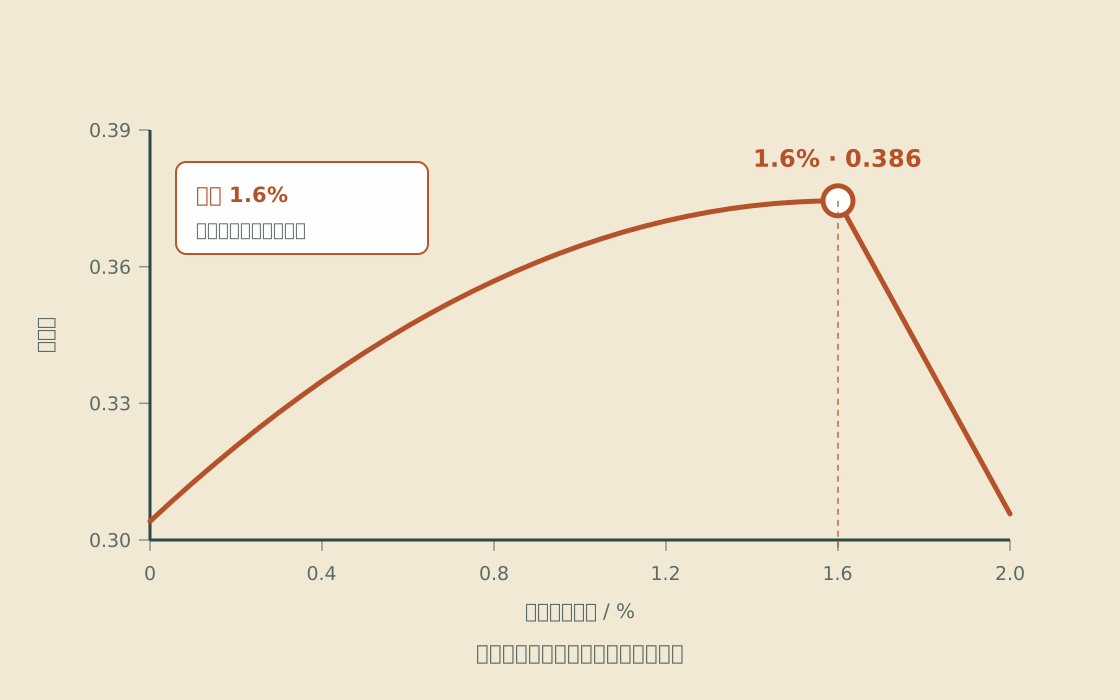
This is the most counterintuitive and also the most valuable point about dispersants. The manual gives a complete set of measured comparisons in the R1800-SK section: the recommended process conditions for surface treatment are pH 6.8, 70℃; the experimental procedure is to put titanium dioxide and R1800-SK into a high-speed mixer, add LLDPE218W once the temperature rises to around 100℃, then re-pelletize, extrude, and blow film, varying only the hyperdispersant content gradient—0, 0.5%, 1.0%, 1.2%, 1.6%, 1.8%, 2.0%—and measuring the film optical density and chromaticity. The experimental formula listed in the R1800-SK section of the manual is: titanium dioxide R298 69.5g, R1800-SK 0.5g, LLDPE218W 30g, first high-speed mixed then re-pelletized, then extruded and blown into film.
At a dosage of 1.6%, the film optical density reaches its maximum of 0.386, with the highest whiteness and lightness and the lowest yellowness. The table above comes from the titanium dioxide experiment of R1800-SK. The physical and chemical specifications of density 1.190g/cm³, viscosity 980-3600mPa·s, flash point 285℃, dispersibility III are recorded with the same values in both the R1800-S and R1800-SK documents; yet they remain different models—R1800-S is aimed at rubber/plastic color masterbatch and oil-based coating inks, while R1800-SK is a version with ester functional groups introduced on that basis; the manual records that it improves yellowing resistance and weatherability in plastic products and is mainly used for rubber/plastic white masterbatch, and should not be treated as the same product.
Why? The explanation given by the manual is: the hyperdispersant usage is related to the specific surface area of the pigment. Initially, as the dosage increases, more and more anchoring groups adsorb onto the pigment surface, reaching saturation at 1.6%, at which point the optical density is maximal. With further increase in dosage, "bridging flocculation" arises from the interaction between hyperdispersants—the pigment particles flocculate through entanglement of the hyperdispersant dissolving chains, so the optical density instead declines.
In other words: once the dissolving chains entangle with each other and produce bridging flocculation, the particles are pulled back into agglomeration. Before the anchoring ends are saturated, more is always good; past the saturation point, entanglement between the dissolving chains takes over. This curve explains why "adding a bit more never hurts" is wrong when it comes to dispersion.
It should be noted that this curve was measured under the set of conditions titanium dioxide + LLDPE218W + pH 6.8 + 70℃. The manual does not give corresponding curves for other pigments, other resins, or other pH conditions, and it cannot be extrapolated to other systems.
The Relationship Between Dispersants and Other Components in the Formulation
A dispersant is not an isolated role; its effect depends on the performance, dosage, and cost of the other raw materials in the same formulation.
The base material determines the processing temperature, melt viscosity, and melt flowability, on which basis the hyperdispersant model and dosage should be selected; the addition level columns for both R1800-S and R1800-SK state 0.5%–1% of the final plastic product, while R1800-S additionally includes a reference table scaled by powder mesh count for sizing.
The dosage of the colorant is crucial. The manual states: different pigment types, different fineness, and different oil absorption values require different amounts of dispersant.
As the amount of filler increases, plasticization of the object slows down, melt strength decreases, and melt pressure drops, making the powder in the melt difficult to disperse and producing fish-eyes—filled masterbatches or other masterbatches with added filler all require dispersants to improve the dispersion of the filler in the plastic, reduce fish-eyes, and improve the flow performance of the material in the screw.
The lubrication system must be matched with the dispersant. The manual records that the internal and external lubrication in the formulation must be mutually balanced: insufficient internal slip easily causes poor dispersion in the masterbatch leading to fish-eyes; too much internal lubrication lowers melt strength and easily reduces product strength. Insufficient external lubrication leads to high convergence-core temperature, over-plasticization, difficult discharge, increased machine current, rough and coarse particle surfaces, and yellowing; too much external lubrication causes severe plate-out.
These four form a matching relationship: no matter how strong the dispersant, it cannot withstand a mismatched lubrication system.
What Else Hyperdispersants Manage Besides Dispersion
In the function list of R1800-S, the manual lists more than just dispersion: dispersing and coating, lubricating and mold release, toughening and brightening, slip and anti-blocking agent, can replace maleic anhydride grafting, can adjust product melt flow rate, can improve product impact strength and tensile strength. In other words, it is a multifunctional additive that is "dispersion-primary with multiple side functions"—so the share reserved for it in the formulation often cannot be calculated solely from the dispersion effect.
The manual also has a compatibility criterion called inertness: it does not react with other additives, and correct use will not produce side effects on the resin's original properties (melt index, viscosity, melting point/softening point, stress/strain, hardness/softness, light resistance, impact resistance, flexural resistance, aging resistance, low-temperature flexibility). The manual also records an additional effect when treating kaolin: adding 2 per mille can improve insulating properties.
Putting It into Practice: How to Use It
Numerical matrix heatmap (unit unified %)
Dimension · %Each cell = one value (unit %); darker color = larger value; rows can be directly compared across columns.
- 800 mesh
- 1250 mesh
- 1500 mesh
- 3000 mesh
- Calcium carbon…
- Relative size within same table (unit unified %) · Color depth does not represent cross-table comparability
- Calcium carbonate0.2–0.5 %
- Talc0.32–1 %
- Kaolin0.3–0.8 %
Chart data (source text verbatim)
| Row | 800 mesh | 1250 mesh | 1500 mesh | 3000 mesh |
|---|---|---|---|---|
| Calcium carbonate | 0.2 % | 0.3 % | 0.35 % | 0.5 % |
| Talc | 0.32 % | 0.38 % | 0.47 % | 1 % |
| Kaolin | 0.3 % | 0.35 % | 0.45 % | 0.8 % |
Source textScale 0.2–1 %
First, put the hard specifications given by the manual up front: the density of R1800-S is 1.190g/cm³, viscosity 980-3600mPa·s, flash point 285℃, dispersibility III. That the viscosity falls in the 980-3600mPa·s range is a parameter to match when selecting the grade; a flash point of 285℃ is a physical and chemical specification listed in the manual; the actual processing melt temperature must be determined according to the process.
Size according to powder mesh count and oil absorption value, rather than guessing by experience. The three reference tables recorded in the manual are as follows:
| Powder | 800 mesh | 1250 mesh | 1500 mesh | 3000 mesh |
|---|---|---|---|---|
| Calcium carbonate | 0.2% | 0.3% | 0.35% | 0.5% |
| Talc | 0.32% | 0.38% | 0.47% | 1% |
| Kaolin | 0.3% | 0.35% | 0.45% | 0.8% |
For organic and inorganic pigments (carbon black, titanium dioxide, ultramarine, chrome yellow, etc.), the manual records an addition level of about 0.3%–1.2%, adjusted according to the actual formulation. In the same table, calcium carbonate goes from 0.2% at 800 mesh to 0.5% at 3000 mesh, talc from 0.32% at 800 mesh to 1% at 3000 mesh, and kaolin from 0.3% at 800 mesh to 0.8% at 3000 mesh—the difference in slope among these three lines is the direct manifestation of the difference in oil absorption values.
The higher the mesh count, the greater the addition amount—the finer the powder, the larger the specific surface area, and the more interface needs to be covered. In the manual's comparison, calcium carbonate is 0.2% at 800 mesh and 0.5% at 3000 mesh; talc is 0.32% at 800 mesh and 1% at 3000 mesh; kaolin is 0.3% at 800 mesh and 0.8% at 3000 mesh. This is the same mechanism as the 1.6% saturation point discussed earlier, viewed from two sides. The manual also records: kaolin at a dosage of 2 per mille can further improve insulating properties; such additional effects generally need to be verified for the specific system.
What This Article Does Not Decide for You
There are several items for which the manual gives no data, and this article will not extrapolate:
- A unified criterion for dispersibility: The manual gives both a qualitative (microscopic observation and photography) and a quantitative (particle size distribution) method, but does not give a unified acceptance threshold, nor the conversion between mesh count and dispersibility grade.
- Processing window and additive matching: The manual clarifies the dosage range for each model, but the actual optimal amount under different equipment and different screw configurations is not given in the manual.
- The complete picture of other dispersion systems: For the six types listed in the manual, the manual only gives the classification names and the statement that "the anionic type is used most," without elaborating on the molecular structure and mechanism of each category.
- Itemized storage and incompatibility precautions: The manual records two prohibited uses for R1800-S—prohibited for use in cold-treated powder and prohibited for use in water-based coatings and water-based inks; but the specific clauses of such restrictions for other models are not given item by item in the manual.
These generally need to be filled in through lab trials and the supplier's technical documentation, and usually also require a lab trial for confirmation before scale-up production.
Common Misconceptions
"A dispersant and a coating agent are the same thing." Taking R1800-S as an example, it is an integrated product made by producing a dispersant and a coating agent together in precise proportions under high-temperature and high-pressure conditions, so it possesses both capabilities at once; but the powder treatment (coating) and dispersion steps carried out separately in the process are still two different things.
"The more you add, the better the dispersion." The parabola above already refutes this.
"Good dispersion just means good-looking color." Dispersion is a processing issue, not just an appearance issue: fish-eyes, die buildup, filament breakage, and elevated melt pressure are all downstream manifestations of poor dispersion. In the section on flat-film filament breakage, the manual attributes it to: poor dispersion of the color masterbatch, pigment particles in the masterbatch granules being too large, and poor compatibility between the carrier and the resin.
"Pinholes and color specks mean insufficient dispersant." To add a boundary: an unclean surface of the color masterbatch granules also has causes including extrusion temperature or die-head temperature being too high or too low, the pigment itself being too hard, and improper lubrication treatment. The dispersant only solves part of it; for what can be solved by changing the temperature, do not buy it with more additive.
In One Sentence
What a dispersant does can be broken into three process steps—wetting, refinement, stabilization—and its most distinctive part is the third: building on the particle surface a coating with an anchoring end and a solvating end that makes the particles bounce apart, and once the dosage exceeds the adsorption saturation point it causes bridging flocculation and the effect reverses. So to judge whether a dispersant is good, look at how far it pushes the optical density value on your powder, with your pigment, on your equipment—not at how much of it you added.
Article actions
Link: https://kj9896.com/en/news/what-is-dispersant
Related reading
- 01Whitening Does Not Equal Greater Whiteness: Criteria for Interpreting Hiding Power, Tinting Strength, and Dispersibility4 October 2026
- 02Anchoring and Solvation: How a Single Dispersant Molecule Divides the Work at the Powder Surface4 October 2026
- 03Exudation and blooming: why your dispersant is not working28 September 2026
Products mentioned in this article
Keep reading
More company announcements and product updates are in the newsroom.