
Product updates · 31 October 2026
PP/PE Under Gamma Radiation: What the Material Goes Through After Sterilization of Single-Use Medical Devices
Disposable medical consumables get one cobalt-60 gamma irradiation before clinical use. High-energy photons break polymer chains, causing mechanical loss, embrittlement, yellowing and cracking deep in the bulk. This paper explains irradiation-aging chain mechanisms and anti-irradiation additives' composition, metrics, dose tiers and compatibility limits.
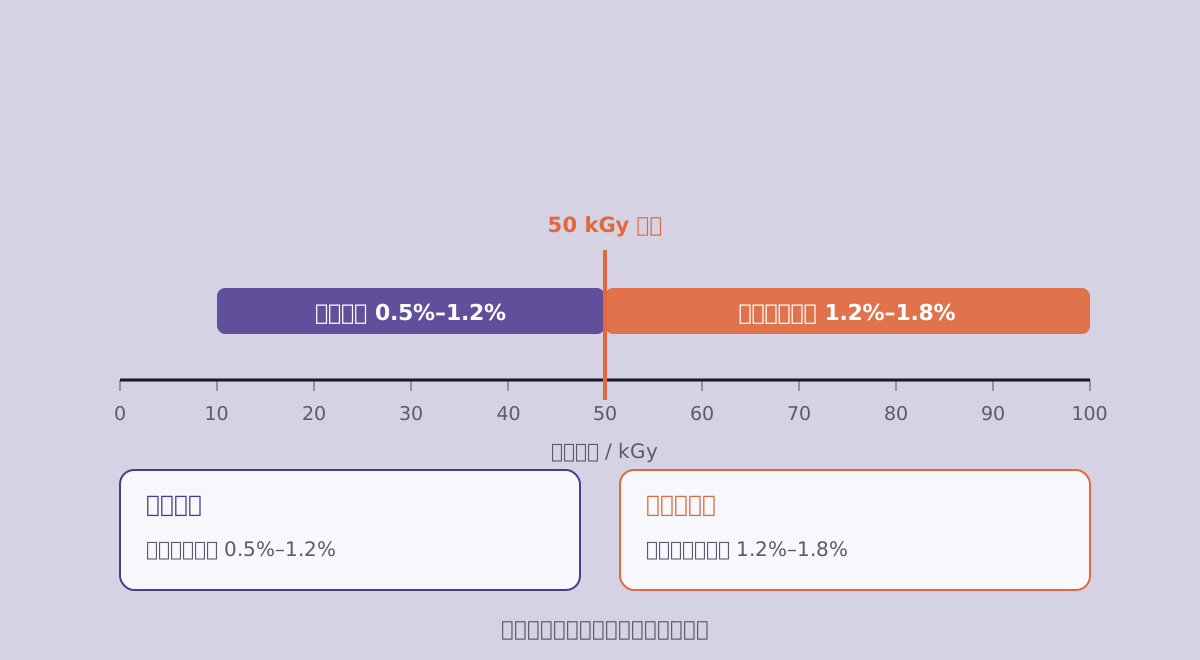
Irradiation dose / kGy — 50 kGy marks the additive threshold
Standard service 0.5%–1.2% · elevated dose & long-term aging 1.2%–1.8%
Moved from the body技术指标:可直接核对的一组数
| Service condition | Addition level | Structural suggestion |
|---|---|---|
| Normal service condition | 0.5% – 1.2% | For thin films and drawn products, add at the lower limit |
| Medium-to-high irradiation dose (above 50 kGy), long-term aging service | 1.2% – 1.8% | For thick-walled structural parts, add at the middle-to-upper limit |
零迁移 · 无Blooming
- ≥ 98.0%
- ≤ 0.05%
- 285℃
Among medical consumables there is a special class of materials: they leave the factory brand new, yet before use they must undergo one high-energy irradiation. Single-use infusion sets, syringe components, medical packaging films, infusion bags—before entering clinical use, the polymers in them are sent into a cobalt-60 irradiation facility to receive a dose measured in kGy.
This is neither heating nor stretching. It is high-energy γ photons striking the polymer chains and breaking them.
After irradiation, PP/PE articles develop the following problems: molecular chain scission, yellowing, embrittlement, mechanical strength decay, cracking, and shortened service life. A dedicated product exists to address this—R333, a gamma-radiation-aging inhibitor specifically for PP/PE.
What the Radiation Does Inside the Material
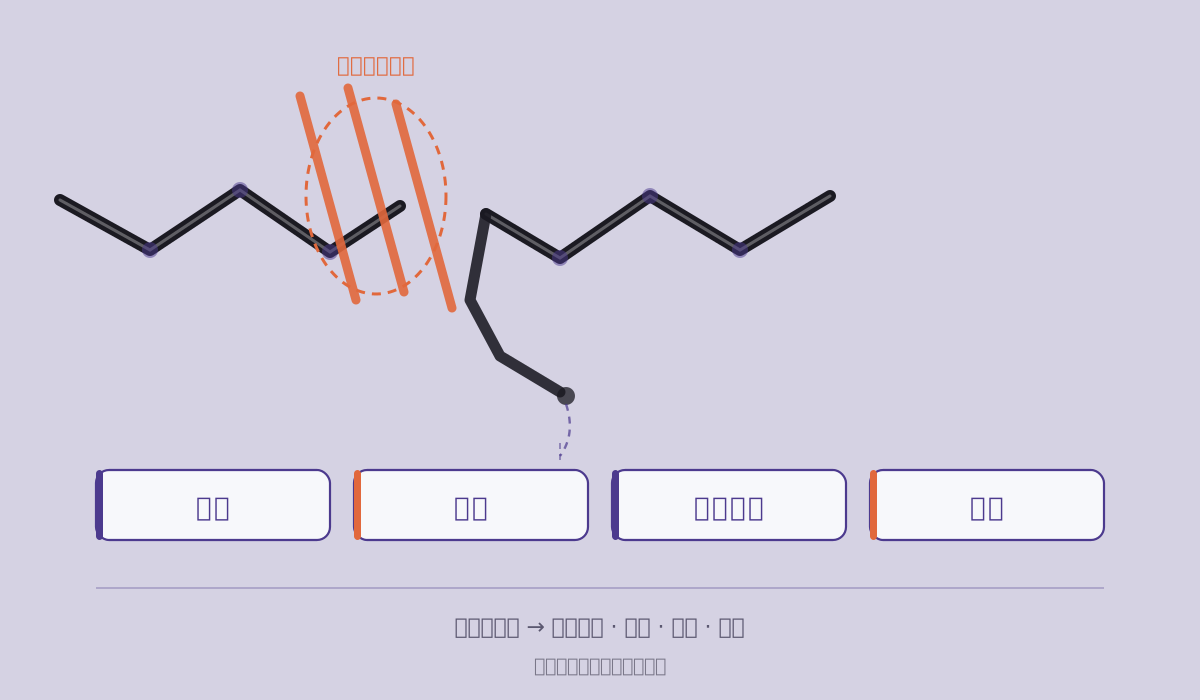
Gamma rays are a form of high-energy electromagnetic radiation. Their primary consequence when acting on polymers is the generation of free radicals: radiation energy is transferred to the C–H bonds along the chain; once broken, free radicals are formed, which propagate along the molecular chain and initiate chain reactions. The macroscopic result is shorter chain length and reduced molecular weight.
What reduced molecular weight means for plastics is the core of this section:
- Mechanical property degradation: As the molecular chains shorten, the cumulative interfacial strength from intermolecular forces declines, affecting both the tensile strength and toughness of the article. As noted in the datasheet: it can substantially improve the post-irradiation tensile strength, toughness, and dimensional stability of the article.
- Embrittlement
- Chain scission makes the material harder and more brittle, lowering impact performance.
- Yellowing
- Chain scission and oxidative side reactions produce chromophoric conjugated structures, yellowing the appearance. The datasheet states that short-term yellowing, chalking, and cracking are prevented.
- Cracking and dimensional change: Internal stresses lose their load-bearing capacity in the embrittled material, manifesting as cracking, deformation, and reduced dimensional stability.
The radiation does not attack only one spot—as long as dose accumulates, chain scission occurs simultaneously throughout the article. The datasheet records that the irradiation tolerance is adapted for 10 kGy to 100 kGy gamma irradiation. (The following passage is industry background analysis, not a datasheet clause: at lower dose ranges, the material mainly shows slow property degradation; in the medium-to-high dose range above 50 kGy, the article's problems concentrate on simultaneous appearance and mechanical deterioration such as yellowing, chalking, and cracking. The fact given by the datasheet is the two-tier boundary of the addition level.) The datasheet gives two addition tiers: 0.5%–1.2% for normal service conditions, and 1.2%–1.8% for medium-to-high irradiation doses (above 50 kGy) and long-term aging service.
From this mechanism, irradiation aging is a process occurring within the bulk phase of the article; surface coating or surface treatment alone usually has limited effect.
Let's Be Clear First: What Is from the Datasheet and What Is Background
The following will draw on general conclusions of radiation chemistry—how radiation transfers energy to polymer chains and why the material embrittles after chain breakage. This part belongs to industry background, not datasheet clauses; what the datasheet provides is this additive's positioning, composition, specifications, and dosage under irradiation conditions. Keeping the two separate prevents mistaking general mechanisms for a commitment specific to a certain product.
What an Anti-Irradiation Additive Must Accomplish at Once
The datasheet describes the composition of R333 as: a blend of hindered amine derivatives, chelating agents, and a stabilization-synergist system (dilauryl phosphate amine), with an active content requirement of ≥ 98.0%. The datasheet does not specify the functional division among the three; the division below is an analysis based on the nature of the components, not the original datasheet text:
- Hindered amine derivatives provide the main stabilization—hindered amines are typical radical-scavenging stabilizers that intercept the chain radicals initiated by irradiation.
- Chelating agents address metal-ion catalysis. Transition metal ions significantly accelerate polymer oxidation and remain active in the formulation even at ppm levels—hence the chelating agent is used in combination with the main stabilizer.
- Stabilization-synergist system is the compatibility layer: the datasheet records that the three are blended as a whole (dilauryl phosphate amine), wherein the stabilization-synergist system and others act synergistically in the formulation.
The product characteristics stated in the datasheet are: excellent compatibility with PP and PE resins, no exudation, no blooming, low volatility, no effect on the original injection molding, blow molding, extrusion, and spinning processability of the substrate, and no change to the light transmittance, gloss, or printability of the article.
The datasheet also lists two easily overlooked points: first, multi-protection—it combines three functions of gamma-radiation resistance, thermal-oxidative aging resistance, and damp-heat aging resistance, suitable for double-85 damp-heat aging and long-term outdoor aging service; second, compatibility—it can be blended with conventional antioxidants, lubricants, mold-release agents, and inorganic fillers without antagonistic reactions and without affecting the substrate's original flame-retardant, toughening, and other modification effects. For a production line already running an existing formulation, the second point is often more practically useful than the anti-irradiation function itself.
The applicable substrates are PP and PE (including low-density, high-density i.e. HDPE, linear low-density, etc.). The PE base-resin grades the datasheet recommends using where possible include Borealis HE2590, Zhejiang Petroleum & Chemical HDPE23050, Sinopec Qilu DGDA6098, Dushanzi Petrochemical DMDA-8920, CNOOC Shell Petrochemical Co., Ltd. HHD55G, and South Korea's LG ME5000; on the PP side it includes Lotte J-560M, Sinopec-SK GA260R, Borealis SE410MO, and LyondellBasell PF511. The datasheet also states that the process-adaptable range for PP/PE is 180℃ to 260℃, and requires that processing at ultra-high temperature (>280℃) be strictly prohibited.
Here is a practical note: The base-resin grade affects the outcome. The datasheet therefore writes "use where possible" into its scope of application rather than giving a universal compatibility promise. Even for the same PE, different grades differ in their initial stabilizer systems, metal-ion residues, and processing history; the same addition level may be sufficient on grade A but insufficient on grade B.
Technical Specifications: A Set of Numbers You Can Verify Directly
The datasheet's technical specification table itemizes as follows:
| Test item | Technical standard |
|---|---|
| Appearance | White uniform fine granules (powder) |
| Active content | ≥ 98.0% |
| Volatile matter | ≤ 1.0% |
| Ash content | ≤ 0.10% |
| Melting point range | 105℃ – 125℃ |
| Thermal decomposition temperature | ≥ 285℃ |
| Irradiation tolerance dose | Adapted for 10 kGy – 100 kGy gamma irradiation |
| Migration rate | ≤ 0.05% (no exudation or blooming) |
Three of these are worth singling out.
The melting point range of 105℃ to 125℃ and the thermal decomposition temperature of ≥ 285℃ leave sufficient processing margin. The melting point determines whether it can melt and blend into the resin during processing; the thermal decomposition temperature determines whether it decomposes first at processing temperature. The datasheet gives the processing temperature for PP/PE as 180℃ to 260℃; a thermal decomposition temperature of ≥ 285℃ means it is stable within the normal processing window.
A migration rate of ≤ 0.05% together with "no exudation or blooming" is a hard specification. Medical articles are in prolonged contact with the human body and drug solutions; any migratable component is a risk. The datasheet gives a clear value on this point.
The irradiation tolerance dose of 10 kGy to 100 kGy covers the magnitude from conventional medical sterilization to high-dose industrial irradiation.
Breaking this table into three groups makes it clearer. Composition and impurities: active content requirement ≥ 98.0%, volatile matter requirement ≤ 1.0%, ash content requirement ≤ 0.10%. Processing tolerance: melting point range 105℃ to 125℃, thermal decomposition temperature requirement ≥ 285℃, while the processing temperature for PP/PE is stated as 180℃ to 260℃. Safety and durability: migration rate requirement ≤ 0.05%, corresponding to the datasheet's "no exudation or blooming."
Note that this table gives product specifications, not acceptance criteria: the datasheet does not provide test methods, test conditions, or standard numbers, so these values cannot be used directly as acceptance thresholds for procurement.
Addition Level: Two Tiers, Divided by Dose
Same-dimension range intersection (% · 2 objects)
Dimension · %X-axis = dimension %; colored band = target interval where the object can fall; points outside the band = portions that cannot be reached.
- Target band
- Normal service con…
- 0.5–1.2%
- Medium-to-high ir…
- 1.2–1.8%
- X-axis same dimension % ·
- X-axis scale based on this article's max (0.5–1.8 %); do not directly compare lengths across articles.
- Normal service con…0.5–1.2 %
- Medium-to-high irr…1.2–1.8 %
Chart data (source text verbatim)
| Object | Range |
|---|---|
| Normal service condition | 0.5–1.2 % |
| Medium-to-high irradiation dose (above 50 kGy), long-term aging service | 1.2–1.8 % |
Source textScale 0–2 %
The datasheet divides the addition level into two tiers:
The directional suggestion given at the same time is: for thin films and drawn products, add at the lower limit; for thick-walled structural parts, add at the middle-to-upper limit.
This direction can be reasoned through physically (belonging to background analysis, not a datasheet conclusion): irradiation aging is a bulk-phase process, and the number of chain scissions per unit volume can differ greatly across geometries—under the same absorbed dose, a thin film has a small volume and a more concentrated dose distribution, so the absolute number of chain scissions may be smaller; a thick-walled part under the same dose experiences a longer and more complex internal dose history, so cumulative damage may be greater.
On the processing method, the datasheet records: it can be directly physically blended with PP/PE resin pellets, R333, and polyethylene wax; after high-speed mixing for 5–10 minutes for uniform dispersion, it goes directly to injection molding, extrusion, or blow molding without additional modification steps; if the formulation already contains an antioxidant system, the existing dosage generally need not be changed (the datasheet does not give a specific dosage range for the antioxidant). The mixing time from charging to molding given by the datasheet is 5–10 minutes.
There are two blending recommendations: for normal service conditions it can be used alone; for high-demand products it can be blended with primary antioxidant 1010 and secondary antioxidant 168 to build a radiation + thermal-oxidation dual stabilization system.
Note a clear boundary here: the datasheet states that processing at ultra-high temperature (>280℃) is strictly prohibited, to prevent trace decomposition of the additive from affecting performance. Although the thermal decomposition temperature in the technical specifications is ≥ 285℃, that is the decomposition temperature under thermal-analysis conditions; actual processing control must leave a margin.
Scope of Application: Five Scenarios
The five categories of application scope listed in the datasheet are:
- Medical irradiation articles: single-use medical PP/PE consumables, medical device accessories, sterilization packaging films (withstand gamma-ray sterilization process).
- Industrial radiation equipment: radiation detection equipment housings, protective plastic accessories for irradiation workshops, industrial radiation-resistant pipes and sheets.
- Aerospace and defense articles: aerospace lightweight PP/PE structural parts, outdoor aerospace supporting plastic accessories (withstand space-ray irradiation aging).
- Long-term outdoor service articles: outdoor PE pipes, photovoltaic plastic accessories, marine anti-corrosion PP/PE articles.
- General modification scenarios: PP/PE injection-molded, extruded, and blow-molded articles that need to balance radiation resistance, aging resistance, high transparency, and high gloss.
Compatibility Boundaries: Not Recommended to Be Blended in Large Amounts with These
The datasheet explicitly lists two precautions:
- Avoid blending in large amounts with metal-ion-containing additives (such as zinc stearate-type additives), heavy-metal additives, and strongly acidic additives, to prevent impairing the anti-irradiation stabilization effect.
- This product is insoluble in water, shows no loss under routine cleaning and damp-heat environments, and has excellent extraction resistance.
The first point deserves elaboration. Metal ions are precisely one of the culprits catalyzing oxidation—which is exactly why a chelating agent is used in the formulation. Zinc stearate is a common internal-external lubrication balance agent; if blended with this product in large amounts, it is like adding a chelating agent on one hand and replenishing metal ions on the other, canceling the effect. So if the formulation already contains an additive such as zinc stearate, the reasonable sequence is to first assess the amount of metal ions introduced, then decide whether to switch to a low-metal-ion alternative, rather than simply forcing it through the original formulation—this point belongs to formulation-design advice, not the original datasheet text.
Storage, Packaging, and Shelf Life
The packaging recorded in the datasheet is standard packaging of 25 kg/PE composite bag, with small-package specifications customizable per customer requirements.
Storage conditions: dry, cool, well-ventilated warehouse, away from heat and ignition sources, avoiding direct sunlight and humid environments, strictly prohibited from being stored together with strongly acidic or strongly alkaline chemicals.
Shelf life: 24 months, stored sealed in original packaging; after opening, it is recommended to be used up within 1 month; if caked from moisture, it can be dried and crushed for normal use without affecting performance.
Transportation: classified as a general chemical auxiliary, non-hazardous, suitable for conventional logistics; avoid heavy pressure, rain exposure, and sun exposure during transport.
Handling Notes
The datasheet states: this product is in the form of fine powdery granules; it is recommended to wear a dust mask during handling to avoid inhaling large amounts of dust, and to keep the working environment ventilated.
Irradiation doses and service environments differ across working conditions; customers are advised to conduct a small-scale trial in advance to determine the optimal addition ratio and process parameters.
This is not boilerplate. Irradiation tolerance is a dose-dependent issue: the stabilizer load required at 10 kGy and at 100 kGy is not of the same order, and the actual dose received by the article depends on the sterilization process setting. First confirm the actual absorbed dose of your product, then set the addition-level tier—this is more reliable than any default value.
What This Article Does Not Decide for You
The datasheet gives dosage ranges and directional suggestions, but several items it does not cover, and this article does not extrapolate:
- Quantified evaluation criteria for tolerance: the datasheet gives the adaptation range of "adapted for 10 kGy – 100 kGy," but does not provide specific criteria such as accelerated aging duration, mechanical retention rate, or yellowing index, so it cannot be used as an acceptance standard—actual judgment usually still depends on the article-side accelerated aging results.
- Specific addition-ratio curve at different absorbed doses: the interval between the two tiers is not subdivided, and the datasheet does not say which tier a product actually falling near 50 kGy should take.
- Magnitude of synergistic effect after blending: the datasheet states that blending with 1010 and 168 "builds a radiation + thermal-oxidation dual stabilization system with better protection," but does not give comparative data before and after blending.
- Compliance documents for food contact: the datasheet mentions in its product characteristics that it is suitable for food-contact scenarios, but does not list which specific regulations, standards, or certification numbers it complies with.
These items usually require obtaining the accompanying technical documents and test reports from the product side; the specific parameters generally need to be confirmed, and generally need to be verified by small-scale trials on your own production line before scale-up.
One-Line Summary
Gamma irradiation damages PP/PE at the chain level: it breaks the molecular chains, and thus mechanical-property degradation, embrittlement, yellowing, and cracking follow; moreover, by the common understanding of radiation chemistry, the damage occurs deep in the bulk phase of the article and cannot be covered by mere surface treatment. R333's approach is to blend hindered amine derivatives, a chelating agent, and a stabilization-synergist system (inferred from component nature, the hindered amine derivatives tend to capture free radicals while the chelating agent tends to suppress metal-ion catalysis), together with the hard specification "migration rate ≤ 0.05% (no exudation or blooming)" and the two-tier addition range. What truly determines the effect comes down to three things: which addition tier corresponds to the actual absorbed dose, whether the base-resin grade is on the recommended list, and whether the formulation contains any metal-ion additive that would compete with it.
Article actions
Link: https://kj9896.com/en/news/r333-gamma-radiation-aging
Related reading
- 01# R300 Water-Based Potassium Hydroxystearate Foam Stabilizer: Blushing and Precipitation in Foamed Coatings—Remove It from the Formulation29 October 2026
- 02# R902 Plastic Modifier: Film Anti-Blocking and Opening—Another Path That Does Not Rely on Fluorinated Additives29 October 2026
- 03# R940 Unsaturated Acrylic-Polyurethane Reactive Flame Retardant: Once the Flame Retardant Is Integrated into the Resin Network, Migration and Blooming No Longer Occur29 October 2026
Products mentioned in this article
Keep reading
More company announcements and product updates are in the newsroom.