
Technology explained · 2 October 2026
R900A + R6800: Two Processes for Degradable Plastics — From Liquid Colour Masterbatch Dispersion to PLA Blending Compatibility
Colour masterbatch for degradable plastics faces two difficulties: the stable dispersion of black masterbatch in degradable systems, and the compatibility of PLA+PBAT+filler blends. R900A and R6800 correspond to these two process lines respectively. This article compiles the manual data for the two models: the physicochemical properties of R900A and the two advantages of liquid colour masterbatch, and the product features, application fields and 1%-10% reference dosage of R6800.
- 01Anti-agglomeration
- 02Distribution rate
- 03Lubrication balance
Moved from the bodyFirst data table in this article (as quoted)
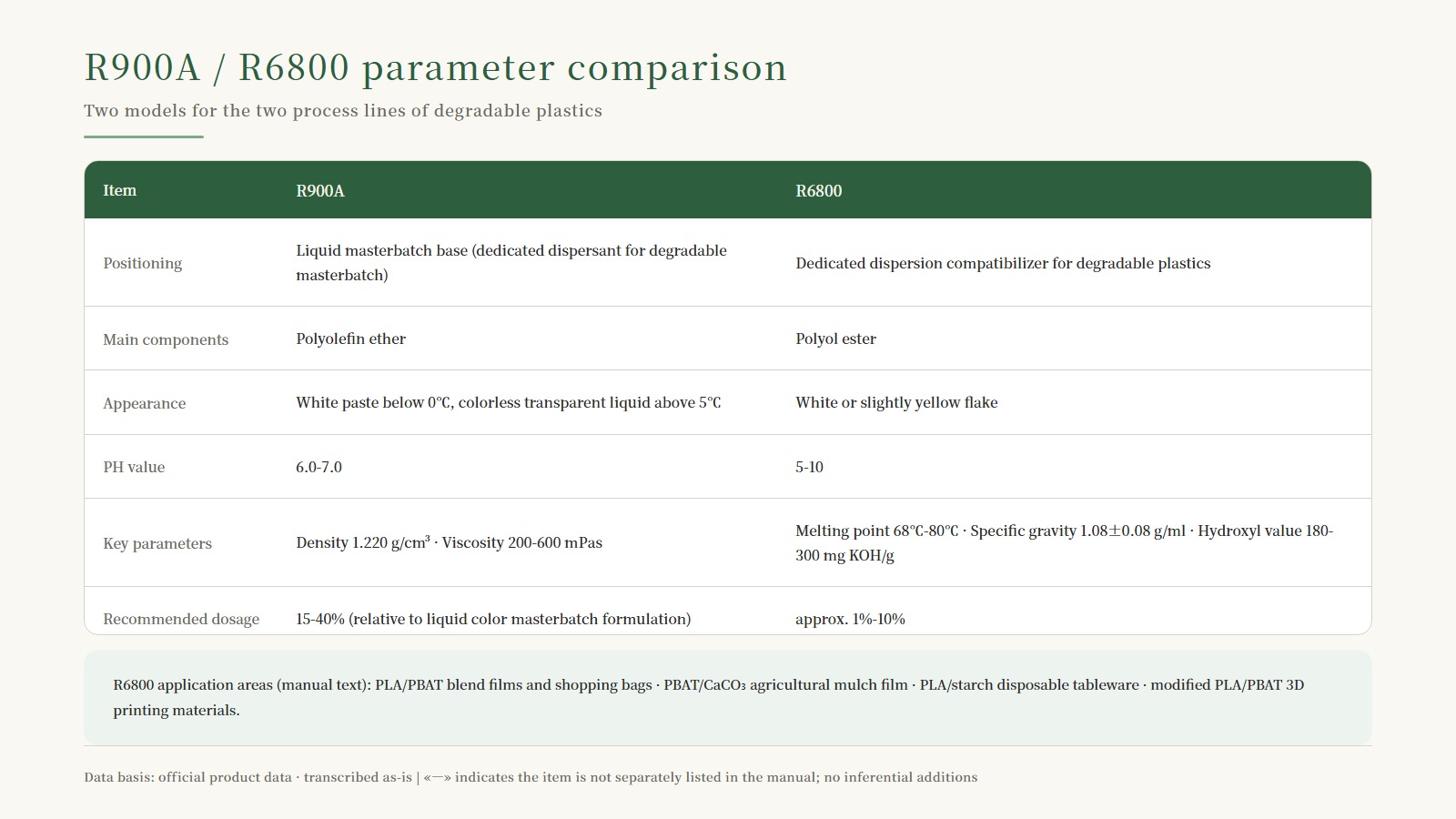
| Item | R900A |
|---|---|
| Appearance | white paste below 0℃, colourless transparent liquid above 5℃ |
| PH value | 6.0-7.0 |
| Density | 1.220 g/cm³ |
| Viscosity | 200-600 mPas |
| Solubility | readily soluble in water |
| Main component | polyolefin ether |
Data source: official product data (product handbook and official on-site product data). All quotations and data in this article are transcribed as-is from the source text without inferential additions.
Two problems in colour masterbatch for degradable plastics
When making degradable plastic finished articles, formulation engineers most often encounter two problems:
The Californium Curium manual contains two models addressing these two problems respectively: R900A is a liquid colour masterbatch base (dispersant dedicated to degradable masterbatch); R6800 is a dispersing compatibiliser dedicated to degradable plastics.
R900A: dispersing base for liquid colour masterbatch
The manual's overview of R900A states: "Our company develops, produces and sells a base for liquid colour masterbatch, a polymer liquid produced under high temperature and high pressure with a precise ratio. It has excellent molecular weight and a fairly narrow molecular weight distribution, and outstanding dispersing performance." The scope of application is given as: plastics, rubber and other products with a heat resistance of 80-280℃, or for the wetting and dispersion of inorganic powders with high oil absorption value, or for the production of black colour masterbatch, etc. (Data source: official product data)
The two advantages of this liquid colour masterbatch route are stated clearly in the manual (Data source: official product data):
- Elimination of colour specks and spots on the surface of finished articles — "in film extrusion and fibre spinning applications it offers advantages unmatched by other colouring methods";
- Higher pigment content per unit weight and a greatly reduced dosage ratio — solid-colour articles are usually added at a dosage of 0.6-2.0%, while transparent articles require only 0.2-0.5%.
Physicochemical properties (Data source: official product data):
R6800: "connecting" the interface between biodegradable plastics and fillers
Moved from the bodyOperation steps (original text, as is)
- How is black masterbatch stably dispersed in degradable plastics? — Degradable systems (PLA, PBAT, etc.) have compatibility requirements for additives that differ from those of oil-based plastics, and the dispersant of a conventional colour masterbatch formulation cannot be adopted as it is;
- How can "PLA + PBAT + calcium carbonate/starch" be kept from fighting during blending? — The poor compatibility between degradable plastics and fillers is the number one source of phase separation, exudation and fluctuations in mechanical properties.
R6800's positioning can be summed up in one sentence: "a key additive used to improve the compatibility between biodegradable plastics (such as PLA, PBAT, PBS, etc.) and fillers (such as calcium carbonate, starch, fibre, etc.), capable of enhancing the mechanical properties, processing properties and stability of the material." (Data source: official product data)
Product features (excerpts from the manual):
- Enhances the compatibility and dispersing performance between biodegradable plastics and pigments/fillers, assists pellet formation during granulation, and increases mechanical properties such as toughness, tensile properties and strength;
- Improves the dispersing performance of pigments and fillers, and enhances the gloss of films or sheets, the light transmittance of natural-colour compounds and the colouration rate and hiding power of coloured compounds;
- By increasing the dispersibility and compatibility of the formulation system, it increases the filler loading and reduces overall cost;
- "This product is an environmentally friendly product and does not affect the degradation rate or effect of biodegradable plastics."
Application areas (Data source: official product data): PLA/PBAT blend films and shopping bags, PBAT/CaCO₃ agricultural mulch film, PLA/starch disposable tableware, modified PLA/PBAT 3D printing materials.
Physicochemical properties and dosage (Data source: official product data): white or slightly yellow flake; PH value 5-10; melting point 68℃-80℃; specific gravity 1.08±0.08 g/ml; hydroxyl value 180-300 mg KOH/g; recommended reference dosage approx. 1%-10%; packed in 25 kg/PE bags, store in a cool, ventilated place and use within 12 months.
How to combine: 2 processes, each handling its own part
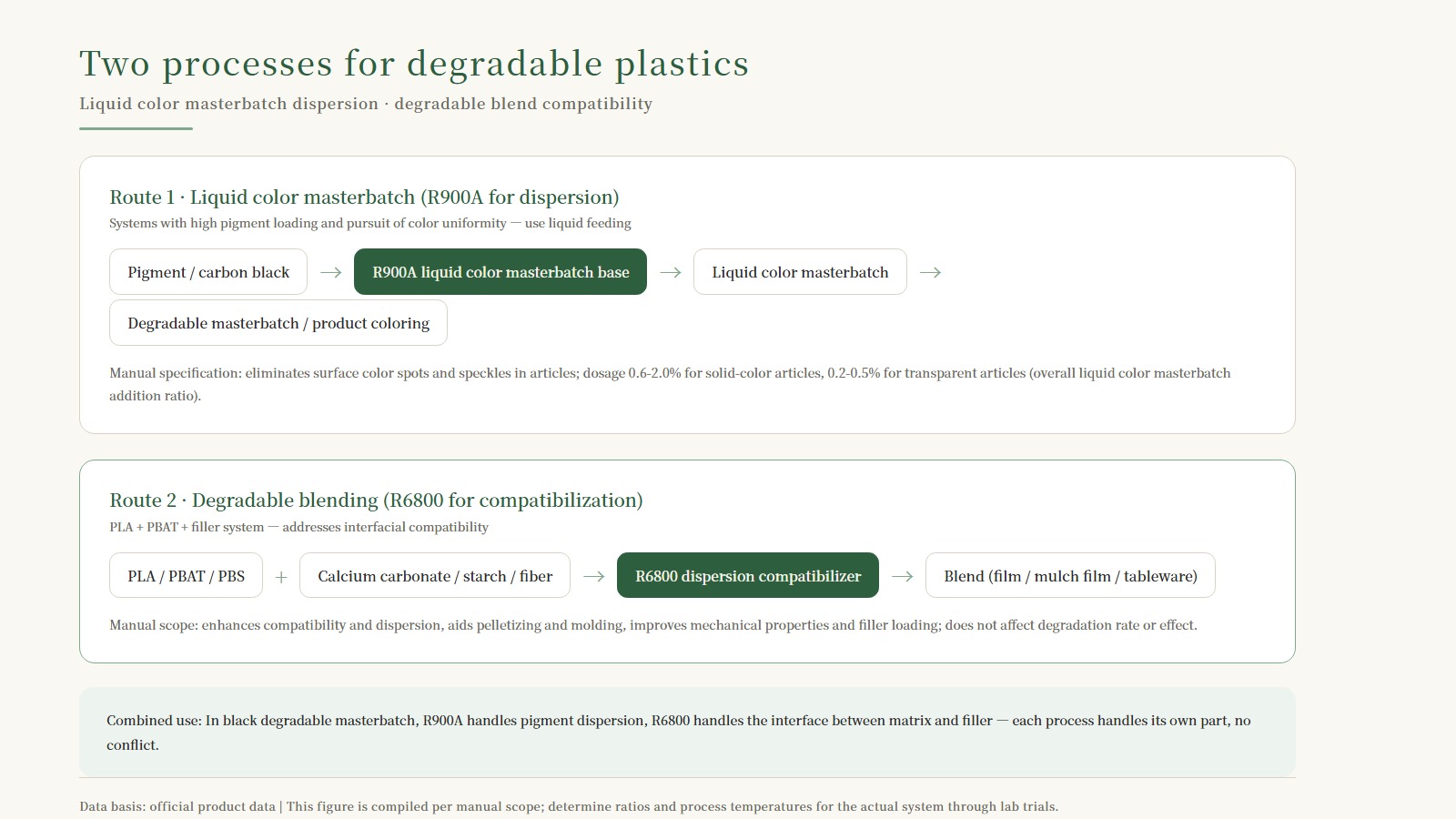
Based on the manual positioning of the 2 models, production can be split along the following lines:
- Liquid colour masterbatch route (high pigment loading, colour uniformity required): use R900A as the liquid colour masterbatch base to disperse pigments/carbon black, then use the masterbatch in biodegradable masterbatch or finished-article systems — liquid feeding gives stable colour;
- Biodegradable blending route (PLA + PBAT + filling): use R6800 to treat the blend interface, improving compatibility and enhancing mechanical properties and filler capacity;
- Combined use: in black biodegradable masterbatch, R900A handles pigment dispersion and R6800 handles the interface between the matrix and the filler — the 2 processes are each responsible for their own part.
The actual ratios and process temperatures for the 2 routes have to be determined by small-scale trials according to your resin system and filler batch; the values given in the manual serve only as a reference.
Data and Basis Notes
- All data in this article is compiled from official product materials (product handbook and official on-site product data); no inferential additions.
- Items that the manual does not state are not supplemented by inference; "does not affect the degradation rate or effect" is the wording of the original manual.
- The product technical data are laboratory typical values; please carry out small-scale trial verification before mass production.
Article actions
If this piece was useful, you can leave a mark — the like count comes from our back office at admin.kj9896.com; when the endpoint is unreachable the buttons are disabled and the count shows “—”. No invented figures are ever filled in.
Link: https://kj9896.com/en/news/r900a-r6800-degradable-plastic-masterbatch
Related reading
- 01Same “0.5–2%,” Two Denominators in Manuals: Why Conductive Carbon Black Additive Dosages Cannot Be Directly Converted11 October 2026
- 02When National Standard FV-2 and UL94 V-2 Are Both Listed: Why Do Both Conclusions Hold for the Same Formulation?11 October 2026
- 03Flame-Retardant Ratings Cannot Be Looked Up in a Table: Loading, Thickness, and UL94 Must Be Considered Together11 October 2026
Products mentioned in this article
Keep reading
More company announcements and product updates are in the newsroom.