
Product technology · 22 October 2026
R1800-SH Carbon Black Superdispersant: 28 Times the Lubrication and 122 Times the Dispersion of Wax
R1800-SH is Californium Curium's superdispersant for carbon black: 28 times the wax's lubrication and 122 times its dispersion. At 3% dosage blackness peaks at 130, optical density 0.487; over 70℃ it works best.
Jetness vs. R1800-SH dosage
3% is the adsorption saturation point of the anchoring groups; beyond it, bridging flocculation takes over
Three figures at the turning point: 3%, 0.487, 80 °C (source text)
- 3%
- 0.487
- 80℃
R1800-SH is the hyperdispersant that Californium Curium developed specifically for carbon black. It disperses pigment carbon black, the blackness goes up rather than down, and the processing performance improves as well.
This article covers three things: how it actually differs from wax; where the 3% dosage turning point comes from and why everything reverses past it; and how to use it at a carbon black plant versus at a black masterbatch plant.
Three numbers to start with
Against polyethylene wax, R1800-SH delivers 28 times the lubricating performance of the wax and 122 times the dispersing performance of the wax.
Carbon black, as an inorganic pigment, is widely used in masterbatches. In use, however, the finer the pigment particles, the more readily they agglomerate into large particles and affect product quality; the material therefore cannot be used directly and must undergo dispersion treatment. The dispersion process of a pigment can be divided into three parts: wetting, comminution (dispersion), and stabilization after comminution (encapsulation). Pigment surface treatment is the process of stabilizing the pigment after comminution: depositing and coating single-molecule or multi-molecule substances on the surface of the pigment particles, including surfactants, modifiers, derivatives of the pigment itself, and the like.
This passage is the manual's full account of "why dispersion treatment cannot be skipped". It splits dispersion into three stages: wetting, comminution (dispersion), and stabilization after comminution (encapsulation). The action of R1800-SH falls in the third stage — it deposits a coating layer on the surface of the pigment particles, and that coating layer, together with the spatial steric barrier, is what lets the particles push each other apart as they approach.
R1800-SH is mainly a silicon and resin ether polymer, a blue paste with a faint lard odor, density 0.860 g/cm³, viscosity 1000–4000 mPa·s, flash point 287℃, amine value ≦8 mgKOH/g, acid value ≦6 mgKOH/g, degree of dispersion III. It is insoluble in water and soluble in most organic solvents at room temperature.
The 3% turning point is both the saturation point and the bridging point

When treating carbon black, the experiments were held at PH = 6.2 and 80℃, with only the R1800-SH dosage varied, over a range of 1% to 5%.
Blackness peaks at 130 at 3%.
The optical density of the film measured in the same series of experiments follows the same curve: as the dosage increases, the optical density rises, reaching its maximum at 3%, where it reaches 0.487; add more and the optical density drops sharply.
This is not a case of "the more you add, the better". 3% is the point at which the anchoring groups reach saturation in their adsorption on the carbon black surface.
Below 3%, the anchoring sites on the carbon black surface are not yet fully occupied, so the adsorbed anchoring groups increase with the dosage, the coating layer becomes more complete, and the optical density rises accordingly.
Above 3%, the excess R1800-SH molecules interact with one another and produce "bridging flocculation" — the pigment particles flocculate through the entanglement of the hyperdispersant solvating chains, so the force that was supposed to push the particles apart instead binds several of them into one clump. The dispersant changes from separator into agglomerator, and the optical density turns around and falls.
This "rises first, then falls" shape is exactly where the hyperdispersant differs from an ordinary lubricant: an ordinary lubricant does not work along the "anchoring—saturation—bridging" path.
80℃ and the switch of the coating layer
The molecular structure of R1800-SH has two parts. The anchoring group is -COOH: these polar groups adsorb tightly onto the pigment surface through ionic bonds, hydrogen bonds and van der Waals forces, preventing the dispersant from desorbing. The other part is the solvating chain (dispersion), which directly determines how stable the dispersed pigment is in the solvent.
The key point is that the behavior of the solvating chain is switched by temperature:
- Below 80℃, the coating layer does not dissolve; it wraps the carbon black particles tightly and acts as an isolating barrier
- Above 80℃, the coating layer starts to dissolve, converts into an ionic coupling agent, and improves the compatibility between the carbon black and the resin
The surface treatment works best when the temperature is above 70℃.
There is one more property that is easy to overlook: the hue darkens as the temperature changes, but it does not affect the color when the product is used.
Dispersibility: two micrographs you can actually see
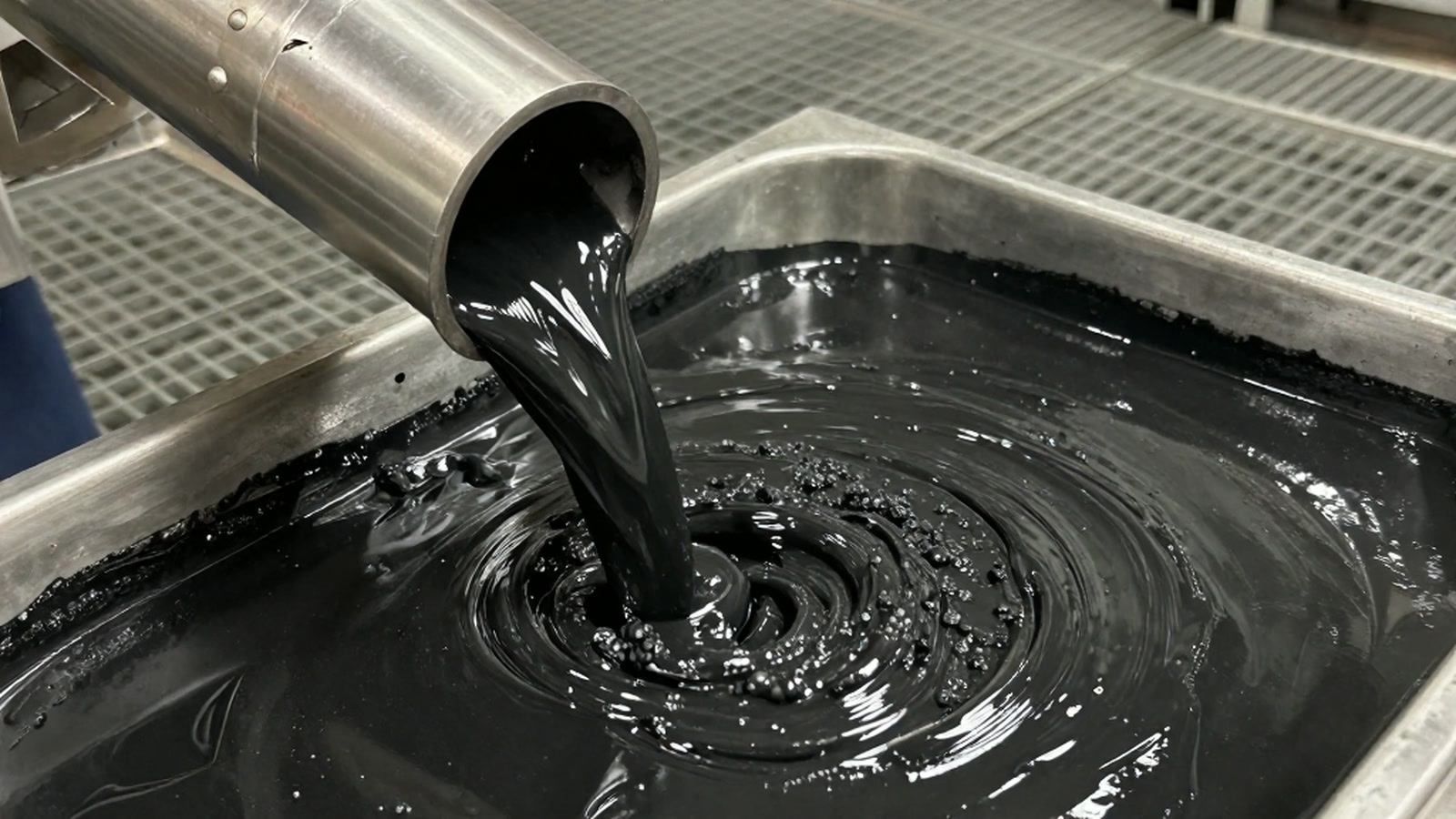
The manual gives two phase-contrast microscope photographs:
- A: carbon black treated with 3% R1800-SH at PH = 6.2 and 80℃, diluted 1:1 with ethanol
- B: untreated carbon black
Image A is fairly uniformly dispersed, with small carbon black particles; in image B the carbon black particles agglomerate severely.
The same qualitative judgment also has a quantitative version: dispersibility is characterized qualitatively by observation and photography under a phase-contrast or electron microscope, and quantitatively by measuring the particle size distribution.
In the carbon black paste, charges accumulate on the particle surface and readily combine with the anchoring groups of R1800-SH (-COOH), forming a firm protective layer on the surface of the carbon black particles. The spatial steric barrier of the solvating chain (hydrocarbon chain) then brings the carbon black to a stable dispersion. It is the two effects working together that make stable dispersion.
Use it at the carbon black plant, or at the masterbatch plant
These are two completely different addition points.
Carbon black plant: this product is normally mixed and pelletized together with the other additives and the carbon black during wet pelletization of the carbon black; in dry pelletization it is added evenly into the carbon black before crushing, and the temperature reached during crushing is what brings out its dispersing effect. If the treatment is done at a carbon black plant, the manual recommends dilution with an alcohol solvent, so that the dosage is spread more evenly through the carbon black powder.
Masterbatch plant: add this product and the other additives to a high-speed mixer at the same time and mix, adding the resin when the temperature reaches about 100℃; once the resin and the carbon black are mixed uniformly, discharge for pelletization.
The function is to lower the oil absorption value of the carbon black, to improve the dispersing performance, flow performance and internal/external lubrication performance of the carbon black, and to enhance the tinting strength and compatibility.
The experimental formulation for black masterbatch can be copied directly:
The process route is: high-speed mixing → pelletization → extrusion film blowing → hiding power → blackness.
In this formulation the 1 g of R1800-SH corresponds to 50 g of carbon black, that is 2% relative to the carbon black; relative to the whole masterbatch (50+1+10+39 = 100 g) it is 1%.
The 3% discussed above is the treatment ratio when the pigment is surface treated — in that series of 1%–5% experiments the carbon black was treated as a powder on its own, with the dosage calculated against the carbon black.
The two numbers have the same denominator, but the scenario differs: one is the ratio for "treating the carbon black powder thoroughly on its own", the other is the dosage ratio "when it is mixed into the resin to make a masterbatch". The two cannot be converted directly into one another.
The final addition level in plastic products
The figure the manual gives for downstream users is: 0.5%—1% of the final plastic product.
Packed in 20 kg/PE plastic drums, stored in a cool dry place, protected from moisture.
Two things to confirm before you use it
First, R1800-SH is insoluble in water. Water-based systems (water-based coatings, water-based inks, water-based pastes) are not suitable for direct use of this product; another grade is recommended instead.
Second, the turning point moves when the carbon black grade changes. The 3% in this set of manual data was measured on Yunnan Zhongyi's pigment carbon black ZY-1, while the formulation uses DK2028P. For your own carbon black grade the specific surface area is different, so the saturation point is different too — the manual also states that the dosage depends on the specific surface area of the pigment. 3% is a starting point, not an endpoint.
There is one more discrepancy in the wording worth noting: the treatment conditions recorded in the overview section of the manual are PH = 6.2, 80℃ and a dosage of 1%, while the conclusion section states that the best treatment of carbon black is obtained at a dosage of 3%. Both statements are in the manual.
Frequently asked questions
Q: Can the 3% figure be carried straight over to another carbon black grade? A: No. The manual states that the dosage depends on the specific surface area of the pigment; 3% is the saturation point of Yunnan Zhongyi's ZY-1 pigment carbon black at PH 6.2 and 80℃. Change the grade and the turning point has to be found again.
Q: Does going up to 5% give a deeper black? A: No. Measured blackness at 5% is 125, lower than 130 at 3%. Past 3%, bridging flocculation takes over and the optical density drops sharply.
Q: What happens if it is used below 80℃? A: The coating layer does not dissolve; it wraps the carbon black particles tightly and acts as an isolating barrier, so dispersion still works — but it cannot convert into an ionic coupling agent, and compatibility with the resin does not improve.
Q: Are the 1 g in the black masterbatch formulation and the 3% the same ratio? A: No. The 1 g corresponds to 50 g of carbon black, that is 2% relative to the carbon black and 1% relative to the whole masterbatch; the 3% is the ratio for surface treating the carbon black powder on its own. The two scenarios cannot be converted directly.
Q: Can water-based pastes use it directly? A: No. R1800-SH is insoluble in water and, at room temperature, soluble only in most organic solvents; for water-based systems another grade is recommended.
Q: The overview section of the manual gives a dosage of 1%, the conclusion section says 3% is best — which one should be followed? A: Both statements are in the manual. 1% is the treatment condition recorded in the overview section, 3% is the measured peak of blackness and optical density. To find the dosage for your own system, follow the measured curve.
In one sentence
R1800-SH's value is not in "being able to disperse" but in "dispersing cleanly and knowing when to stop". 3% is the anchoring saturation point on the carbon black surface; past it, bridging flocculation takes over and builds the agglomerates again. 80℃ is the switch of the coating layer, and the surface treatment works best when the temperature is above 70℃. Remember these two, and everything else is dosing at the right addition point.
Article actions
If this piece was useful, you can leave a mark — the like count comes from our back office at admin.kj9896.com; when the endpoint is unreachable the buttons are disabled and the count shows “—”. No invented figures are ever filled in.
Link: https://kj9896.com/en/news/r1800-sh-carbon-black-dispersion
Related reading
- 01R1800-SK and R900A for flame-retardant dispersion without affecting flame retardancy12 October 2026
- 02E099 Superdispersant for Fluoroplastics: Dispersion Stability, Compatibility and Processing in the 200–400°C Window22 October 2026
- 03R101A Polyol-Modified Organosilicon: the Third Generation of Titanium Dioxide Organic Coating Agents22 October 2026
Products mentioned in this article
Keep reading
More company announcements and product updates are in the newsroom.